
Strategy · 3 min read
Use Two-Way Shots to Protect Against a Miss
A two-way shot attacks a legal pocket while considering what happens if the object ball misses. The best examples preserve the make while steering the cue ball or object ball toward distance, cover or traffic. They are not excuses for vague speed; both the offensive and defensive outcomes need a plan.
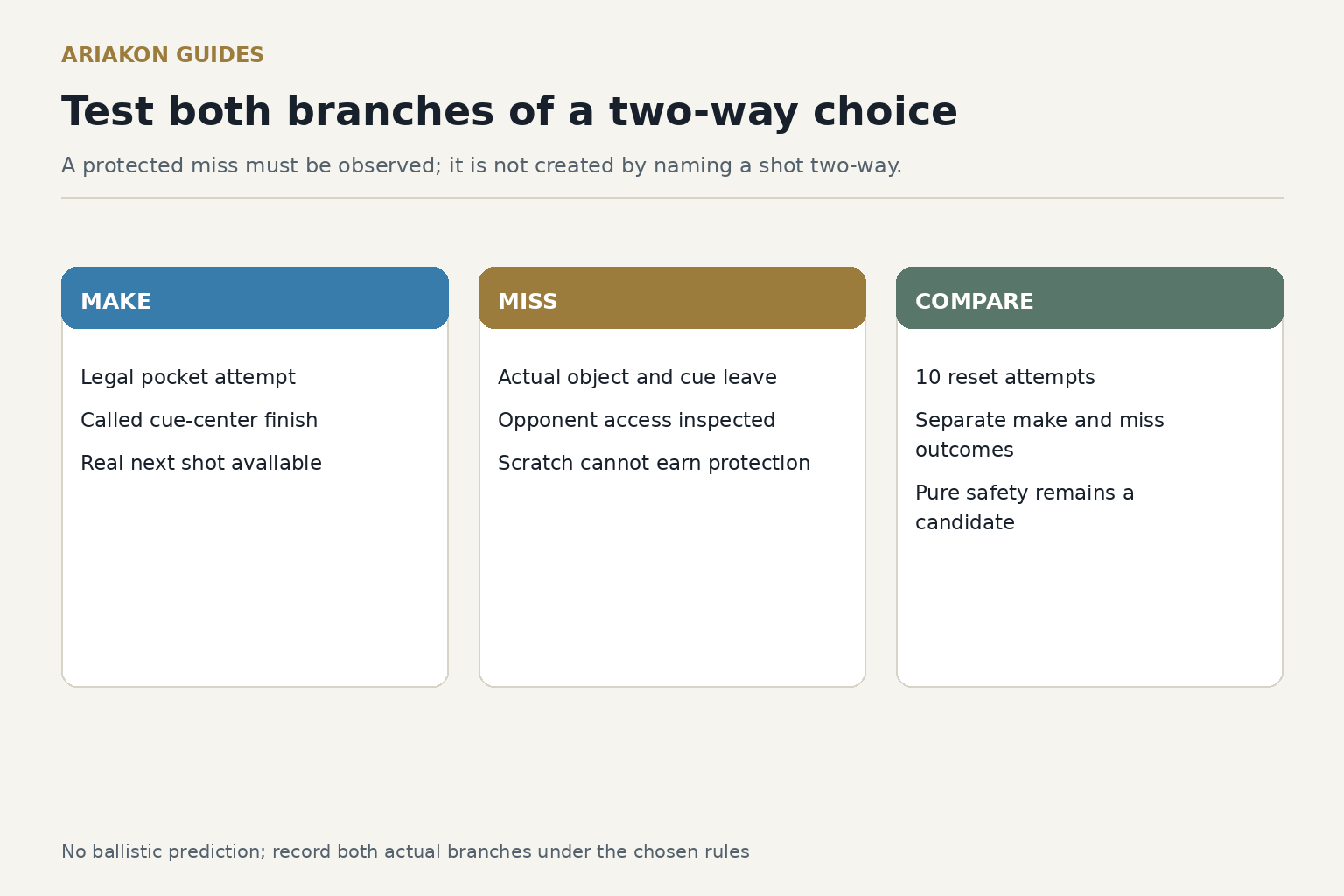
Start with the primary shot
Confirm the called pocket or legal target, the required object-ball line and the cue-ball position if the shot succeeds. If the pot is not worth attempting on its own, adding a hopeful safety outcome does not automatically improve it.
Then trace the most likely miss: overcut, undercut, short bank or long bank. A two-way idea is useful only when a realistic miss tends to leave the opponent a harder reply.
Use cue-ball cover
One common design sends the cue ball behind a blocker after object-ball contact. If the object ball drops, the cue ball still reaches a playable zone; if it misses, the blocker may hide the next legal target.
Use a broad cover area instead of one exact hiding point. Check the scratch line and make sure the blocker will still exist after the object ball’s likely miss.
Use distance and awkward angles
When full cover is unavailable, separate the cue ball and object ball. A long, thin reply from the rail can be meaningful protection even if the opponent can see the ball.
Distance alone is not safety against a strong player. Combine it with an awkward bridge, traffic, a narrow cue-ball route or limited access to the next ball.
Protect the successful outcome
- Choose the pocket and make path first.
- Identify the most probable miss rather than every theoretical miss.
- Trace cue-ball and object-ball paths through that miss.
- Prefer a broad defensive zone over a perfect hook.
- Reject routes that scratch or lose the next shot when the ball is made.
- Play a pure safety when offense forces too many compromises.
Practice both branches
Set one layout and shoot ten attempts. Score a made ball with position separately from a miss that leaves a difficult legal reply. A miss that sells out scores zero even when it looked close.
Vary speed before adding sidespin. The goal is to learn which speed window supports both outcomes, not to manufacture cover with an unreliable extreme hit.
Keep the rules in the decision
A two-way shot must still satisfy the current game’s legal contact, rail and called-shot requirements. Review the applicable rules before competition, especially for combinations, banks and safeties.
Use two-way thinking when it preserves a reasonable attack and limits the opponent’s reward. When the offensive percentage is high and position is simple, play the runout. Strategy should reduce unnecessary risk, not turn every shot into indecision.
Sources and further reading
References support the specific factual information above. The practical checklists are Ariakon editorial guidance.