
Strategy · 3 min read
Build a Strong Pool Safety With Three Controls
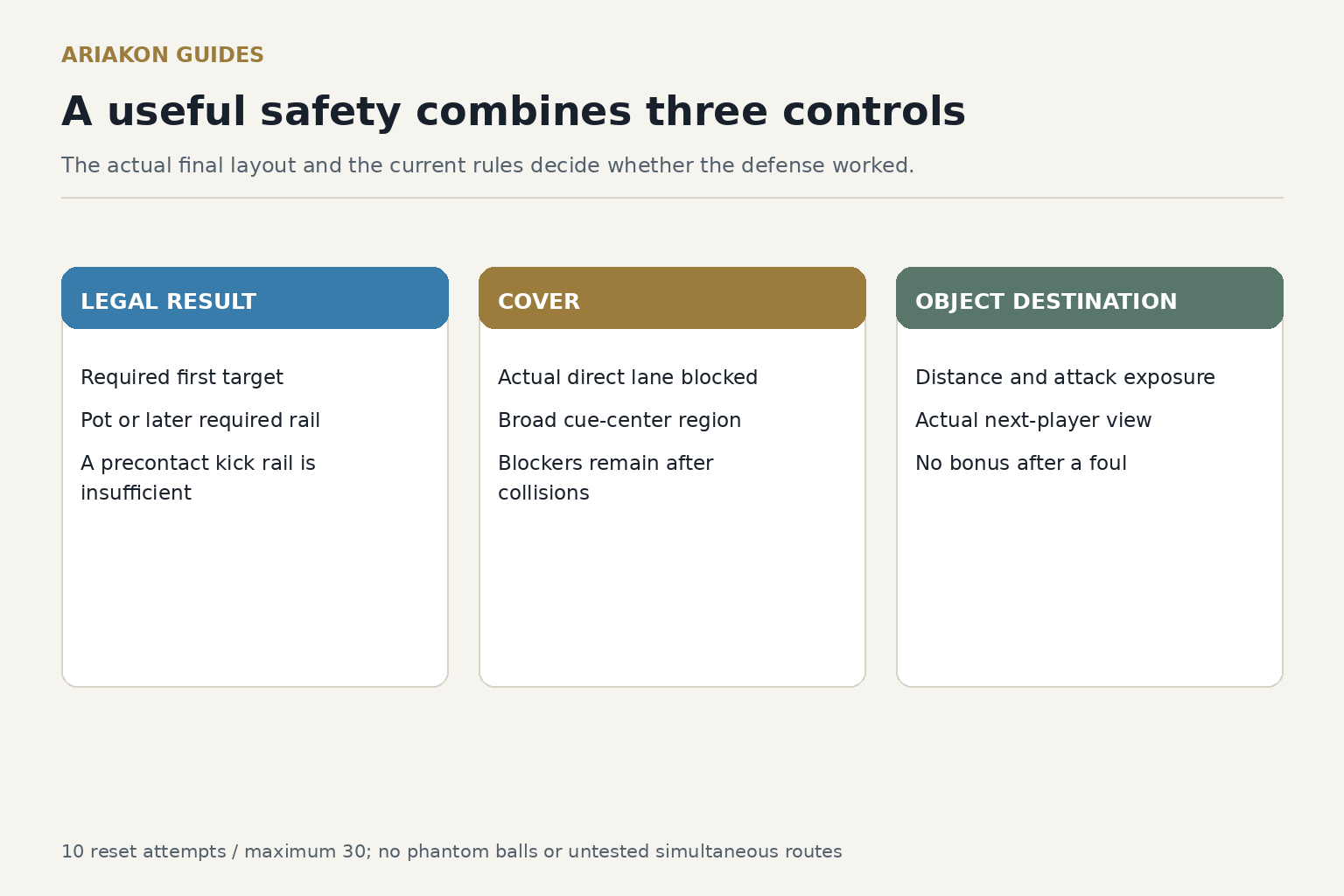
A safety is more than hiding the cue ball. The strongest defensive choices combine three controls: make the required legal contact, place one ball behind useful cover and send the other ball somewhere difficult to attack. You rarely need perfection in all three. You do need to know which part carries the shot.
Control one: satisfy the game rules
Identify the first ball you must contact and what must happen afterward. Under WPA general rules, a legal shot normally requires the cue ball to contact a legal object ball and then at least one ball to reach a cushion unless a ball is pocketed. Game-specific rules determine which ball is legal.
Trace that requirement before evaluating the hiding place. A brilliant-looking hook that fails the required contact or cushion condition is a foul, and ball in hand may give away far more than the safety could gain.
Control two: place the cue ball behind cover
Choose a blocker that creates a wide visual barrier. Hiding behind a cluster or two separated balls is usually more forgiving than trying to nestle directly behind a single ball. Mark a cue-ball zone, not an exact dot.
Approach the zone along its long dimension when possible. If a small speed error still leaves the direct path blocked, the layout is helping you. If two inches turns a hook into an open shot, the safety has very little margin.
Control three: leave the object ball awkward
Distance magnifies the difficulty of the opponent's kick and return safety. Sending the object ball to a cushion or the far side of the table can prevent an easy containing shot even if the cue ball is not perfectly hidden.
Avoid rolling the object ball toward a pocket unless you have accounted for a possible sellout. A safety that hangs the game ball can lose to a fortunate hit. Prefer destinations with no direct scoring reward.
Choose which ball is easiest to predict
A thin hit gives the cue ball speed while moving the object ball less. A fuller hit transfers more speed to the object ball and can hold the cue ball. Use that relationship to choose the ball you want to control most precisely.
If cue-ball cover is large but the object-ball target is small, favor the object-ball speed. If the object ball can travel anywhere along a safe cushion but the cue ball must stop behind one blocker, prioritize cue-ball speed.
Plan the opponent's best reply
Look from the opponent's side before shooting. Can they see an edge? Is there an easy one-rail kick that sends the object ball toward a pocket? Can they intentionally foul without serious cost? A good safety reduces the strength of the best reply, not merely the obvious shot.
Also consider the score and game. When a foul gives the opponent ball in hand in a decisive rack, a lower-risk containing safety may be better than an ambitious lockup with a narrow legal-contact margin.
Score a practical safety drill
- Set one legal object ball and two blockers in fixed positions.
- A known foul or unsafe result scores 0 for the entire attempt, regardless of cover or separation. Unknown contact/legality stays unscored; no bonus is inferred from an unseen leave.
- Earn one point for legal contact and the required post-contact cushion.
- Earn one point if there is no direct line to the object ball.
- Earn one point if the object ball finishes outside a chosen attack zone.
- Shoot ten attempts, then change only the contact fullness or speed that costs the most points.
Sources and further reading
References support the specific factual information above. The practical checklists are Ariakon editorial guidance.