
Position play · 6 min read
Use Stop Shots to Build a Three Ball Position Pattern
An ideal straight stop leaves the cue ball near its collision-center position, one ball diameter behind the object’s original center. It does not occupy that object center. This pattern builds each following straight start from the preceding contact center, then keeps the measured leave separate from the nominal plan.
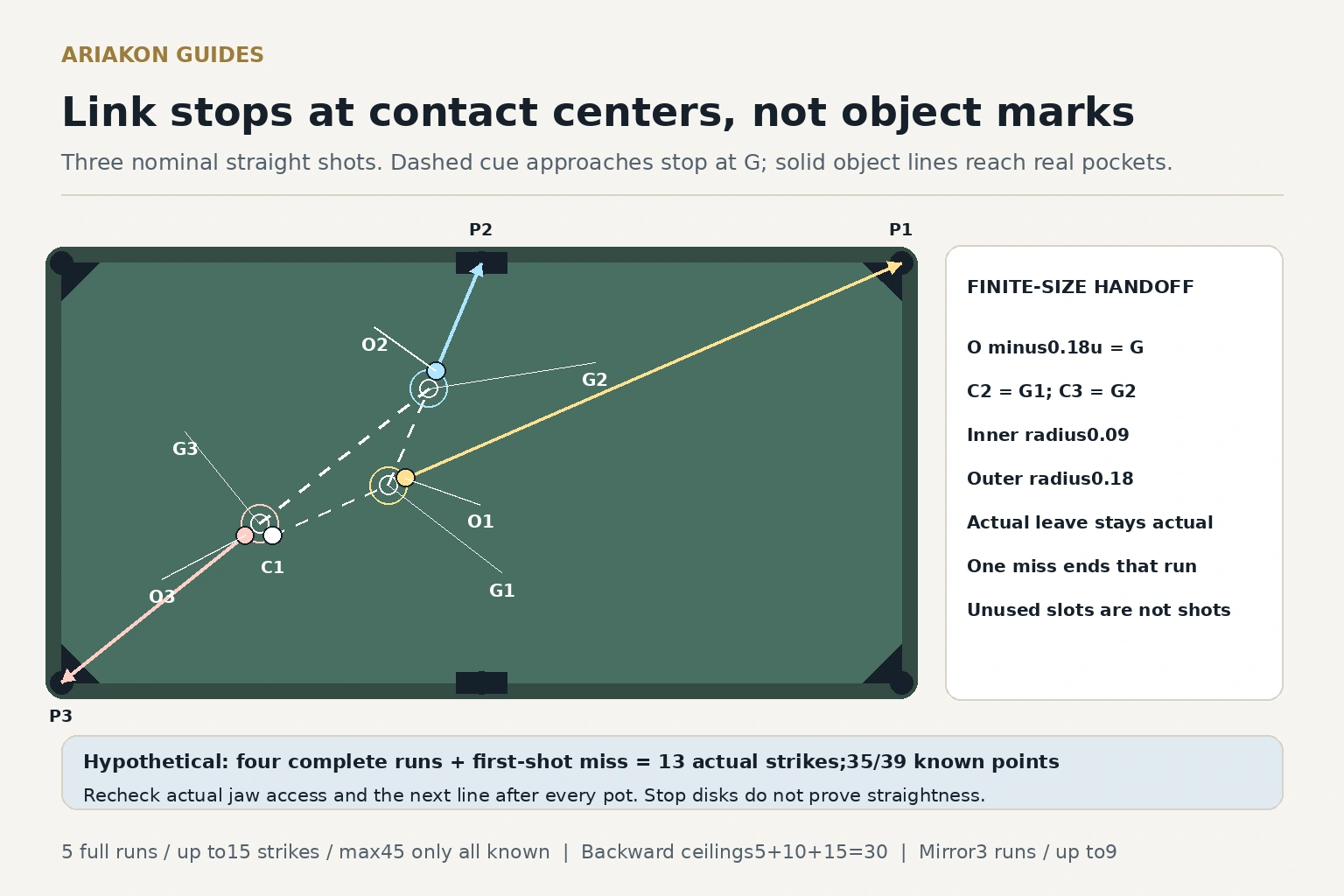
Construct the pattern from the last contact backward
Coordinates describe ball centers on an illustrative 100×50-inch bed: x=0..8 along the length, y=0..4 across it, origin at the lower-left cushion-nose corner. One unit is 12.5 inches; equal 2.25-inch balls have radius 0.09 and diameter 0.18 units. Intact-cushion center limits are 0.09..7.91 and 0.09..3.91. The four corners and (4,0),(4,4) are real pocket locations, not spots inside the bed. Measure actual balls, bed, mouths and jaws before scaling. Remove measuring aids before striking and never mark a competition table.
For Shot 3 choose O3(1.75, 1.4) and lower-left P3(0, 0). Its direction is u3=(P3−O3)/|P3−O3| and G3=O3−0.18u3=(1.890556, 1.512445). Choose its cue start G2(3.5, 2.8) on the same approach line.
For Shot 2 use upper side P2(4, 4), u2=(P2−G2)/|P2−G2|, O2=G2+0.18u2=(3.569231, 2.966154) and start G1=G2−u2=(3.115385, 1.876923). For Shot 1 use upper-right P1(8, 4), u1=(P1−G1)/|P1−G1|, O1=G1+0.18u1=(3.280465, 1.948675) and C1=G1−1.2u1=(2.014845, 1.398578).
All three nominal starts, contact centers, objects and pockets are collinear. The later objects do not obstruct those intended first approaches or object-pocket lines. Check actual mouths and jaws; the diagram is not a pocket specification. Use ordinary modest delivery and no intentional sidespin. A straight no-roll collision is a calibration reference, not a guarantee of zero motion.
Calibrate the single stop at its real contact center before using a stop as another shot’s start.
Keep contact centers and object centers visibly different
Use inner cue-center stop disks radius 0.09 at G1,G2,G3. The outer ring is 0.09<distance≤0.18; outside means distance>0.18. Boundaries are exclusive: an exact 0.09 error is inner, an exact 0.18 error is outer. These are chosen practice tolerances, not match rules or a declaration that every in-disk leave is straight.
The nominal handoffs are C2=G1 and C3=G2, not C2=O1 and C3=O2. At the first collision, |O1−G1|=0.18; similarly for the later two. Ball size is part of the pattern rather than a rounding error.
| Shot | Cue start | Object | Real pocket | Chosen stop center |
|---|---|---|---|---|
| 1 | (2.014845, 1.398578) | (3.280465, 1.948675) | (8, 4) | (3.115385, 1.876923) |
| 2 | (3.115385, 1.876923) | (3.569231, 2.966154) | (4, 4) | (3.5, 2.8) |
| 3 | (3.5, 2.8) | (1.75, 1.4) | (0, 0) | (1.890556, 1.512445) |
Use two backward preparation gates before the full card
Reset all required objects and the starting cue center between runs. A miss, foul, unresolved legality or safety concern ends that run; do not play its later shots as if the sequence succeeded. The next allocated run starts only if safe. Failure of a preparation gate stops progression, rather than awarding ten or fifteen fictional later strikes.
All preparation and full-card ceilings total 5+10+15=30 strikes only if every run completes and both preparation gates pass. A last-shot block ending after five attempts does not imply the pair or full block was played. Unused later allocations remain unused.
| Stage | Five allocated runs | Actual strike ceiling | Advance only when |
|---|---|---|---|
| Last shot alone | Shot 3 from G2 | 5 | At least 4 known legal pots and 3 inner finishes, without unsafe action |
| Last pair | Shots 2–3 from G1, actual leave after 2 | 10 | At least 4 complete legal pairs and 3 runs with both inner finishes |
| Full pattern | Shots 1–3 from C1 | 15 | Evaluate the separate five-run gate below |
Score known outcomes without combining missing shots
If the pot is known but the cue finish is unobservable, retain the pot and leave the nested points unknown; reduce its possible score by 3. A known foul remains 0 even if the finish is hidden. A pot alone cannot certify the stop position.
The full card has five started runs and up to 15 actual strikes. A complete known three-shot run has a maximum 9, so a maximum of 45 requires all fifteen struck, known outcomes. For a run ending after a missed first shot, record one actual 0, two unused slots and no completion, not three missed shots.
The full transfer gate requires all five runs to have been started safely, at least 4 complete legal patterns, at least 36 known points and no more than 2 known potted finishes outside the inner disks. Every actual potted finish must be observable for this gate. These are original practice thresholds, not a measured ability scale.
| Points | Known result | Finish category |
|---|---|---|
| 0 | Known miss or foul | Pot fails; leave does not earn stop points |
| 1 | Known legal pot; cue center farther than 0.18 from G | Outside |
| 2 | Known legal pot; cue error greater than 0.09 and at most 0.18 | Outer |
| 3 | Known legal pot; cue error at most 0.09 | Inner |
Continue from the actual leave, not the drawing
After a legal pot keep the cue ball where it rests. Select the next real approach from that center; do not silently move it to G1 or G2. Even a leave inside the chosen disk changes the next cut slightly. The nominal straight-stop reference cannot prove that the following actual shot remains a stop shot.
If the next shot is playable, continue the allocated run using a safe ordinary choice. If it is unresolved or unsafe, end the run. Record forward/backward/lateral stop error as observations, not proof of exact impact spin or tip offset. Mixed errors call for rechecking geometry, condition and delivery before increasing force.
Hypothetical full-card point rows: (3,3,3), (3,2,3), (3,3,3), (3,3,3), (0). Four complete patterns and 13 actual strikes yield 35 of 39 known possible points, with two unused allocations. This misses the 36-point gate. It is not 35/45 from fifteen actual shots and does not become a passing record by deleting the final miss.
Use differential probes for mixed stop errors when the first supported change is unclear.
Transfer one changed constraint in a new record
After the full gate passes, mirror every object, contact center, cue start and pocket by x→8−x for three new runs, up to 9 strikes and 27 known possible points. Keep actual cue leaves between shots and score against the mirrored G targets. Do not mirror only the cue or add those points to the original 45 ceiling.
Name the objects 1,2,3 and use ordinary nine-ball first-contact rules for the transfer; potting 3 is not a nine-ball win. Three complete mirror runs require 9 strikes;30 complete preparation/full strikes plus 9 transfer strikes would be 39, not an automatic workload.
A run in ordinary play may need follow, draw or a new angle rather than another stop. Carry the contact-center planning habit into a real rack, not a rule that every pattern should consist of straight stops.
Test whether a central leave preserves the next line when stopping at a nominal contact center leaves the wrong task.
Calibrate finite stun travel separately when the actual next shot is no longer straight.
Sources and further reading
References support the specific factual information above. The practical checklists are Ariakon editorial guidance.