
Kick shots · 4 min read
A One Rail Kick Aiming Worksheet for Beginners
This beginner worksheet answers one question: where does the mirror line actually cross an intact cushion when the ball has a radius? Build five starts with one fixed target, then record the real arrival. It is separate from bank-shot construction, multi-rail systems and speed/spin table calibration.
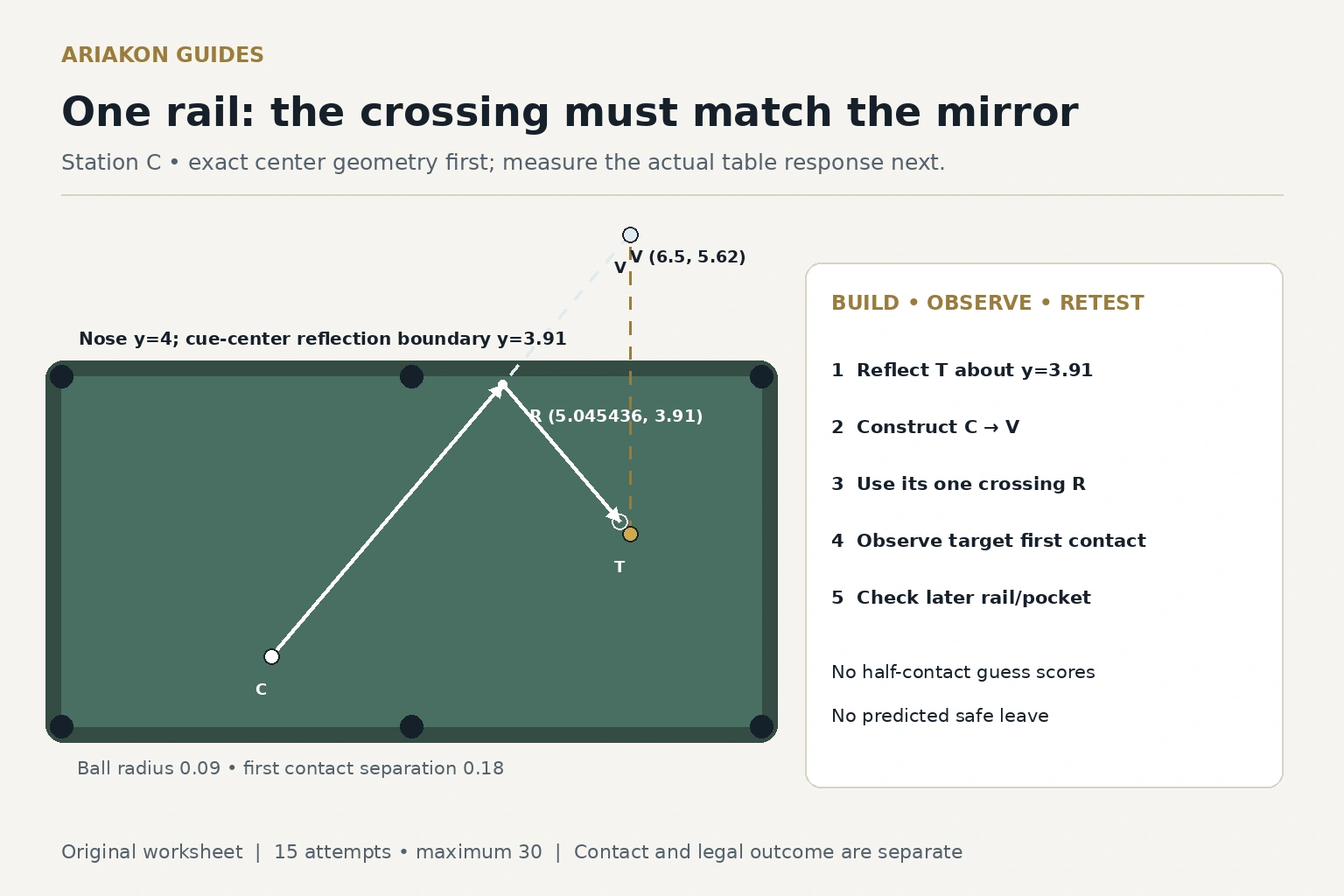
Reflect a ball-center target across the center boundary
Coordinates describe ball centers on an illustrative 100×50-inch bed: x=0..8 along the length, y=0..4 across the width, origin at the lower-left cushion-nose corner. Equal 2.25-inch balls have radius 0.09 and diameter 0.18 units. Intact-cushion center limits are 0.09 and 7.91 in x, 0.09 and 3.91 in y. Pockets interrupt these limits at the four corners and at (4, 0),(4, 4). Inspect actual mouths and jaws; scale to the measured bed and actual ball size. These are not universal diamond coordinates. Remove measuring aids before a shot; do not mark a competition table.
Choose upper nose y=4, so the rebounding cue center reaches H=3.91. Hold target T(6.5, 2.2). Reflect its center to V(6.5, 5.62), not to a point the same distance behind the wooden rail. From any cue center C, the crossing is R_x=C_x+(6.5−C_x)×(3.91−C_y)/(5.62−C_y), R_y=3.91.
A line to the virtual center is geometric construction only. The actual cue ball first contacts T when their centers are 0.18 apart. No target ball exists outside the bed, and no post-contact route is promised. Keep the first rail contact well clear of the real side-pocket jaws.
Use the separate kick-versus-bank calibration when you need to compare traveling balls and real table response.
Change only the cue start across five stations
Use the same no-intentional-sidespin contact, comfortable pace and near-level cue for the first round. Record the chosen pace in your own words and keep it stable. Fifteen struck attempts complete five stations; replace balls and do not use the drawing as a literal rail-inlay scale.
The illustration shows station C. Its R and first-contact center are (5.045436, 3.91) and (6.383374, 2.337107). The line C→V, incoming C→R and reflected R→T agree at the same point. If your first-rail crossing changes, investigate setup or delivery before adjusting the model.
| Station | Cue C | Cue center at first cushion R |
|---|---|---|
| A | (1.2, 0.8) | (4.61971, 3.91) |
| B | (1.8, 0.8) | (4.832573, 3.91) |
| C | (2.4, 0.8) | (5.045436, 3.91) |
| D | (3, 0.8) | (5.258299, 3.91) |
| E | (3.6, 0.8) | (5.471162, 3.91) |
Keep contact separate from a legal outcome
Under ordinary WPA nine-ball rules, first contact must be the lowest-numbered remaining ball; if nothing is pocketed, a ball must reach a cushion after object contact. Your first kicking cushion occurs before contact and cannot satisfy that later requirement. Record first-contact count and complete legal-result count separately, even when using this 0–2 practice score.
This worksheet does not score a called target half whose direction could not be seen. Mark uncertain first contact for review rather than awarding the point. Special game rules, push-outs and frozen-ball situations require their own rule checks; this practice card is not a substitute.
| Points | Observed result |
|---|---|
| 0 | No required first contact, a foul or scratch |
| 1 | Required target first contacted, but later legality not established |
| 2 | Required target first, required later rail or pocket event, and no other foul |
Use signed coordinates instead of ambiguous short and long
In the ideal reflected model, the outgoing centerline at y=2.2 reaches x=R_x+(R_x−C_x)×1.71/3.11. Shifting R_x by+0.05 shifts this predicted crossing by about+0.07749. Thus a repeatable arrival to smaller x can be tested with a small positive-x rail adjustment; an arrival to larger x with a small negative-x adjustment. This is a model-based experiment, not a universal speed correction.
When target contact prevents observing the crossing, use a separate cue-only retest with T removed and a registered overhead view to observe the y=2.2 crossing. Take three attempts at one problematic station with the adjustment frozen. That adds three strikes; do not count those cue-only tests as successful object contacts. If the camera cannot resolve the crossing, keep signed miss notes qualitative.
Transfer the construction to a blocked first target
For a separate five-attempt nine-ball-shaped transfer use station C, T as the 1-ball and blocker B(4.45, 1.5) as a higher-numbered ball. B lies on the direct C→T centerline and removes direct access. Its diameter-clearance check does not obstruct either leg of the constructed kick; the first-cushion point remains intact.
Before the shot name the legal target and the first rail. Afterwards observe any required later rail or pocket event and scratch, rather than assuming legality from touching the 1. Five attempts have a maximum 10 practice points; keep this separate from the fifteen-station total. A poor leave can follow a legal hit, so also inspect the opponent’s actual next view without awarding an invented safety point.
Compare the complete escape options when a calibrated kick is only one possible reply.
Study defensive kicking as a later task when first contact is reliable but the leave remains poor.
Sources and further reading
References support the specific factual information above. The practical checklists are Ariakon editorial guidance.