
Kicks and banks · 4 min read
How to Calibrate One Rail Kicks and Banks
In a kick, the cue ball reaches a cushion before the required object. In a bank, the object ball reaches a cushion before its called pocket. Similar reflection arithmetic does not make their collisions, speed or success definitions interchangeable. Build one record for each.
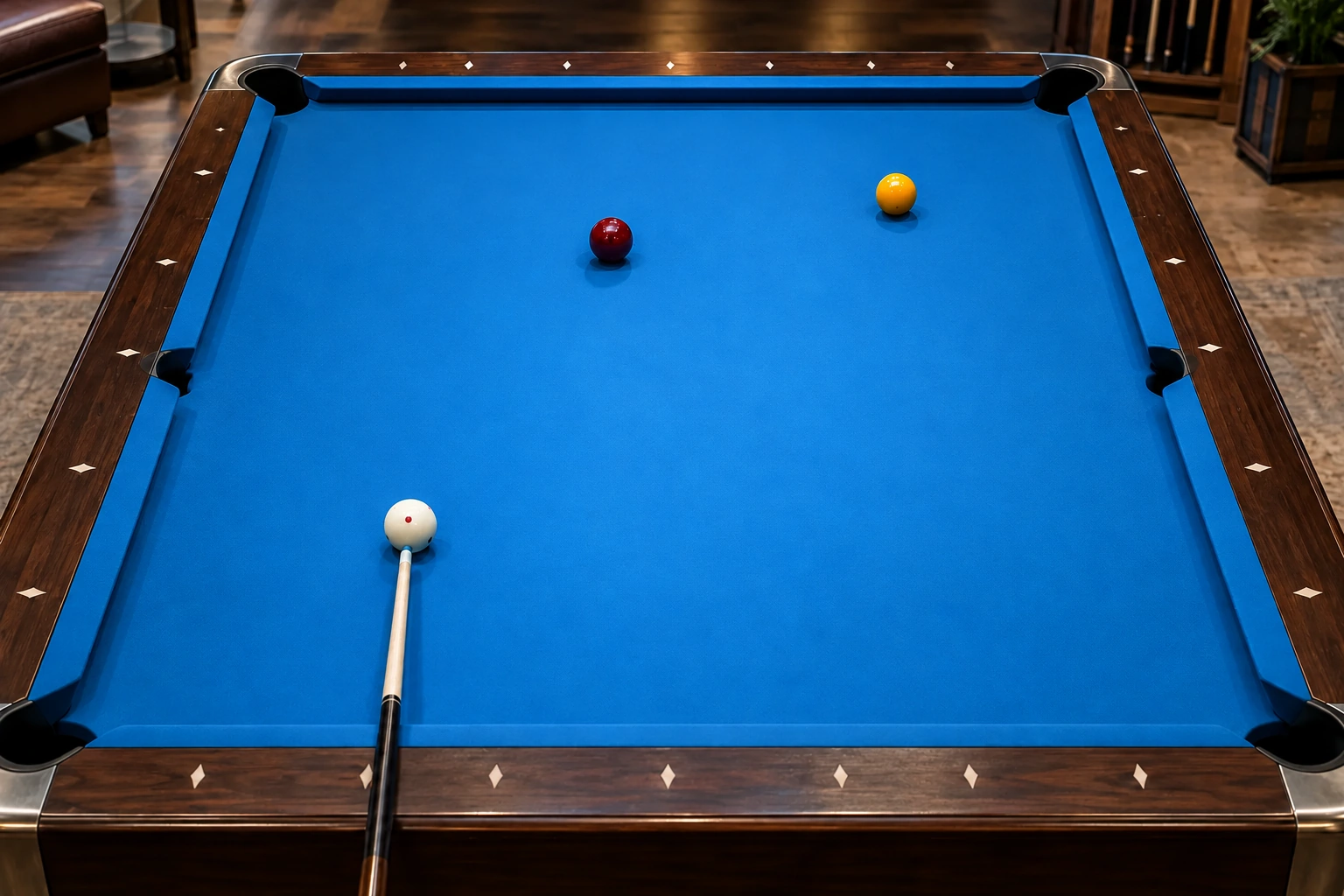
Measure the center envelope, not the rail inlays
The illustrative playing bed is 8×4 units, equivalent to 100×50 inches. A 2.25-inch ball has radius 0.09 and diameter 0.18 units. Coordinates describe ball centers from the lower-left cushion-nose corner. The center envelope for intact cushions is x=0.09 or 7.91 and y=0.09 or 3.91: the ball edge, not its center, touches the nose. Real pockets interrupt that envelope at the four corners and at (4,0) and (4,4). Inspect the actual pocket mouths and reject any rail target in a gap or jaw area. Scale the construction to your measured bed and actual ball size; these coordinates are not universal diamond values.
Use no intentional sidespin and a repeatable comfortable pace as a baseline. Diamonds are visual references behind the nose, not the physical collision boundary. The equal-angle model is a starting construction; real rebound and throw are observations.
Read diamonds as consistent references without confusing inlays and cushion contacts.
Construct the cue-ball kick first
Aim from C toward the reflected target. The cue center reaches (4.694444, 3.91) then heads toward T. It first contacts the object at separation 0.18, not at the object center. The cushion point is away from the schematic side-pocket gap; inspect actual jaws and width. No post-contact route or safe leave is predicted.
Take six struck attempts. Record target contact, required post-contact pocket/rail event and scratch separately. Contact after the first rail is not automatically a legal shot under rules requiring a later cushion.
| Item | Center coordinate | Task |
|---|---|---|
| Cue ball | (2, 1) | Traveling ball |
| Required object | (6, 2.5) | First object contact after the rail |
| Reflected object | (6, 5.32) | Reflection about y=3.91 |
| Cue center at cushion | (4.694444, 3.91) | Cue edge touches upper nose y=4 |
Construct an object-ball bank as a different setup
First solve O→lower cushion→side pocket. Then choose the incoming cue line through the tangent ghost center, one diameter opposite the object departure direction. This is not a cue-ball kick line. The object approaches a real side-pocket opening after one intact-cushion contact.
Take six struck attempts, calling the one-cushion route and pocket before shooting. Pocket outcome earns 1 only for that called route without a foul; a separate process flag records the frozen setup and cueing. Observe the cue ball after contact, but do not invent a stopping or scratch-avoidance prediction from this object-path diagram.
| Item | Coordinate | Meaning |
|---|---|---|
| Object ball | (5, 2) | Traveling bank ball |
| Called pocket | (4, 4) | Existing side pocket, not an imaginary head-center pocket |
| Reflected pocket | (4, -3.82) | Reflect about lower center boundary y=0.09 |
| Object center at lower cushion | (4.671821, 0.09) | Object edge touches lower nose |
| Ghost cue-ball center | (5.030481, 2.1774) | One full diameter behind object along departure vector |
| Cue-ball start | (5.233689, 3.36007) | 1.2 units behind the ghost center |
Keep two denominators and diagnose the first error
The bank pot and kick contact are different events. Do not add 4 and 2 and call 6/12 an accuracy score. If the first cushion point varies, recheck setup and delivery. If the first point repeats but the arrival differs, record speed/rolling state and the observed rebound before changing the first aim.
A later speed comparison uses a new version with six attempts per family at each of two explicitly defined personal paces: 24 strikes, with separate records. Do not infer how much faster or softer to hit from the generic words short or long alone.
| Record | Maximum | Hypothetical example |
|---|---|---|
| Kick target contact | 6 | 4/6 |
| Kick legal outcome | 6, separate | 3/6 |
| Bank called-route pocket | 6 | 2/6 |
| Bank process flag | 6, separate | 5/6 |
Choose the task that the game needs
Under the actual game rules, call the required object, pocket or defensive goal. Check blockers, pocket gaps and actual scratch risks before shooting. A legal hit can still leave an easy opponent shot; a made bank can still foul. Record the actual positions and legality rather than awarding an unmeasured safe-leave flag.
Use the separate contact-versus-pocketing progression for more stations after these two baselines.
Add a second cushion deliberately when the simpler line is unavailable.
Sources and further reading
References support the specific factual information above. The practical checklists are Ariakon editorial guidance.