
Kicks and banks · 4 min read
How to Practice Three Rail Kick Shots
For three-cushion practice, measure the first failed checkpoint rather than blaming the last miss on a remembered formula. This independent worksheet unfolds a simple equal-angle model, then uses the table to test it. It does not teach a named numbering system or a fixed spot on a room wall.
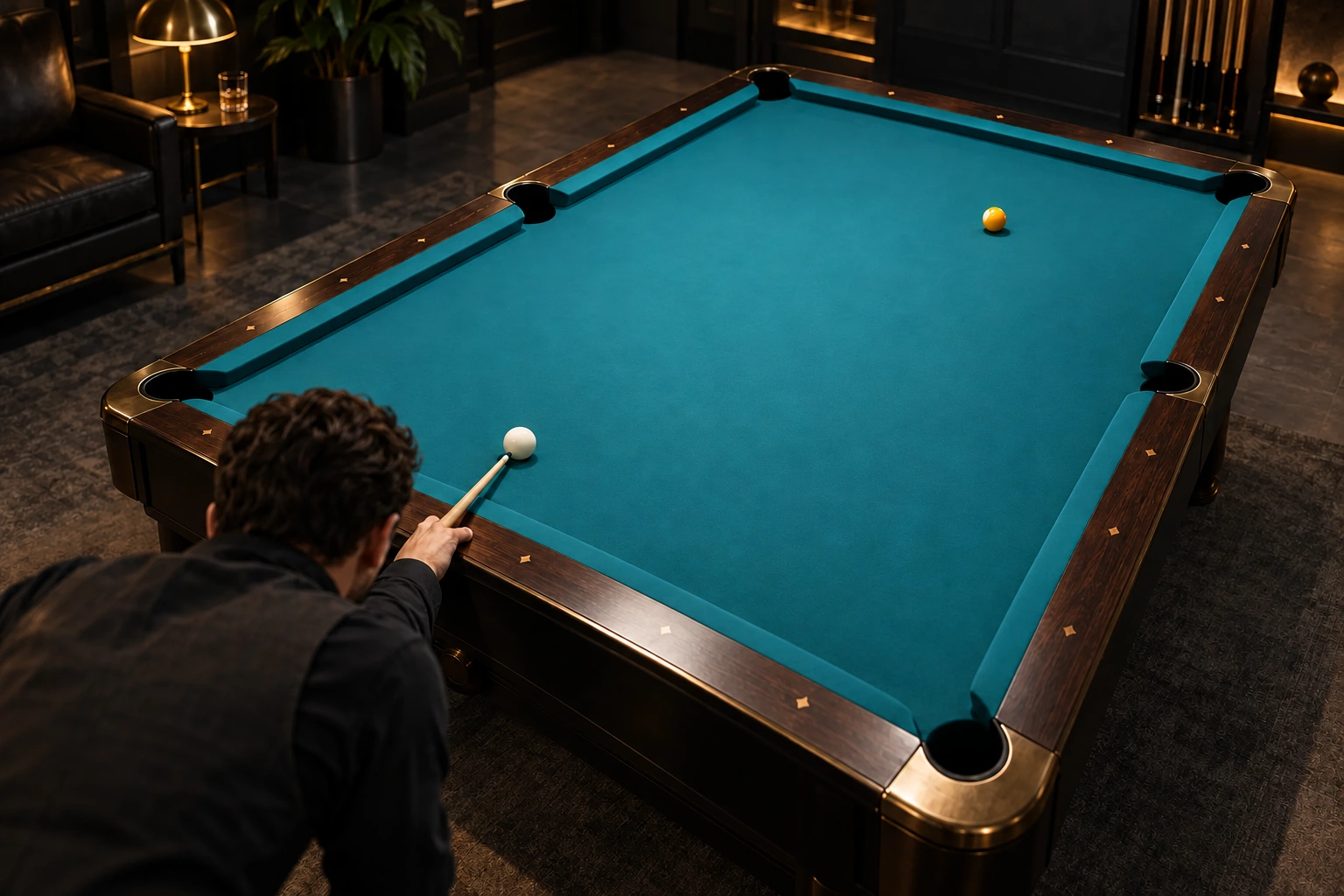
Define the physical boundary and route order
The illustrative playing bed is 8×4 units, equivalent to 100×50 inches. A 2.25-inch ball has radius 0.09 and diameter 0.18 units. Coordinates describe ball centers from the lower-left cushion-nose corner. The center envelope for intact cushions is x=0.09 or 7.91 and y=0.09 or 3.91: the ball edge, not its center, touches the nose. Real pockets interrupt that envelope at the four corners and at (4,0) and (4,4). Inspect the actual pocket mouths and reject any rail target in a gap or jaw area. Scale the construction to your measured bed and actual ball size; these coordinates are not universal diamond values.
The route is upper long cushion, right short cushion, lower long cushion, then target object. Place cue center C=(2,1) and target object center T=(6,1.5). No blockers are needed for calibration. Do not intentionally scratch as a benchmark, and do not add a blocker until the entire measured path is clear.
Establish the one-cushion distinction first when kick versus bank is not yet clear.
Unfold from the target in reverse rail order
Aim from C toward the unfolded point. Its slope is (9.14−1)/(9.82−2). Fold the line at each specified center boundary; only those contacts change its direction. Each segment is straight in this elementary model. The cue center first touches the object when center separation reaches 0.18; it does not travel through the object center.
The listed rail locations are away from the schematic pocket openings, but inspect real jaws and equipment before practice. Reflection is geometry, not a claim that real rolling balls conserve the angle exactly. Cushion response, speed, spin and cloth change the observed route.
| Step | Center coordinate | Interpretation |
|---|---|---|
| Target reflected over lower center rail | (6, −1.32) | Reflect y about 0.09 |
| Then reflected over right center rail | (9.82, −1.32) | Reflect x about 7.91 |
| Then reflected over upper center rail | (9.82, 9.14) | Reflect y about 3.91 |
| First checkpoint | (4.795602, 3.91) | Upper cushion nose y=4 |
| Second checkpoint | (7.91, 0.668159) | Right cushion nose x=8 |
| Third checkpoint | (7.35457, 0.09) | Lower cushion nose y=0 |
| Object target | (6, 1.5) | Contact occurs before the cue center reaches T |
Keep three checkpoint observations per struck attempt
Begin with a comfortable rolling pace and no intentional sidespin. Use enough controlled speed to reach the target; do not force a hard stroke. If the cue ball does not complete the route, label speed insufficient instead of assigning an endpoint coordinate. Where safe, a stationary camera or partner can record approximate checkpoints without placing objects on the route.
Freeze each five-shot block. A small change to the first aim point is supported only after the first contact is repeatable. Do not prescribe an automatic running-spin correction: that adds a separately calibrated condition. Keep residuals as measured values, not a universal short/long adjustment.
| Block | Initial target | Attempts | Record |
|---|---|---|---|
| Baseline | First checkpoint x=4.795602 | 5 | Actual first/second/third points, object contact, scratch |
| One correction | One measured first-cushion offset only | 5 | Same speed and no intentional sidespin |
Count contact and legality independently
Ten struck attempts provide ten possible contact flags and ten separate legal-shot flags. Contact earns 1 only when the target is the first object touched after all three intended cushions. For a rules-based legal flag, confirm the required first object, then a pocket or required cushion contact after the object collision, plus no other foul. Three earlier cushion contacts do not satisfy a post-object rail requirement.
Hypothetical log: 7/10 target contacts and 5/10 legal outcomes means two contact attempts failed another legal condition. It does not mean seven successful escapes. If the first cushion scatters, repair delivery; if early cushions are stable and the last varies, record the later response before moving every target.
Add a game layout without claiming a guaranteed leave
Only after calibration, inspect direct and simpler routes under the actual rules. Identify the required object and the consequences of each reachable contact. Add one blocker whose center is at least a full ball diameter from every measured cue-center segment, with additional allowance for your actual scatter. An ideal line alone does not prove clearance.
Record the actual post-contact positions separately; no safe leave is implied by this construction. Preserve the table, ball, speed condition and observed corrections in the next session.
Use the separate two-cushion route when it is the simpler available option.
Separate contact from the required later outcome before calling an escape successful.
Sources and further reading
References support the specific factual information above. The practical checklists are Ariakon editorial guidance.