
Kicks and banks · 4 min read
Understand Diamond System Assumptions Before Trusting the Numbers
Diamond systems turn table references into repeatable starting lines, but the printed number is not the shot. Every system assumes a coordinate convention, a point on the cushion, a cue-ball state, a speed and some table response. Change one without recording it and a mathematically tidy answer can miss repeatedly. This worksheet audits those assumptions before any correction is trusted.
Write the five assumptions above the numbers
Do not mix numbering from one system with the aiming convention from another. Some systems sight through a rail diamond; others refer to the cushion nose or an imaginary point. A diagram without that definition is incomplete.
| Assumption | Record before shooting |
|---|---|
| Coordinate | Where zero begins and which direction numbers increase |
| Reference point | Diamond center, rail nose or projected point through the diamond |
| Cue-ball state | Sliding, rolling or specified spin at the first cushion |
| Delivery | Speed band and cue elevation |
| Equipment | Table, cloth, cushion, balls and current cleanliness |
| Success | Exact contact side or size of legal contact window |
Read diamonds for a one-rail kick for a full coordinate and mirror-line drill.
Practice a three-rail calibration after the assumption card is stable.
Construct one geometric worked example
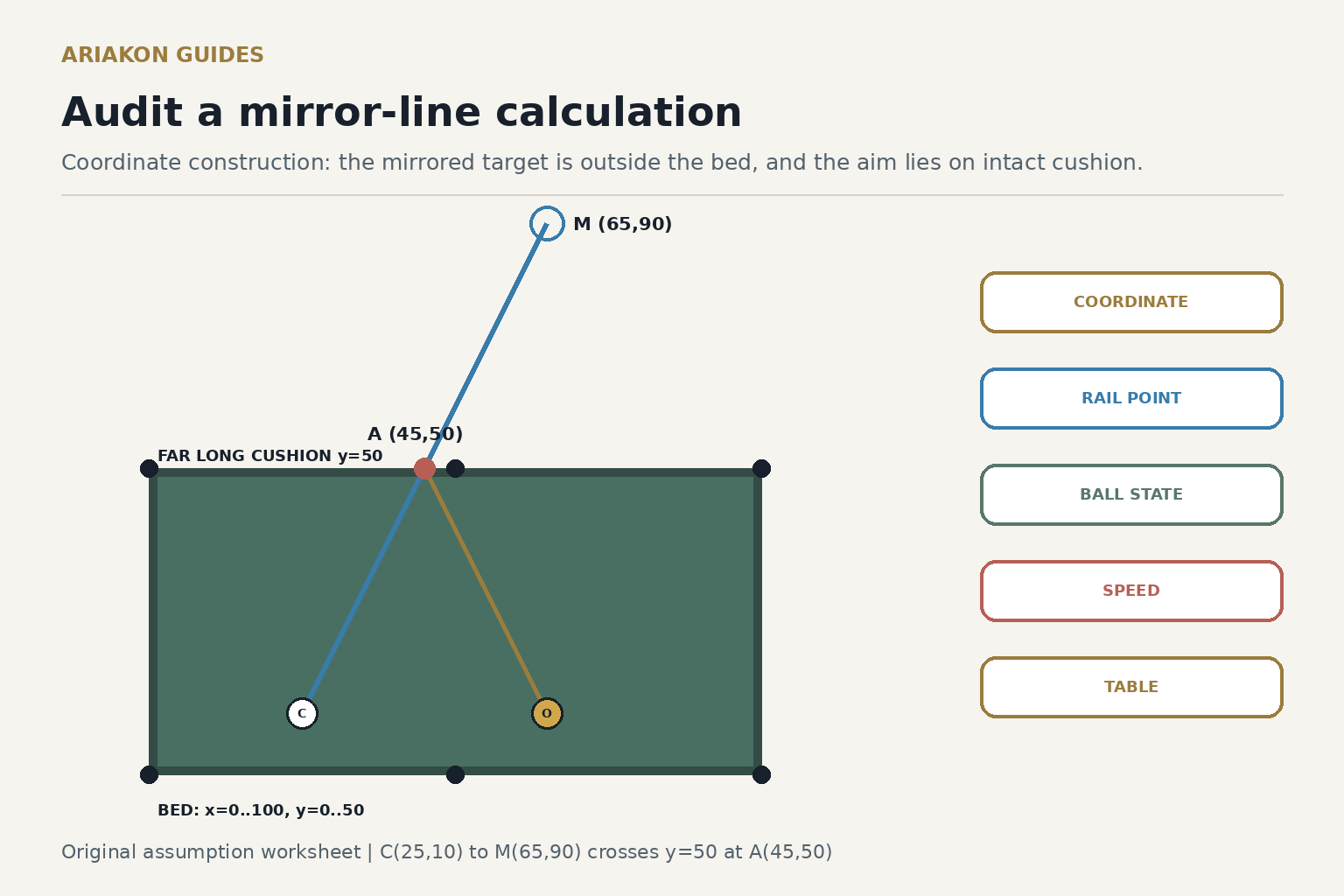
Treat the playing surface as a coordinate rectangle from 0 to 100 along its length and 0 to 50 across its width. For a point-particle mirror construction, use the cue-ball reference C=(25,10) and target reference O=(65,10). This first model deliberately ignores ball radius. For a one-cushion kick off the far long rail at y=50, mirror the object-ball center across that rail to (65, 90).
Draw a straight line from (25, 10) to the mirrored point (65, 90). It crosses y=50 at x=45, the geometric cushion target. This is a no-spin mirror baseline, not a promise of a center hit: cushion compression, speed, rolling state and table condition can move the real rebound. The value of the example is that the starting assumption is explicit.
For equal balls of radius r on a real bed bounded by cushion noses y=0 and y=50, reflect a desired cue-center destination across the effective center boundary y=50−r instead. A target at y=10 reflects to y=90−2r. The symmetric example still crosses that center boundary at x=45; the cue center is y=50−r there, and the cushion-nose point is (45,50). To call an object-ball half, define the desired ghost-ball center one ball diameter from the object-ball center first, then mirror that destination rather than the object-ball center. Record the actual measured ball size and cushion convention.
Run an eighteen-shot table-response worksheet
Mark the cue-ball and object-ball centers plus the x=45 cushion target. Shoot six attempts at a soft rolling speed, six at medium rolling speed and six at a firmer controlled speed, all on the vertical axis. Call center, left half or right half of the object ball before each shot. Reset exact centers.
Record the first-cushion target actually used and the object-ball miss in half-ball widths. A legal hit alone is not enough for calibration: signed miss direction shows whether the table needs a consistent local correction.
| Point | Requirement |
|---|---|
| 1 | Reference and speed band called before the stroke |
| 1 | First cushion contacted within the marked target band |
| 1 | Called object-ball half contacted |
| Maximum 54 | 18 attempts; log signed miss in half-ball widths |
Calculate a correction without rewriting the system
| Result pattern | Next action |
|---|---|
| All speed bands miss same side | Shift the local cushion target in small measured bands |
| Soft and firm miss opposite sides | Keep separate speed rows; do not average them |
| First-cushion marks scatter | Fix aim or delivery before changing the number |
| Center contact is good; halves fail | Practice contact-window calls, not more arithmetic |
| Table changes after cleaning or weather | Create a new dated row rather than erasing the old one |
Worked result and advanced transfer
Suppose six medium shots contact the target band, yet the object ball is missed on the same side four times by roughly half a ball. The honest conclusion is a candidate local correction for that speed, table and setup—not that the system is wrong. Move the cushion aim one small marked band in the needed direction and run six new attempts. Keep both rows.
For transfer, choose one three-rail route and write the same five assumptions plus the success window before applying its published numbering. Score rail contacts separately from final contact. If the route fails, the card identifies whether to check convention, delivery or table response before changing arithmetic.
Test table size effects when moving to unfamiliar equipment.