
Kicks and banks · 4 min read
The Parallel Line Method for Two Rail Kicks: Test Its Limits
A midpoint parallel shift is useful only when its shifted line actually reaches two intact cushions. This guide builds that reference from a ball-center envelope, checks it by reflection and keeps measured corrections separate from ideal geometry.
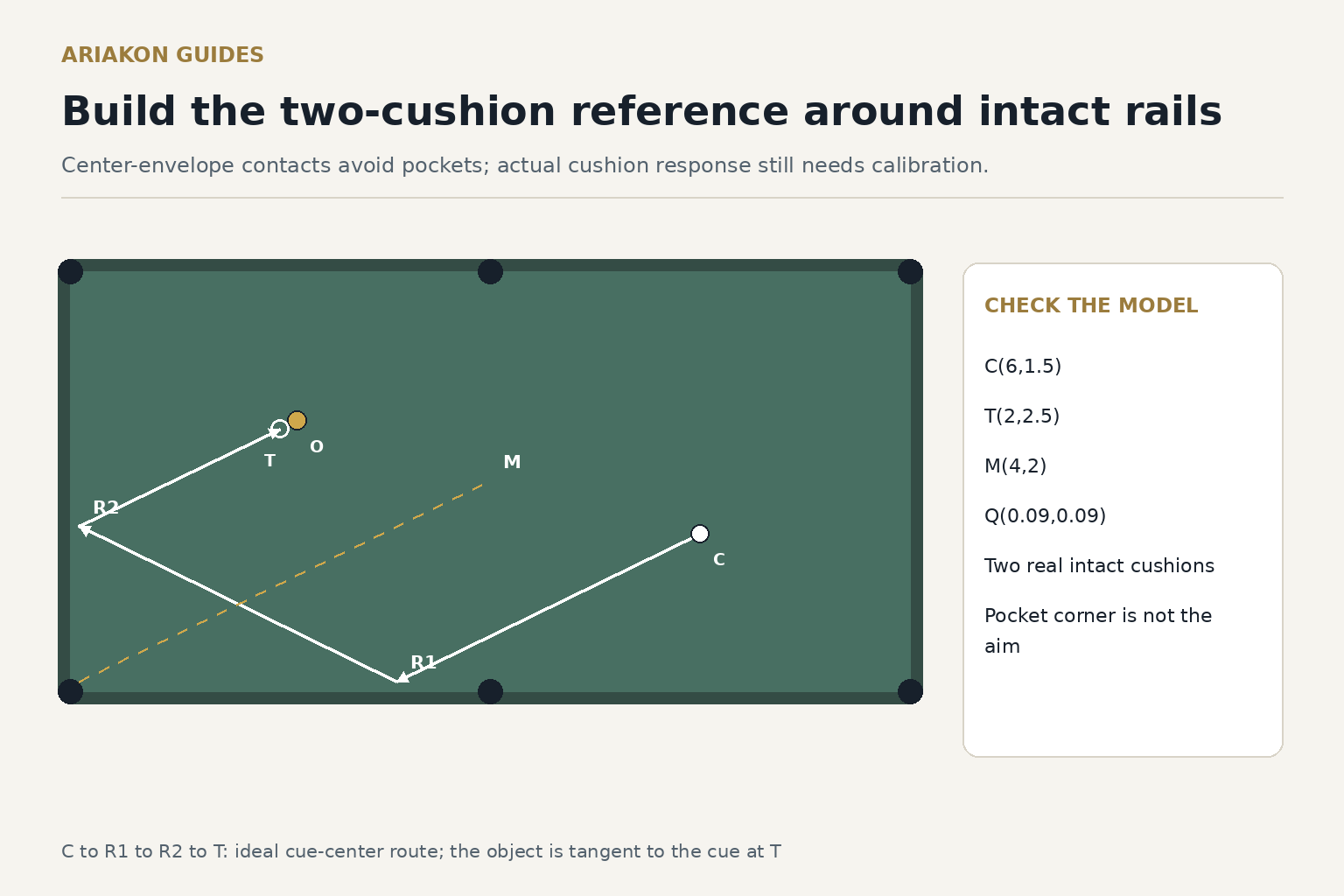
Distinguish the ball-center corner from the physical pocket
Coordinates are ball centers on an illustrative 100 by 50 inch bed: x=0..8 along length, y=0..4 across width, origin at the lower left cushion nose. One unit is 12.5 inches. For 2.25 inch equal balls, radius is 0.09 and diameter 0.18 units. Intact cushion center boundaries are x=0.09,7.91 and y=0.09,3.91; pockets interrupt the physical boundary at the four corners and (4,0),(4,4). Measure actual bed, balls and jaws before scaling. Remove every measuring aid before shooting; never mark a competition table.
Use cue start C(6,1.5) and intended terminal cue-center T(2,2.5). The two reflecting center boundaries are y=0.09 then x=0.09. Their intersection Q(0.09,0.09) is a mathematical center-envelope corner, not a pocket or a place the ball is meant to visit.
Build the midpoint and parallel shift
Midpoint M=(C+T)/2=(4,2). Draw Q to M on paper. Shift that line parallel through C and follow it toward the lower cushion. Its first center contact is R1(3.113560,0.09), then the left center boundary at R2(0.09,1.566982), then T. The corresponding physical cushion nose points are (3.113560,0) and (0,1.566982), both on intact cushions.
Reflect T across x=0.09 and y=0.09 to virtual V(-1.82,-2.32). The straight C to V line is an independent check of the same ideal equal-angle construction. No part of the intended route uses the lower-left pocket. At T the outgoing unit direction is approximately(0.898525,0.438922). Place the real target object center O=T+0.18u=(2.161735,2.579006); the equal balls then first touch when the cue center reaches T.
This is an ideal no-intentional-sidespin starting construction, not a model of cushion compression, rotation or measured success. Use a modest repeatable pace sufficient to reach the target. If the actual table has an obstructed nose or different pockets, hold and rebuild instead of using an old number.
Give the four blocks exact identities
Take six strikes per block: benchmark C(6,1.5),T(2,2.5); near target T(2,2.2); far target T(2,2.8); steeper entry C(6,1.8),T(2,2.5). Keep the other coordinate unchanged. Recompute midpoint and both cushion intersections for every block with the same Q. Place each object 0.18 beyond its T along that block’s terminal direction. Do not reuse the benchmark object center after moving T.
Before any strike confirm both intended contacts lie on intact cushions away from mouths, the cue path reaches the legal object first after the two rails, and ordinary delivery is comfortable. A schematic midpoint can be valid while the real shot remains unsuitable.
Score 24 real strikes with explicit legality
Use ordinary nine-ball contact rules with this object as the lowest remaining ball; these are not break or push-out attempts. The two precontact cushions do not satisfy the later rail requirement. Score 0 for a foul or wrong rail order;1 for the known intended two-rail route with no target contact;2 for that route and a complete legal target hit;3 for score 2 plus cue rest inside a called radius 0.5 disk at(3,3). The finish disk is a chosen tolerance, not a predicted route. Maximum 18 per block and 72 overall for 24 known scores.
Unknown rail/contact/finish evidence leaves the nested score unscored; retain each visible event separately and reduce that block’s known denominator. A known foul is 0. Keep a signed miss at the target alongside points. A repeated miss selects one small new rail-aim or pace test, not an automatic running-spin prescription.
Keep a table correction with its conditions
Retest one block with six new strikes after one modest recorded change. Never erase its first six. Use the construction only as a starting hypothesis on another table. In game transfer, preserve actual required first contact and postcontact legality, and compare the miss with a simpler legal escape.
Sources and further reading
References support the specific factual information above. The practical checklists are Ariakon editorial guidance.