
Kicks and banks · 4 min read
How to Calibrate Two Rail Kick Shots
A two-cushion construction can fit a particular layout without becoming a universal escape formula. This short-rail-first worksheet checks that both contacts occur in the intended order, then calibrates one condition at a time. It does not adapt a proprietary midpoint shift or promise that two rails are safer than one.
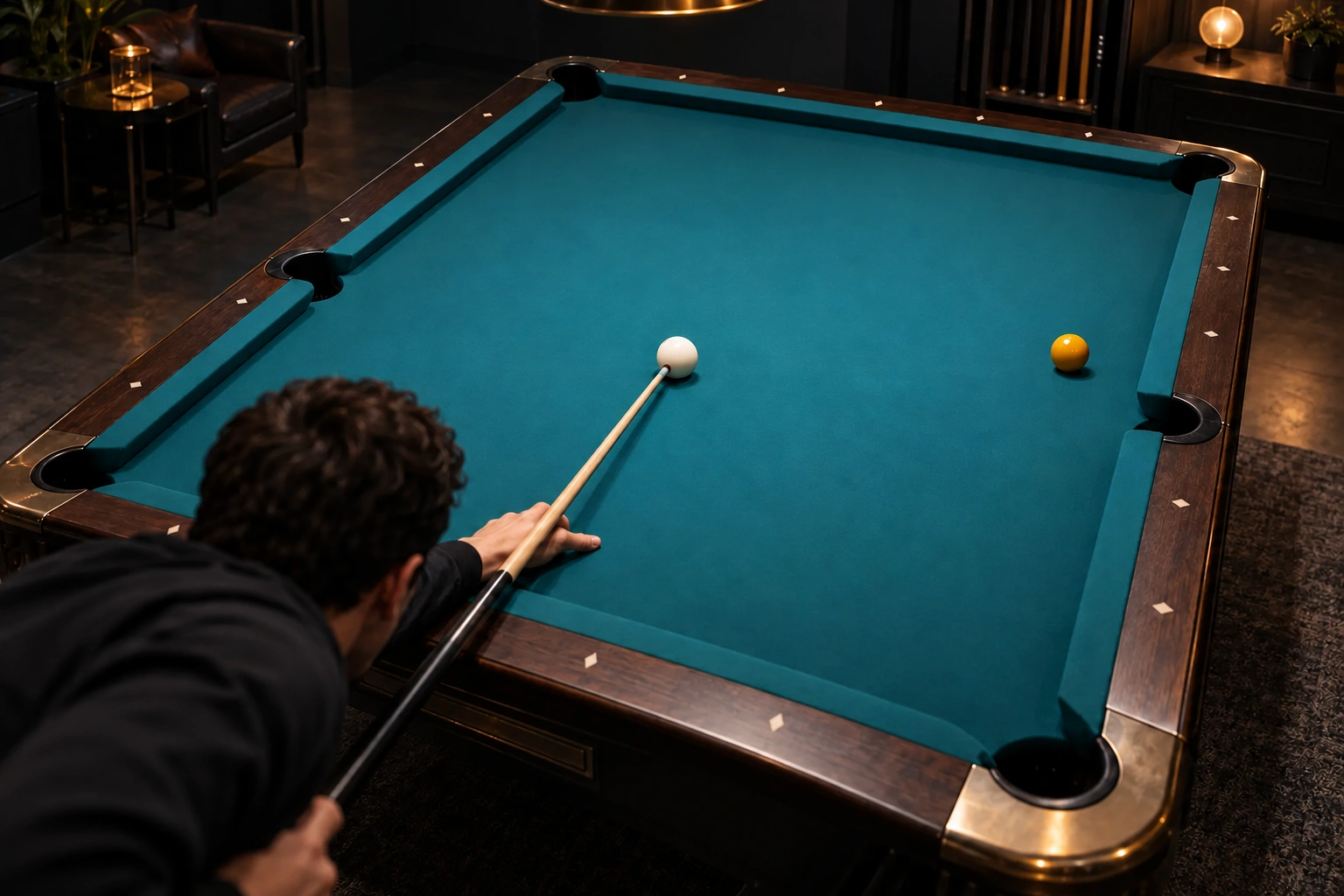
Declare the route before doing arithmetic
The illustrative playing bed is 8×4 units, equivalent to 100×50 inches. A 2.25-inch ball has radius 0.09 and diameter 0.18 units. Coordinates describe ball centers from the lower-left cushion-nose corner. The center envelope for intact cushions is x=0.09 or 7.91 and y=0.09 or 3.91: the ball edge, not its center, touches the nose. Real pockets interrupt that envelope at the four corners and at (4,0) and (4,4). Inspect the actual pocket mouths and reject any rail target in a gap or jaw area. Scale the construction to your measured bed and actual ball size; these coordinates are not universal diamond values.
Place cue center C=(2,1) and target object T=(5,3.2). The intended order is right short cushion, then upper long cushion, then object contact. Keep other balls out of the benchmark. These target coordinates are deliberately different from the three-cushion and numbered-map resources; do not interchange their corrections.
Check the simpler one-rail baseline before adding a second cushion.
Use the separate numbered worksheet when the reader task is to label and retain a personal rail map.
Prove that the short cushion comes first
The unfolded slope is (4.62−1)/(10.82−2). At x=7.91 the center height is 3.425646, below 3.91, so the right cushion comes first. A construction whose first intersection is the top boundary belongs to another rail order and must be recalculated.
After right reflection, the line reaches y=3.91 at x=6.729890, then proceeds down-left toward T. Real object contact occurs at center separation 0.18 before T. Inspect the first point near the corner on the actual table; if jaw clearance is inadequate, change the setup rather than pretending a pocket is a cushion.
| Point | Coordinate | Meaning |
|---|---|---|
| Target reflected over upper center rail | (5, 4.62) | Second cushion reflection first |
| Then reflected over right center rail | (10.82, 4.62) | Unfolded aim destination |
| First center checkpoint | (7.91, 3.425646) | Right nose x=8 |
| Second center checkpoint | (6.72989, 3.91) | Upper nose y=4 |
| Object target | (5, 3.2) | Stop geometric center path at first tangency |
Compare a baseline and one recorded offset
Use no intentional sidespin and one comfortable pace. Record first and second cushion positions, target contact, insufficient speed and scratch separately. The ±0.08-unit aim rows are test inputs, not a prescribed correction or a promise of identical second contacts. Inspect all three points for jaw clearance.
Five strikes in each row allocate 15. Keep each row frozen. Compare complete observations; do not call a slow attempt an aim miss when it never reaches the object. Repeat on another occasion before retaining a correction. Stop if a stable legal route requires an uncontrolled or unsafe stroke.
| Row | First center target y | Purpose |
|---|---|---|
| Lower | 3.345646 | One controlled offset |
| Geometric | 3.425646 | Unadjusted model |
| Higher | 3.505646 | Opposite controlled offset |
Keep the post-contact rule visible
A contact flag is 1 when the required target is first touched after both specified cushions. A separate legal flag is 1 only when the actual rules are also satisfied, including a required pocket or cushion contact after the object collision and no scratch or other foul. Earlier rails are not counted as later rails. Each complete 15-attempt record has 15 possible flags in each category, not a combined escape percentage.
Hypothetical rows yield contact counts 3,4,2 out of five and legal counts 2,3,1. That is 9/15 contact and 6/15 legal outcomes; the geometric row has 4/5 contact but is not proved universally best from five shots.
Transfer the observed route, not the label
When adding a blocker, check every segment for real ball-diameter clearance and observed scatter. The construction does not predict a favorable side of contact or safe leave. Record the actual collision and resting positions before selecting the route in a game.
A new table, pace or deliberate spin choice creates a new calibration condition. Save the exact version; do not silently update a home-table correction using one successful away-table shot.
Use three-cushion checkpoint diagnosis only when the layout actually requires the longer route.
Keep kick contact separate from bank pocketing when comparing different shot families.
Sources and further reading
References support the specific factual information above. The practical checklists are Ariakon editorial guidance.