
Kick and bank shots · 4 min read
Separate Kick Shot Contact From Bank Shot Pocketing Practice
A kick and a bank both use a cushion, but they solve different problems. In a kick, the cue ball rebounds before contacting an object ball; in a bank, the object ball rebounds on its way to a pocket. Combining them in one success percentage hides whether the player can predict the cue ball, deliver the object ball or manage the extra collision. This drill builds and scores the two skills separately before linking them in game decisions.
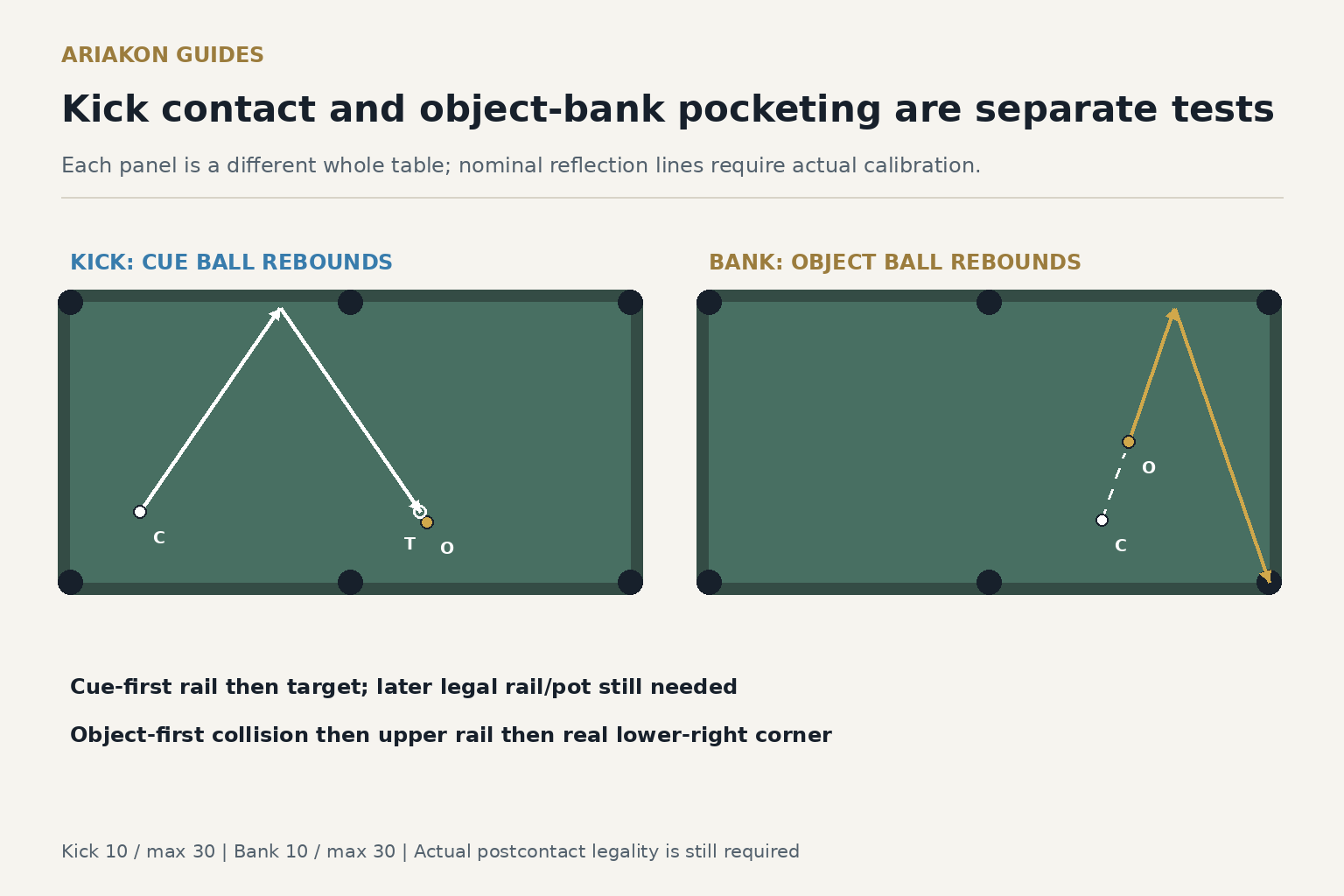
Name the ball that reaches the cushion
| Shot family | Ball contacting cushion | Primary success | Secondary evidence |
|---|---|---|---|
| Kick | Cue ball | Legal object-ball contact | Contact side and cue-ball finish |
| Bank | Object ball | Called pocket or target gate | Cue-ball control after collision |
| Combined position | Depends on chosen route | Legal shot under current rules | Miss consequence |
Calibrate the shared mirror-line reference before isolating the two result types in this drill.
Build the kick-contact lane
Coordinates are ball centers on an illustrative 100 by 50 inch bed: x=0..8 along length, y=0..4 across width, origin at the lower left cushion nose. One unit is 12.5 inches. For 2.25 inch equal balls, radius is 0.09 and diameter 0.18 units. Intact cushion center boundaries are x=0.09,7.91 and y=0.09,3.91; pockets interrupt the physical boundary at the four corners and (4,0),(4,4). Measure actual bed, balls and jaws before scaling. Remove every measuring aid before shooting; never mark a competition table.
Kick lane: cue C(2,1), intended postrail contact center T(6,1), upper center boundary y=3.91. Reflect T to V(6,6.82); the ideal rebound center is R(4,3.91). That is directly below the upper side pocket, so this symmetric lane is rejected. Instead use C(1,1) with T(5,1); R is(3,3.91), away from the mouth. Set object O=T+0.18(2,-2.91)/sqrt(2^2+2.91^2)=(5.101954,0.851658). Calibrate actual rebound from the intact upper cushion.
Call center contact and a cue rest disk radius 0.5 at(6,2). Use the object as the lowest ball in ordinary nine-ball practice. A precontact rail does not replace the postcontact rail/pot requirement. Reset after each of ten strikes; no physical target or helper ball stays on the cloth.
Build the bank-pocket lane
Bank lane is a separate setup: object O(6,2), upper center boundary y=3.91 and real lower-right P(8,0). Mirror P to V(8,7.82); the ideal object rebound is R(6.656357,3.91), physical nose(6.656357,4). Set intended cue-center G(5.941502,1.829771) and C(5.616513,0.884053), collinear with O toward R. Equal balls touch at G; no additional objects are present.
Take ten reset attempts with no intentional sidespin at one controlled pace. Score object-bank contact and pocket separately from cue rest. Real cushion response, induced object spin and jaws can change the ideal route; do not promise that center-height cueing eliminates them.
Score twenty attempts without mixing outcomes
| Lane | 0 points | 1 point | 2 points | 3 points |
|---|---|---|---|---|
| Kick | Known foul/wrong rail or no object contact | Legal contact, center call not met | Legal called center contact, finish disk missed | Legal center contact and called finish disk |
| Bank | Known foul or wrong required cushion | Correct cushion, called pocket missed | Correct cushion, jaw contacted without pot | Correct cushion and legal called pot |
Retain unknowns and two independent denominators
An unknown required event or finish makes the corresponding nested score unknown; keep visible events separately. Each lane has 30 possible points only when all ten scores are known. A known foul is 0 regardless of other hidden events. The two lanes are not simultaneous play or one shared physical layout.
Diagnose the first failed event
Twenty attempts have a maximum of 60 points. Pass a lane at 22 of 30 or better with at least eight correct cushion contacts. Keep the two subtotals. A 26-point kick result and 13-point bank result means the mirror reference is usable for cue-ball contact but object-ball bank delivery still needs work.
For a kick, inspect cue-ball start, rail target, speed and the called contact half. For a bank, inspect the cut into the object ball, transferred spin, object-ball rail point and pocket entry. Institutional billiards education material notes that speed, spin and table conditions alter rebounds and that banks add cut-induced spin effects not present in the same form on a simple rolling kick.
Use one controlled correction
| Pattern | Family | Change once | Hold fixed |
|---|---|---|---|
| Cue ball passes long of target | Kick | Move rail target a small measured amount | Speed and cue-ball start |
| Kick contacts wrong half consistently | Kick | Refine object-ball contact call | Rail target |
| Bank reaches rail but misses consistently | Bank | Test one small recorded aim or pace change | No universal short/long correction assumed |
| Bank direction varies | Bank | Restore object-ball hit and setup | Do not add sidespin |
Transfer the stronger family into a game choice
Create a legal layout where a blocker removes the direct pocket. Mark one kick contact route and one bank pocket route. Shoot five attempts of each from the same opening position, scoring 0 for a foul, 1 for legal contact, 2 for the called primary result and 3 for the result plus a safe next leave; maximum 30.
Choose the route whose misses are safer and whose isolated lane already passed. A bank is not automatically more aggressive and a kick is not automatically defensive; the layout, rules and leave decide.
Plan kick, jump or curve escapes when a kick competes with other legal escape families.
Sources and further reading
References support the specific factual information above. The practical checklists are Ariakon editorial guidance.