
Kick shots · 4 min read
A Numbered Two Rail Kick Worksheet With Table Calibration
A numbered two-cushion map needs an explicit rail order, a physical center boundary and a saved table condition. This worksheet numbers an upper-long-cushion then right-short-cushion route, constructs four fixed stations and records corrections without turning one table result into a universal formula.
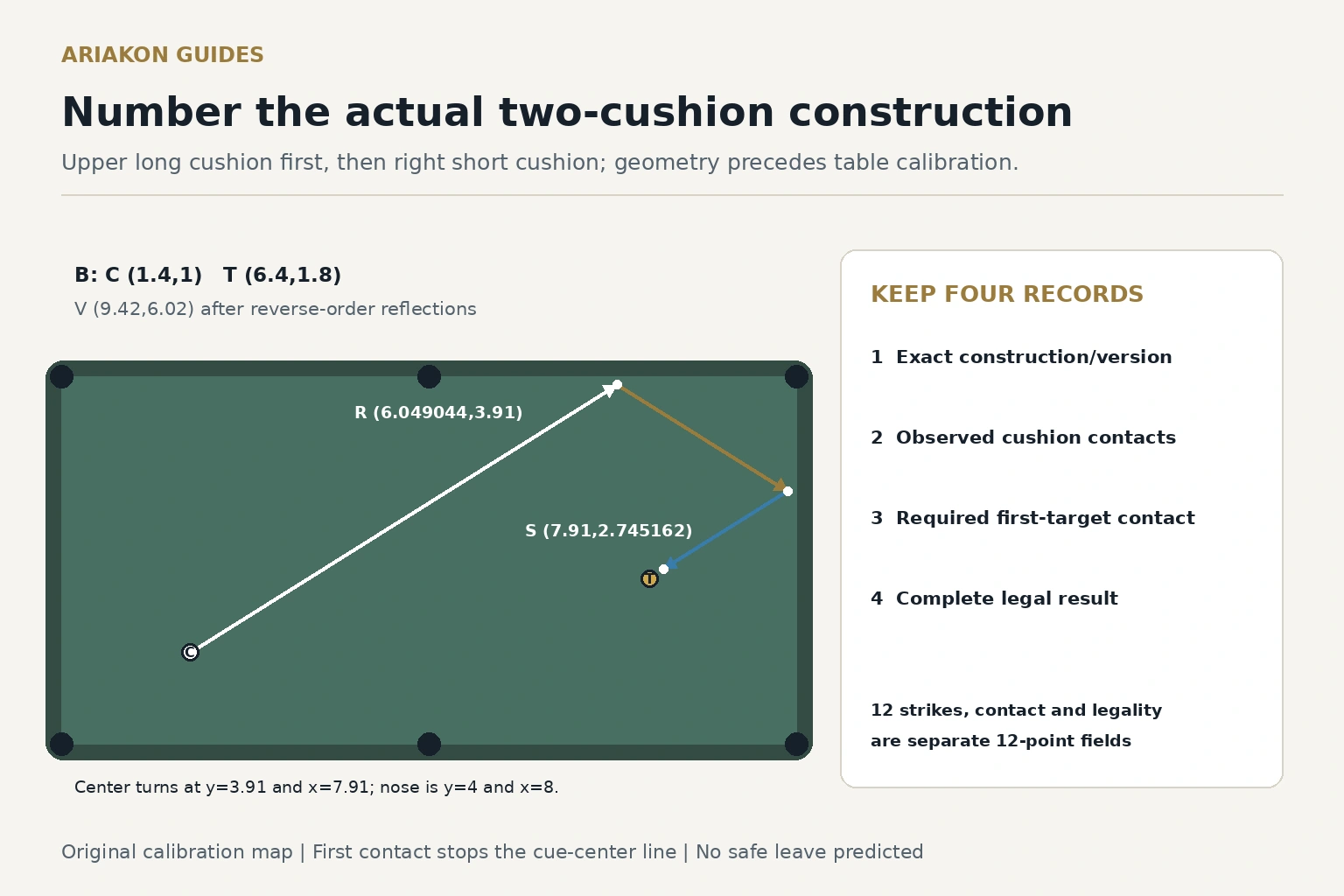
Number a measured center envelope
Use ball-center coordinates on an illustrative 100×50-inch bed represented by 8×4 units, origin lower-left at the cushion noses. Equal 2.25-inch balls have radius 0.09 and diameter 0.18. Intact center boundaries are x=0.09 or 7.91 and y=0.09 or 3.91. Real pockets interrupt the corners and side midpoints; inspect actual jaws. Scale to your measured bed and ball size and remove setup aids before play.
For this worksheet label upper-cushion nose locations by x and right-cushion nose locations by 4−y. One model unit is a diamond-length reference, not a promise about actual inlay placement. Keep exact calculated coordinates, approximate quarter-unit labels and measured real contacts in separate columns. The cue center turns one radius inside the nose; it does not strike an inlay or pass through a pocket opening.
Reflect in reverse order and prove which cushion comes first
Use C=(1.4,1.0), T=(6.4,1.8) for station B. The intended order is upper long cushion then right short cushion, then target. Reflect T over the second center boundary x=7.91 to(9.42,1.8), then over the first center boundary y=3.91 to V=(9.42,6.02). The straight C→V construction reaches y=3.91 at R=(6.049044,3.91), before x reaches 7.91. After folding, the second point is S=(7.91,2.745162).
The next ideal segment points down-left toward T and stops at first tangency G=(6.552576,1.895502), one diameter from T. Equal-angle reflection is an ideal model; speed, spin, cloth, ball condition and cushions still require observation. Reject a checkpoint inside actual pocket jaws rather than treating a missing cushion as intact.
Use the separate short-cushion-first construction when that is the route order the actual layout needs.
Rebuild four stations rather than reusing one correction
A,B,C share cue C=(1.4,1.0) and change only target height. D mirrors B by x→8−x, including cue, target and both checkpoints: its order is upper long then left short cushion. These are alternative active setups, not simultaneous targets. Begin with a familiar controlled rolling request and no intentional sidespin.
| Station | Cue / target | First R | Second S |
|---|---|---|---|
| A | (1.4,1.0) / (6.4,1.4) | (5.705941,3.91) | (7.91,2.420474) |
| B | (1.4,1.0) / (6.4,1.8) | (6.049044,3.91) | (7.91,2.745162) |
| C | (1.4,1.0) / (6.4,2.2) | (6.451558,3.91) | (7.91,3.069850) |
| D | (6.6,1.0) / (1.6,1.8) | (1.950956,3.91) | (0.09,2.745162) |
Record contact and later legality separately
Four stations×three strikes=12 baseline attempts. Record target-first after the stated cushions, complete legal outcome and actual cue finish separately. Under ordinary WPA rotation play, earlier kicking cushions do not satisfy a required cushion after object contact. Confirm the required first ball and all remaining foul conditions.
Use one point for established required target-first contact and one separate point for an established complete legal result. Maximum 24 applies only when both fields can be observed for all twelve strikes. A known foul earns no legal point; target-first can still be recorded factually. Unknown is listed outside that field’s observed denominator. Do not award a called contact half that could not be seen or an unspecified safe half of the table.
Save one signed correction for each frozen condition
Keep first and second observed contacts as signed coordinates and note the target miss side. If a direction repeats over three trials, test one small named first-cushion adjustment at that station; do not prescribe a universal quarter-diamond move or change all contacts at once. Three new strikes make 15 if the baseline was completed. Retain the original geometric line alongside the tested adjustment.
For a later speed comparison, label soft, medium and firmer as personal effort requests, not measured velocities. Add deliberate running spin only as another permitted controlled condition. Each condition needs its own actual attempts, observed path and saved correction; a successful isolated shot does not validate a general lookup.
| Station/version | Pace/spin request | Observed R / S | Target-first / actual | Complete legal / actual | Saved tested adjustment |
|---|---|---|---|---|---|
| ___ | ___ | ___ | ___ | ___ | ___ |
Use the map conservatively in games
Before an escape, inspect every segment for full ball-diameter blocker clearance plus observed scatter. The construction predicts neither the favorable side of contact nor a safe leave. Observe the opponent’s actual next view and scratch risks after a legal trial.
Recheck the same stations on a new table. Preserve each task’s rail order, condition and denominator; a right-short-first formula and this upper-long-first record are different constructions.
Extend a separately calibrated route to three cushions only when the actual layout requires it.
Separate contact from a defensive leave after complete legal contact is repeatable.
Sources and further reading
References support the specific factual information above. The practical checklists are Ariakon editorial guidance.