
Kick shots · 4 min read
Read Pool Table Diamonds for a One Rail Kick
Diamonds are fixed visual references around the table, not automatic aiming answers. For a simple rolling one-rail kick, mirror geometry gives a first rail line; speed, spin, cushion response and whether you sight the cushion nose or the rail diamond can move the real rebound. This guide teaches one labeling convention, one geometric start and a scored calibration that stays attached to a specific table.
Choose one coordinate convention
Coordinates are ball centers on an illustrative 100 by 50 inch bed: x=0..8 along length, y=0..4 across width, origin at the lower left cushion nose. One unit is 12.5 inches. For 2.25 inch equal balls, radius is 0.09 and diameter 0.18 units. Intact cushion center boundaries are x=0.09,7.91 and y=0.09,3.91; pockets interrupt the physical boundary at the four corners and (4,0),(4,4). Measure actual bed, balls and jaws before scaling. Remove every measuring aid before shooting; never mark a competition table.
Record coordinates from the same physical cushion noses throughout. Rail diamonds sit outside the ball-center envelope. Use their projections as references, not as an interchangeable impact point. Here all starts and intended contact centers are at y=2, an equal 1.91 units from reflecting center boundary y=3.91.
Use the broader one-rail calibration guide for speed, spin and bank-shot extensions after this reading exercise.
Build the mirror line, not a slogan
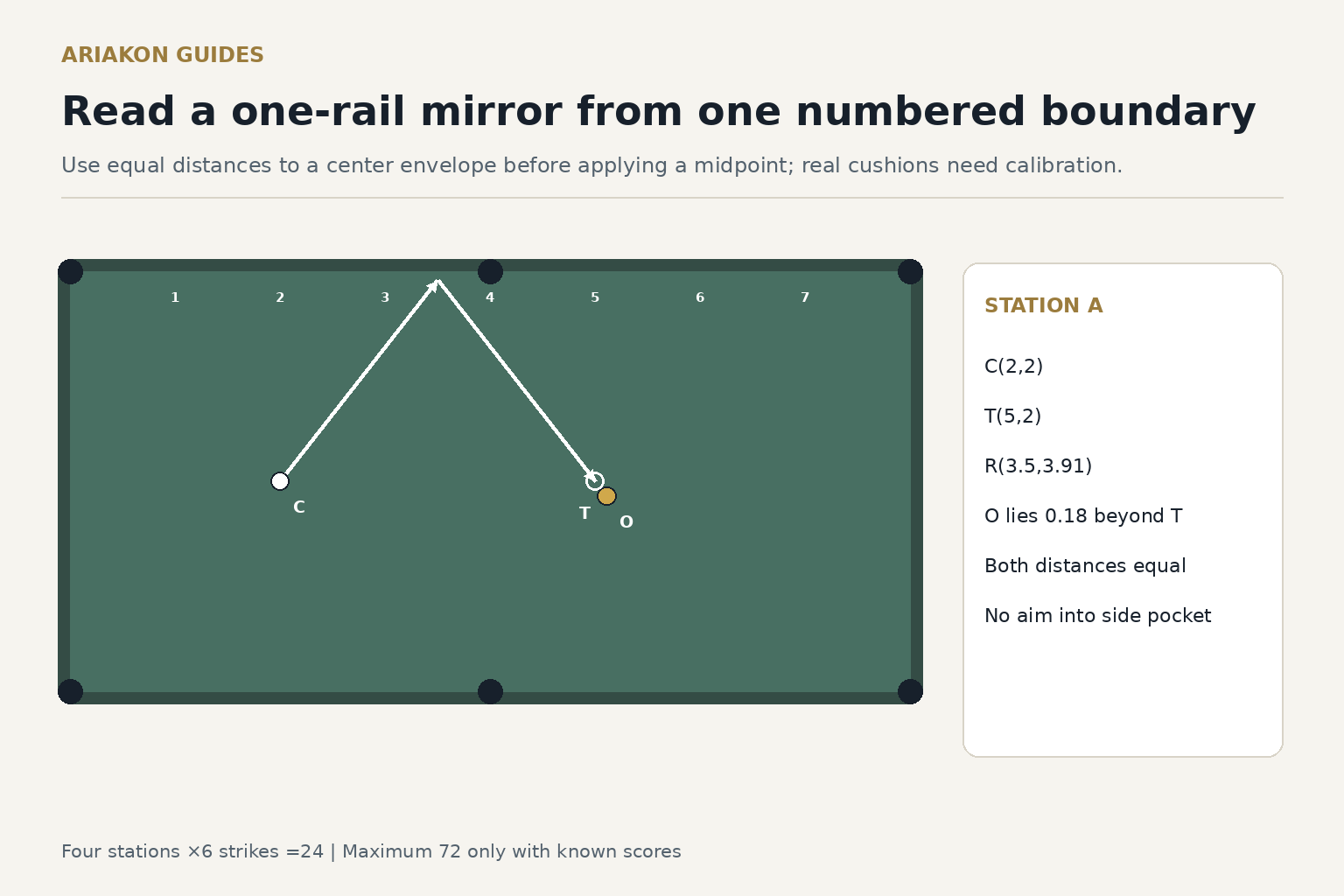
For station A use C(2,2) and intended target cue center T(5,2). Mirror T across y=3.91 to V(5,5.82). The C→V construction meets the center envelope at R(3.5,3.91), physical nose point(3.5,4), safely away from the side mouth at x=4. The midpoint 3.5 works because both perpendicular center distances are equal.
Let u=(T−R)/|T−R| and put the real target object at O=T+0.18u, approximately(5.111175,1.858437) for A. At first contact the cue center reaches T while the equal circles touch. Never use the object center as if the cue could travel through it. The ideal mirror ignores cloth/cushion effects and supplies no guaranteed hit.
Run four stations with fixed delivery
For every station use the same upper center boundary and place its real object 0.18 beyond T along that station’s terminal direction. Each row is a separate setup. Inspect real mouth/jaw extents before shooting; if any intended nose contact is obstructed, hold and rebuild that station. Call center contact and a cue-center rest disk radius 0.5 at(4,1), a chosen criterion rather than a predicted route.
Use the object as the lowest legal ball under ordinary nine-ball practice. A cushion before first object contact does not satisfy a required later rail or pot. No physical aiming marker remains on the table.
| Station | Start projection | Target projection | Geometric rail start | Attempts |
|---|---|---|---|---|
| A | C(2,2) | T(5,2) | R(3.5,3.91) | 6 |
| B | C(1,2) | T(4,2) | R(2.5,3.91) | 6 |
| C | C(3,2) | T(6,2) | R(4.5,3.91) | 6 |
| D | C(2,2) | T(7,2) | R(4.5,3.91) | 6 |
Score contact side and rail reading
| Result | Points | Record | Meaning |
|---|---|---|---|
| Known foul or wrong required rail | 0 | First failed event | No contact/finish bonus |
| Required rail; target missed | 1 | Signed miss at target | Not a complete legal object hit |
| Complete legal target contact | 2 | Contact side and actual finish | Known finish outside disk |
| Legal called center contact plus finish disk | 3 | Contact and cue-center rest | Chosen control success |
| Required evidence hidden | Unscored | Retain visible fields | Unknown is not zero |
Calculate a table-specific correction
Twenty-four attempts have a maximum of 72 points. At each station, shoot the first three at rolling medium-soft speed. If all valid misses pass the same side, move the rail reference by one-eighth diamond toward the correction and shoot three more. Record the signed correction beside the table, cloth date and speed label.
Pass a station only after at least four known complete legal object contacts among six actual strikes, all required evidence readable and no safety stop. A stable small correction remains attached to the table, input and setup. A same-side miss suggests a new bounded test; it does not prove which variable caused it. Unknowns reduce their own known denominator, and no high total waives a missing postcontact rail.
Diagnose the reference before adding spin
| Pattern | Inspect first | One change | Hold fixed |
|---|---|---|---|
| All misses long | Table rebound at chosen speed | Apply signed rail correction | Start, target and center-ball hit |
| All misses short | Same reference and cushion response | Apply opposite correction | Speed family |
| Alternating sides | Cue delivery and setup reset | Shorten distance and restore line | Do not add sidespin |
| First half passes, second drifts | Speed or table change | Restart the station | Do not average two conditions |
Transfer one calibrated number to a safety
Keep the target at the easiest passed station and add a blocker on the direct line. Call the same one-rail contact half and a broad cue-ball finish zone behind cover. Shoot five attempts, scoring 0 for a foul, 1 for correct rail, 2 for legal target contact and 3 for contact plus the called finish; maximum 15.
Use the table note only under a similar speed and spin condition. Recalibrate when cloth, balls, humidity or cushions change. The diamonds help you reproduce a reference; they do not remove the need to observe the table.
Sources and further reading
References support the specific factual information above. The practical checklists are Ariakon editorial guidance.