
Kick shots · 4 min read
Practice Short One Rail Kicks Near a Pocket
A short kick beside a corner pocket gives little distance after the cushion for an aiming error to spread out. Use a center-envelope construction first, then calibrate the actual hit. The rail before contact is not automatically the rail required after contact, and touching the target is not always a legal result.
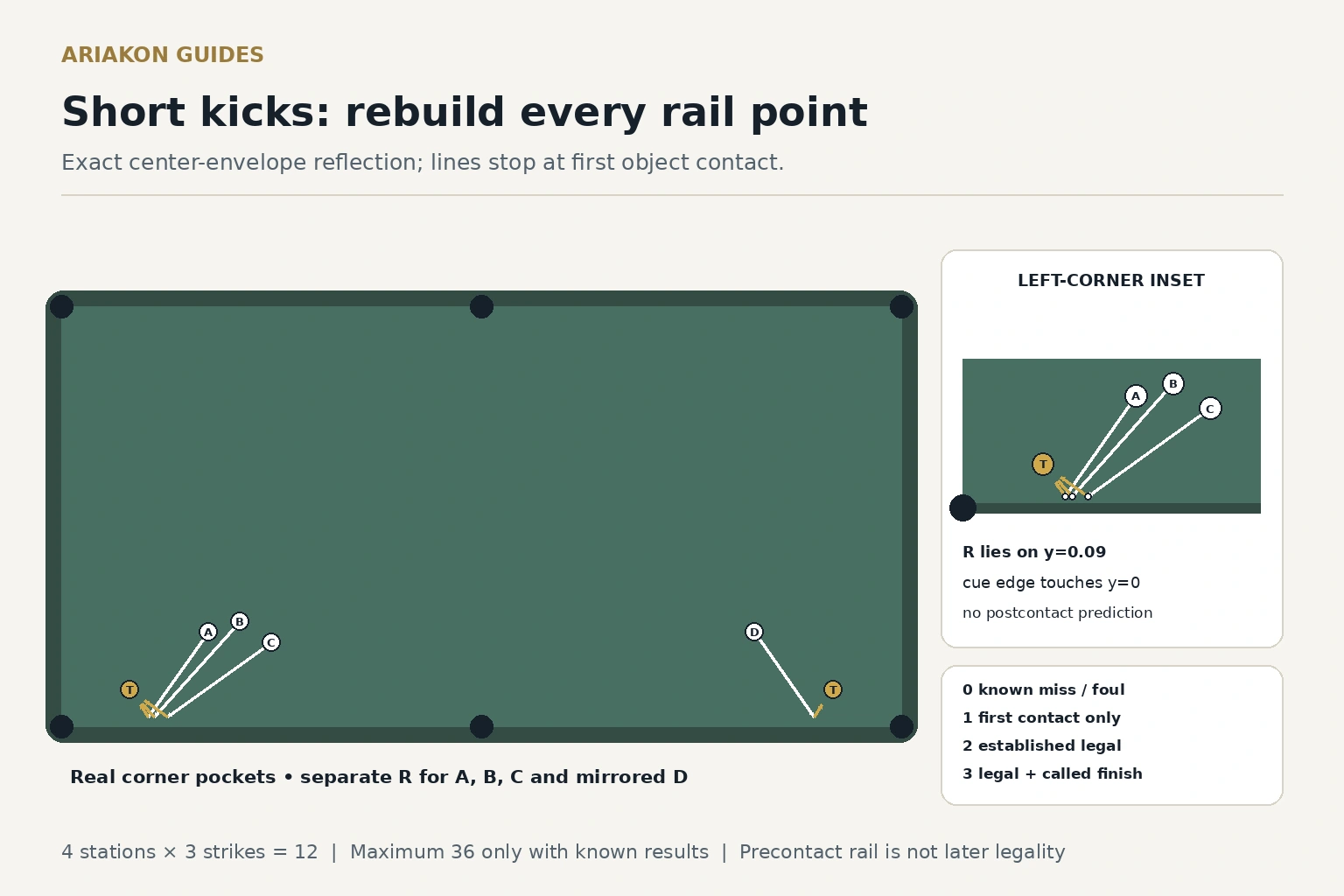
Set a near-pocket task rather than a full-table rebound
Use ball-center coordinates on an illustrative 100×50-inch bed: x=0..8 along the length, y=0..4 across it, origin at the lower-left cushion-nose corner. Equal 2.25-inch balls have radius 0.09 and diameter 0.18 units. Intact-cushion center limits are 0.09..7.91 and 0.09..3.91. Real pockets interrupt the boundary at four corners and (4,0),(4,4). Measure your actual bed, balls and pocket mouths before scaling. Remove measuring aids before shooting and never mark a competition table.
For A,B,C put the required object T at (0.65,0.35), separated from the lower cushion and lower-left pocket. There are no other balls during baseline. D mirrors A across x=4: T(7.35,0.35), near the real lower-right corner. In an ordinary rotation-rules example use the lowest remaining object; this is not a break or push-out.
Reflect T across the lower cue-center boundary H=0.09: V=(Tx,2H−Ty). Intersect C→V with y=H to obtain R. The ideal outgoing line R→T reaches first tangency at G=T−0.18×unit(T−R), before the cue center could reach T. The real cushion can differ with speed, spin and condition; record a correction rather than treating R as an exact universal aim.
Learn the general one-rail mirror construction before adding the short near-corner constraint.
Rebuild the rail point for each start
R is a cue-center location, not the rail-top diamond. The cue edge touches cushion nose y=0 at R. Check the actual mouth interrupts neither incoming nor outgoing leg; never aim at a missing cushion segment. None of these station points is a pocket mouth. Keep a comfortable stated pace and no intentional sidespin for baseline.
| Station | Cue C / target T | Cushion center R | First-contact cue center G |
|---|---|---|---|
| A | (1.4, 0.9) / (0.65, 0.35) | (0.832243, 0.09) | (0.753316, 0.202603) |
| B | (1.7, 1) / (0.65, 0.35) | (0.883333, 0.09) | (0.770224, 0.216036) |
| C | (2, 0.8) / (0.65, 0.35) | (1.011856, 0.09) | (0.796179, 0.244968) |
| D | (6.6, 0.9) / (7.35, 0.35) | (7.167757, 0.09) | (7.246684, 0.202603) |
Score only the event you can establish
For A,B,C call cue-center finish rectangle x=0.3..2.3,y=0.3..1.5; D uses x=5.7..7.7,y=0.3..1.5. These rectangles are observation preferences, not predicted safe routes. If target-first itself cannot be established, mark unknown outside the numerical score and list it. One point is not a declaration that the shot was legal.
If no ball is pocketed, an ordinary WPA shot needs a ball driven to a rail after object contact. The earlier kick rail does not suffice. Inspect actual contact, later rail/pocket, fouls and final center separately. Do not award a called thin/full fraction from a vague image or infer contact from where the cue ball eventually stops.
| Score | Established result |
|---|---|
| 0 | Missed required first object, scratch or another known foul |
| 1 | Required first object contacted; complete later legality not established |
| 2 | Required first object plus the required later rail/pocket event, with no other foul |
| 3 | Score 2 plus cue center resting in the separately called finish region |
Calibrate a signed rail adjustment before adding force
Record actual miss side as smaller-x or larger-x of the required target at the near-target crossing. Keep the original R, new trial R and pace request. A short segment makes visual placement and speed error important; a small R change need not equal the same-size target change. No canned correction is prescribed.
Hypothetical station A has scores 2,3,1: six points out of a possible nine, with only two completely established legal outcomes. An unknown station-B attempt stays one unknown, not zero or three; show numeric subtotal over the eleven scored attempts and its maximum 33, plus that missing observation.
Add a real blocker as a separate five-shot transfer
Reset A and add blocker B(0.8,0.46). It lies on direct C→T, so a straight target approach is blocked. Its center is more than one diameter from both ideal kick segments C→R and R→G, so those legs clear it geometrically. Recheck on the actual table and do not confuse centerline clearance with a universal scratch-safe outcome.
Take five new attempts with the same legal-outcome fields. Seventeen total strikes occur only if the twelve baseline and five transfer attempts finish. The final leave determines whether this was a useful reply; successful first contact alone does not. The general kick/bank calibration and defensive-reply guides answer separate broader questions.
Calibrate kick and bank tasks separately when speed or rebound behavior changes.
Evaluate the actual defensive reply after legal contact is established.
Sources and further reading
References support the specific factual information above. The practical checklists are Ariakon editorial guidance.