
Specialty shot control · 5 min read
Control Jump Shot Landing Distance With a Scored Progression
A blocker can be cleared while the first landing is still wrong. Measure those two events independently, using open cloth and a previously learned legal stroke. This resource advances landing-distance observation; it does not teach a beginner to launch a jump, rank jump cues or promise a ballistic path from a cue angle.
Confirm a controlled prerequisite, then freeze the input
Confirm room permission, actual game and equipment restrictions, sound assembly and supervised controlled launch competence before this progression. The WPA general jump definition is an elevated cue driving the cue ball down into the surface so it rebounds. Intentional scooping is not this method; some disciplines prohibit jumping. Stop for cloth contact, unstable support, uncontrolled flight or any ball leaving the table.
Use one familiar permitted cue, bridge, intended contact and comfortable delivery. Record the input; do not prescribe a new high-force stroke to reach a farther window. Place cameras and people clear of all paths, with recording permission. Do not leave targets or protective objects on the cloth without the owner/instructor’s explicitly approved setup.
Complete the safe jump foundation first because this progression assumes controlled launch competence.
Use launch and clearance troubleshooting separately when clean clearance itself is failing.
Define first landing with non-overlapping boundaries
Coordinates describe ball centers on an illustrative 100×50-inch bed: x=0..8 along the length, y=0..4 across the width, origin at the lower-left cushion-nose corner. Equal 2.25-inch balls have radius 0.09 and diameter 0.18 units. Intact-cushion center limits are 0.09 and 7.91 in x, 0.09 and 3.91 in y. Pockets interrupt these limits at the four corners and at (4, 0),(4, 4). Inspect actual mouths and jaws; scale to the measured bed and actual ball size. These are not universal diamond coordinates. Remove measuring aids before a shot; do not mark a competition table.
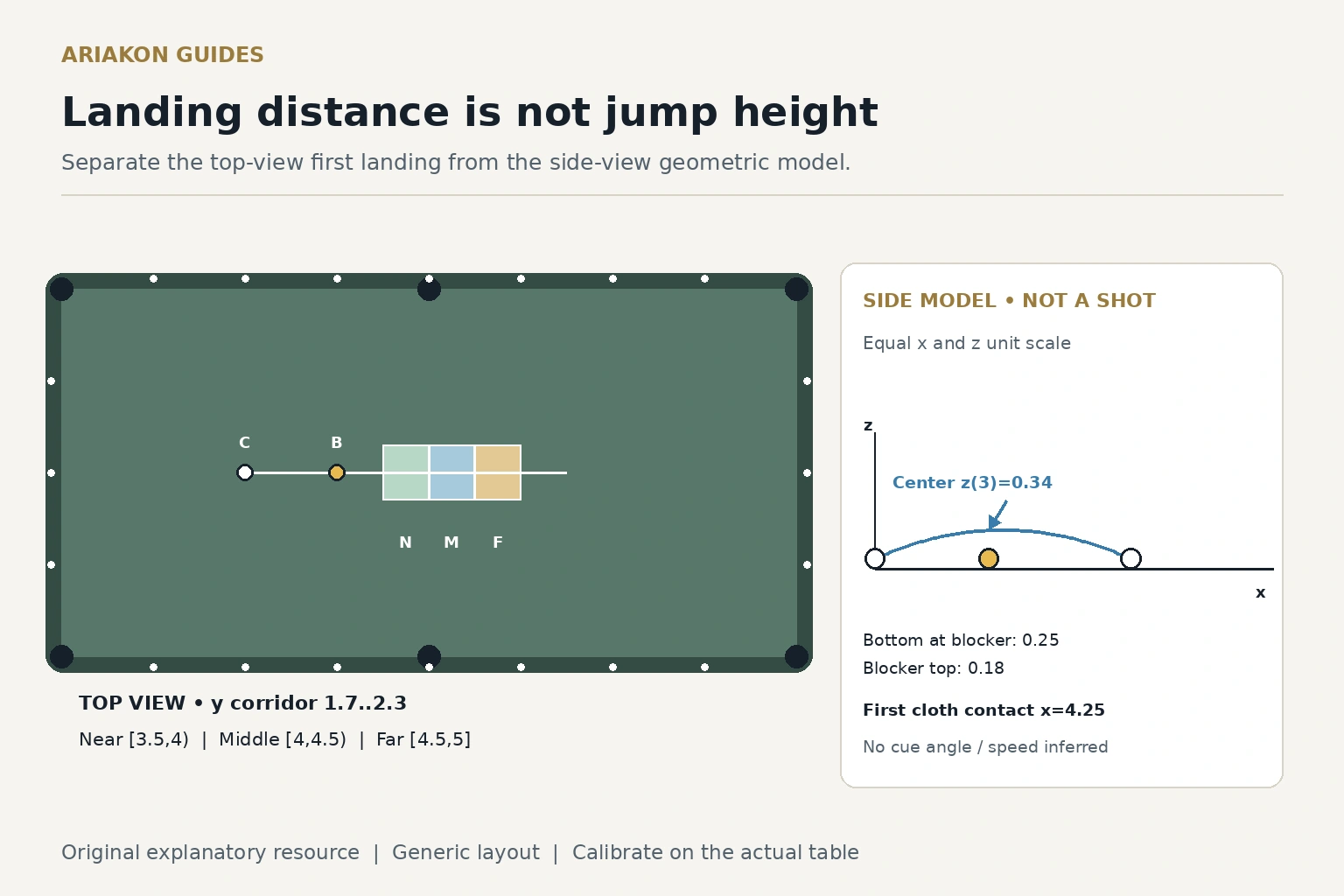
Put C(2, 2) and blocker B(3, 2) on the long centerline. No target object is used in the baseline. Observe the cue ball’s first return to cloth after launch, not its final resting position or a second bounce. Landing means the center’s vertical projection at that first bottom-to-cloth contact.
Use a common corridor 1.7≤y≤2.3. Near is 3.5≤x<4.0; middle 4.0≤x<4.5; far 4.5≤x≤5.0. An exact boundary at 4.0 belongs only to middle, and 4.5 only to far. Landing before 3.5 or beyond 5.0 is outside all windows. Unresolvable video remains unknown, not a made-up exact coordinate.
| Block | Called first-contact window | Attempts | Maximum points |
|---|---|---|---|
| Near | [3.5, 4.0), corridor 1.7..2.3 | 10 | 40 |
| Middle | [4.0, 4.5), same corridor | 10 | 40 |
| Far | [4.5, 5.0], same corridor | 10 | 40 |
Separate a geometric illustration from a real stroke
The diagram’s side model uses x from 2 toL=4.25, center height z(x)=0.09+0.20×(x−2)×(4.25−x), with z=0 at cloth and ball radius 0.09. Center height at blocker x=3 is 0.34, so the cue ball’s bottom there is 0.25, above the blocker’s top 0.18. The first return to center height 0.09 is x=4.25. The full center-distance check also stays above the 0.18 collision separation.
That constructed curve proves only that this illustration clears a same-size blocker and lands in the middle window. It is not a physical prediction: launch, cloth rebound, spin, drag and secondary bounces have not been measured. It supplies no cue elevation, speed or device result. Use actual observed landings for the score.
Apply the safety gate before awarding landing points
Replace the cue and blocker after every strike, and call the window before address. Complete ten attempts at the easiest controlled window before expanding. A clean middle landing when near was called can earn clearance and corridor points, but not the window points: 2/4 rather than 4/4.
A hypothetical completed ten-trial block has 10 clearances, 7 correct windows and 8 corridor outcomes: 10+2×7+8=32/40. These are original practice criteria. Advance only after all ten are safely clear, at least seven meet the called window and the score is at least 30, repeated on another day. If stopped after four strikes, use four actual attempts and report the hold, not six assumed failures.
| Field | Points | Gate |
|---|---|---|
| Clean clearance | 1 | Permitted controlled launch; no blocker clip, scoop, cloth strike or off-table ball |
| Called x window | 2 | Clean clearance and observed first contact in the called x interval |
| Center corridor | 1 | Clean clearance and observed first contact within 1.7..2.3 |
| Clip/foul/unsafe result | 0 overall | Record cause; unsafe delivery ends the session |
| Unobserved landing | Unknown fields | Do not silently award or convert unknown into failure |
Choose one adjustment from a repeatable error
A short or long first landing can reflect launch input, elevation, strike location or observation error. Verify the frozen setup and camera first. Under the instructor’s safe limits, test one small input change, then repeat the same called window. Do not treat a shallow angle or harder effort as a universally safe distance correction.
Side scatter needs a line/contact check; blocker clipping belongs to clearance, not to the landing-distance lesson. Stop and return to the prerequisite when that condition fails. Repeated unknown first contacts require a better permitted view or a simpler observation task, not more jumps.
Add target contact only after the window repeats
For a separate five-shot transfer, put the lowest required target on y=2, half a unit beyond the passed window’s upper x edge:near target (4.5, 2), middle (5, 2), far (5.5, 2). Keep C and B fixed. Call the first landing window; observe target first contact and any required later rail or pot separately. The target is at least 0.5 units beyond the window, more than a ball diameter, but actual post-landing direction still needs control.
Five target contacts are not five legal shots unless all rule conditions were met. Keep transfer counts separate from the thirty baseline strikes. A poorly repeatable far window remains a practice question; compare the kick before selecting it in a match.
Choose the full escape with its consequences instead of selecting jump solely because the blocker was cleared.
Sources and further reading
References support the specific factual information above. The practical checklists are Ariakon editorial guidance.