
Aiming · 4 min read
Aim Moderate Cut Shots With a Ghost Ball Reference
A ghost-ball reference turns a moderate cut into a center-to-center geometry problem. The imaginary cue-ball position is the place the real cue ball must occupy at impact to send the object ball along the chosen pocket line. It is a starting reference, not a guarantee: throw, speed, spin, cut direction and delivery can shift the result. This exercise makes the construction visible, tests it at three moderate angles and uses signed misses to choose one correction.
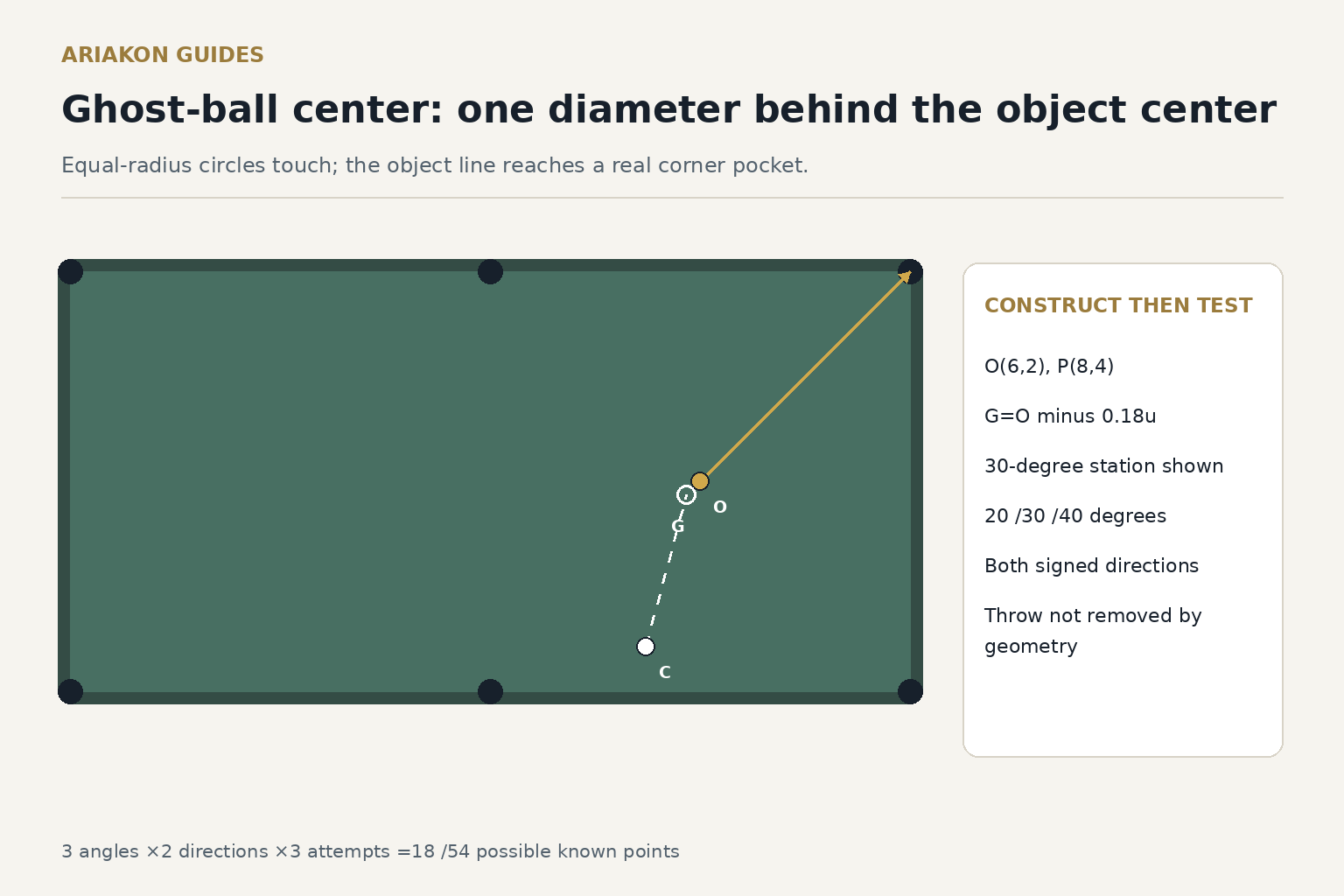
Construct the reference from the pocket backward
Choose the center of the pocket opening as the target. Draw an imaginary line from that target through the center of the object ball. The object-ball contact point is on the back of the object ball along that line. Continue one cue-ball radius farther to locate the ghost-ball center.
The ghost reference is the imaginary cue-center position at first object contact. A beginner construction ignores throw; a more complete reference adjusts the required ghost-ball position for throw while squirt and swerve affect the cue ball's path to that position. Begin with center-ball cueing and a medium personal speed so those extra variables stay bounded.
Use the separate thin-cut progression when the overlap becomes small and the margin for error narrows.
Mark three moderate cut stations
| Station | Approximate cut | Cue-ball distance | Attempts | Primary observation |
|---|---|---|---|---|
| A | About 20 degrees | 1 diamond | 3 left + 3 right | Ghost center and pocket entry |
| B | About 30 degrees | 1.5 diamonds | 3 left + 3 right | Signed miss side |
| C | About 40 degrees | 2 diamonds | 3 left + 3 right | Alignment under smaller overlap |
Set each shot from the object ball
Coordinates are ball centers on an illustrative 100 by 50 inch bed: x=0..8 along length, y=0..4 across width, origin at the lower left cushion nose. One unit is 12.5 inches. For 2.25 inch equal balls, radius is 0.09 and diameter 0.18 units. Intact cushion center boundaries are x=0.09,7.91 and y=0.09,3.91; pockets interrupt the physical boundary at the four corners and (4,0),(4,4). Measure actual bed, balls and jaws before scaling. Remove every measuring aid before shooting; never mark a competition table.
Fix O(6,2), real upper-right P(8,4) and G(5.872721,1.872721). Unit object direction u=(1,1)/sqrt(2). For signed cuts ±theta use incoming e=(cos(45°±theta),sin(45°±theta)); set C=G−d e. Stations(theta,d) are(20°,1),(30°,1.5),(40°,2). Take three left and three right at each station,18 strikes overall. The centers at contact are exactly one diameter apart, not one radius.
Use a helper ball only to inspect the imagined tangent position before the attempt, with table-owner permission, then remove it and all other measuring aids. Use comfortable ordinary no-intentional-sidespin delivery and check actual pocket jaws. Real throw can shift the ideal object direction.
Score geometry before speed or position
| Result | Points | Record | Meaning |
|---|---|---|---|
| Foul or wrong object-ball contact | 0 | First failed event | Delivery invalid |
| Correct pocket side; misses outside jaws | 1 | Overcut or undercut | Reference direction found |
| Called pocket contacts a jaw | 2 | Near or far jaw | Small signed error |
| Clean called pocket | 3 | Entry half | Usable reference |
Require mirrored evidence
Eighteen attempts have a maximum of 54 points. Pass a station at 13 of 18 or better across its six attempts, with at least two clean pockets in each cut direction. Keep left-cut and right-cut subtotals; a result that works only one way can indicate alignment or visual bias rather than a complete aiming reference.
If four or more valid misses at a station are undercuts, move the delivered cue-ball center slightly toward a thinner hit and repeat three shots. If they are overcuts, move toward a fuller hit. If misses alternate, restore setup and stroke line instead of changing the ghost-ball construction.
Diagnose the first failed event
| Pattern | Inspect first | One correction | Hold fixed |
|---|---|---|---|
| Both directions undercut | Ghost center and throw | Test one small thinner offset | Speed and center-ball hit |
| Both directions overcut | Ghost center placement | Test one small fuller offset | Object-ball location |
| Only one direction misses | Vision center and stance entry | Rebuild standing alignment | Target line |
| Miss side alternates | Cue delivery | Shorten the shot and pass a cue-line gate | Do not add sidespin |
Transfer one passed angle into position play
Choose the hardest passed station and add a two-diamond-wide cue-ball destination zone. Shoot five attempts with one natural rolling route. Score 0 for a foul, 1 for the correct object-ball side, 2 for the pocket and 3 for the pocket plus destination zone; maximum 15.
Keep the ghost-ball line as the object-ball solution and treat the cue-ball route as a second decision. If position spin changes the pocket result, return to the center-ball baseline and measure the adjustment rather than abandoning the construction.
Sources and further reading
References support the specific factual information above. The practical checklists are Ariakon editorial guidance.