
Aiming · 3 min read
Measure Pool Pocketing Accuracy by Distance and Cut Angle
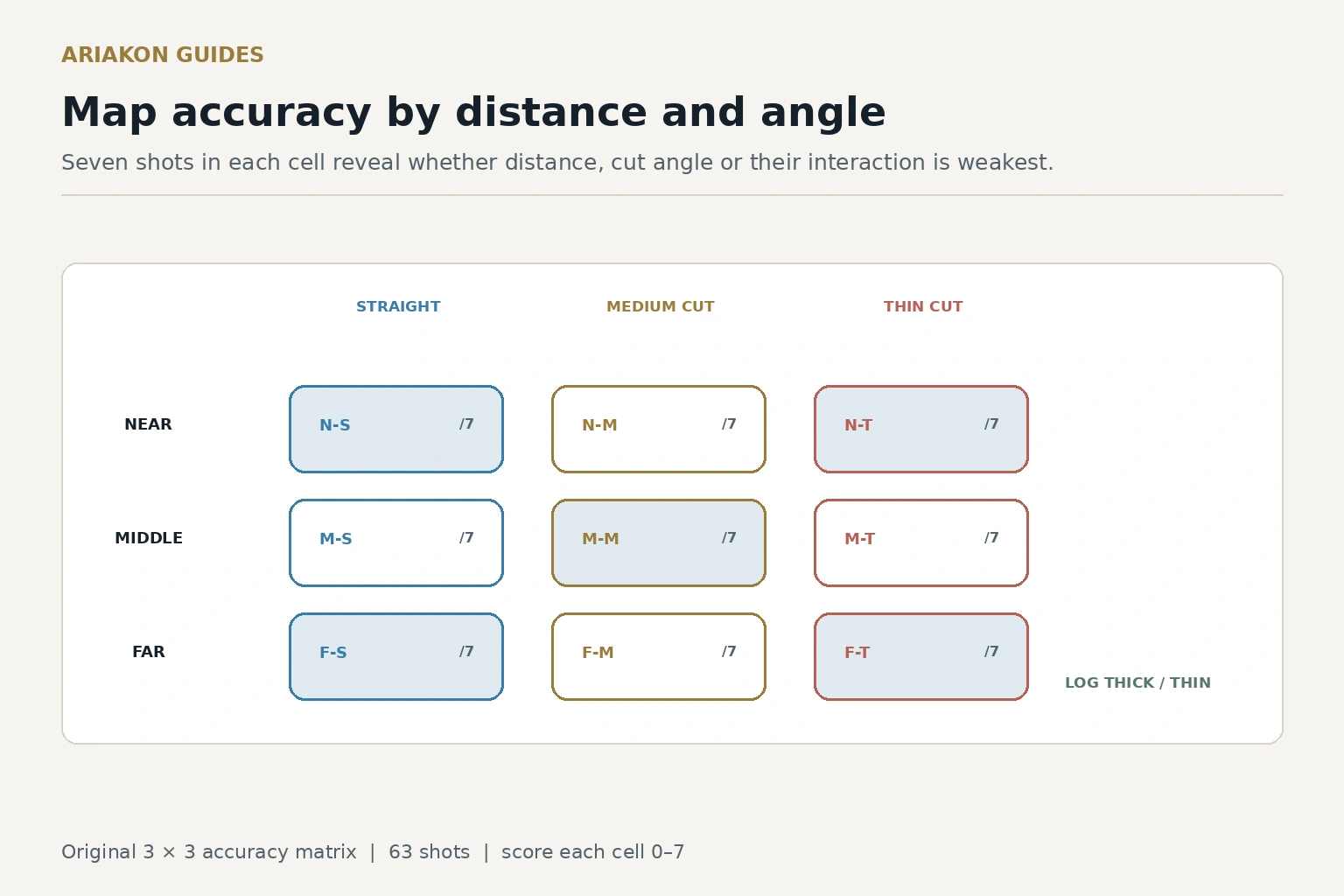
A single make percentage can hide the shot that needs work. A player may pocket short thin cuts and long straight shots but struggle with medium cuts at distance. This matrix holds the pocket and object-ball line steady while testing three cue-ball distances across three cut-angle bands. It creates a session-specific map, not a permanent player rating.
Build three angle lanes to one pocket
Use one foot corner throughout. Place the object ball about one diamond from the foot rail and one diamond from the long rail, on a line to the chosen pocket. Mark three cue-ball approach lanes: straight behind the object-ball-to-pocket line, a medium-cut ray and a thinner-cut ray from the required ghost-ball center. Exact cut angles depend on table geometry; label the lanes straight, medium and thin rather than claiming degree measurements.
Choose three fixed approach rays at about 0, 25 and 45 degrees to the object-ball-to-pocket direction. On each ray, mark cue-ball starts one, two and three measured diamond units behind the same required ghost-ball center. Distances are measured along the ray so cut angle stays fixed while distance changes. If a mark falls off the playing surface or creates rail interference, move the entire setup inward while preserving the ordered distances. Use center-ball rolling contact at one comfortable speed.
Check shot alignment before mapping misses when misses alternate unpredictably or the cue does not start on the intended line.
Compare aiming references after the baseline only after the weak distance-angle cell is known.
Shoot a nine-cell matrix
Complete cells in a rotating order—N-S, M-M, F-T, N-M, M-T, F-S, N-T, M-S, F-M—so fatigue does not always fall on the same angle. Replace each ball exactly and do not practice a miss between scored attempts.
| Cue-ball distance | Straight lane | Medium-cut lane | Thin-cut lane |
|---|---|---|---|
| Near: about 1 diamond | Cell N-S | Cell N-M | Cell N-T |
| Middle: about 2 diamonds | Cell M-S | Cell M-M | Cell M-T |
| Far: about 3 diamonds | Cell F-S | Cell F-M | Cell F-T |
Score makes and signed misses
Each cell is 0–7; the matrix maximum is 63. Record the miss side from the shooter's intended cut, not from a camera view. If thick and thin are confusing, use left and right and keep that convention for the whole session.
| Outcome | Score | Log |
|---|---|---|
| Clean pocket in called corner | 1 | Make |
| Misses pocket on thick side | 0 | Thick |
| Misses pocket on thin side | 0 | Thin |
| Miscue, foul or setup disturbed | 0 | Invalid execution; do not replace attempt |
Read the pattern before choosing a fix
| Pattern | What it suggests | Next isolated block |
|---|---|---|
| Scores fall mainly with distance | Longer delivery/alignment changes | Ten straight shots at the weakest distance |
| Scores fall mainly with thinner cuts | Cut reference changes | Ten shots at the weak angle from the near mark |
| One cell alone is weak | Interaction of that distance and angle | Repeat only that cell another day |
| Miss sides alternate in most cells | Baseline is noisy | Simplify speed and review alignment |
| One miss side dominates a row or column | Consistent reference or delivery bias | Keep setup; test one aiming or alignment change |
Work the numbers without overclaiming them
Worked example: near cells score 7, 6 and 5; middle cells score 6, 4 and 4; far cells score 5, 2 and 2. Ten of the far-angle misses are thick. The useful conclusion is that distance plus cut angle is the current weak condition. The next session repeats F-M and F-T for seven attempts each before changing technique. It does not claim a 65-percent true ability from one session.
Table size, pocket geometry, cloth, balls, speed and setup accuracy affect the results. Record those conditions and compare the same matrix only when they are reasonably similar.
Transfer the weakest cell to a decision
Add one next ball after the weakest cell. Play six attempts and call either the original pocketing route or a safety before standing down. Award 1 for the correct legal first contact, 1 for the chosen outcome and 1 for executing the called option; maximum 18. The transfer score stays separate because it adds position and strategy to a pocketing measure.