
Aiming · 3 min read
How to Make Thin Cut Shots More Consistently
Thin-cut practice needs a defined angle, not an arbitrary step farther outside after a miss. Keep one object and pocket fixed, change the incoming direction in named steps, and record the price paid in speed and cue-ball travel. A successful pot is useful only when the next consequence is tolerable.
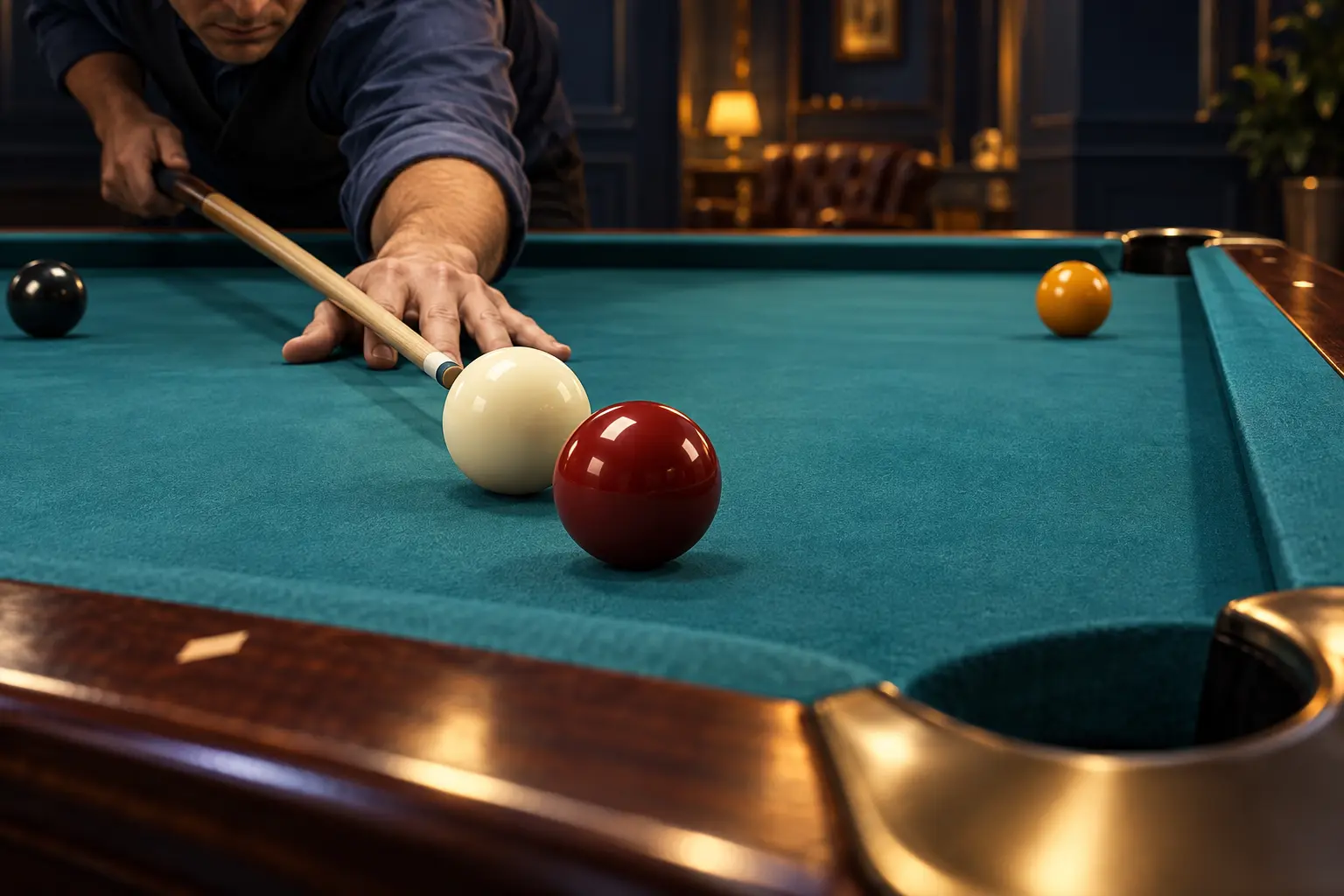
Hold the pocket line and finite contact fixed
Use ball-center coordinates on an illustrative 100×50-inch bed: x=0..8 along the length, y=0..4 across it, origin at the lower-left cushion-nose corner. Equal 2.25-inch balls have radius 0.09 and diameter 0.18 units. Intact-cushion center limits are 0.09..7.91 and 0.09..3.91; real pockets interrupt the boundary at four corners and (4,0),(4,4). Measure your actual bed, mouths and balls before scaling this example. Remove all measuring aids before shooting; do not mark a competition table.
Use O(6,3), real corner P(8,4), unit normal n=(2,1)/√5 and G(5.839003, 2.919502). Each cue center is 1.2 units behind G on a unit incoming direction made by rotating n through the listed angle. The angle is a friction-free geometric cut; actual throw can alter the object direction.
All six starts lie inside the center envelope and produce first tangency at G without entering the object earlier. Mirror the incoming angle about the object line to compare both cut directions without changing the target pocket. No numbered aiming code, downloaded angle template or proprietary drill is relabeled here.
| Geometric angle | Cue center C |
|---|---|
| 30° | (5.177815, 1.918087) |
| 45° | (5.45953, 1.781082) |
| 60° | (5.767105, 1.721657) |
| -30° | (4.641159, 2.9914) |
| -45° | (4.700583, 3.298975) |
| -60° | (4.837589, 3.580689) |
Keep each block diagnostically simple
Use four attempts per start: twenty-four baseline strikes. Begin with ±30°, then ±45°, then ±60°. Reset C and O, use no intentional sidespin and a familiar near-level delivery. Record the pace request for each block; change only enough to carry the object to the pocket safely.
A thinner collision generally transfers less forward speed to the object. More cue-ball speed can create a much longer cue-ball route. Do not hide a scratch or uncontrolled travel behind a pot count. Stop when delivery or safety fails; an incomplete block stays incomplete rather than receiving hypothetical results.
Check repeatable throw separately instead of attributing every thin-cut miss to one effect.
Record the first visible failure
Use pot count out of actual attempts, not out of planned attempts when the block stops. Choose a practice progression threshold of three pots out of four with no scratch before extending difficulty next session. That threshold is a personal training gate, not a match runout probability.
| Column | Allowed observations |
|---|---|
| Object | Pot, miss, contact failure or unknown |
| Miss direction | Signed side relative to the stated pocket line; unknown when unresolvable |
| Travel | Reached pocket area or died short; note the requested pace |
| Cue consequence | Safe finish, scratch, collision or unknown |
| Delivery | Repeated approach issue visible or not established |
Work the ladder before changing the aim
Hypothetical counts for +30,+45,+60 are 4/4,3/4,1/4; mirrored −30,−45,−60 are 3/4,2/4,1/4. Together that is fourteen pots out of twenty-four, but the aggregate hides the weaker side and the failed thin angle. Revisit −45° before simply increasing speed at ±60°.
If two misses die short but the pocket line is consistent, test travel speed as its own variable. If both reach the pocket area on the same wrong side, inspect approach and contact before a small aim retest. Scattered misses give no reliable compensation direction.
Transfer only after considering the cue-ball cost
Add four separate attempts at one passed angle with a called cue-center finish region selected from the actual observed route. That makes twenty-eight strikes if all baseline blocks were completed. Do not move another target into that region and assume collision clearance; check all ball diameters and scratch openings first.
If the same thin pot requires pace that repeatedly scratches or misses the useful region, compare another pocket or a legal defensive choice. The ladder measures execution under fixed geometry; it does not command attacking every difficult cut.
Reconcile the pot and cue-ball tasks before lowering into a match shot.
Compare the eight-ball dependency ledger when a low-margin pot removes a future option.
Sources and further reading
References support the specific factual information above. The practical checklists are Ariakon editorial guidance.