
Pool strategy · 4 min read
Play Smarter Eight Ball With Better Decisions
A good eight-ball decision is more specific than choosing an easy pot. Write what the shot keeps available, what it removes and what must be solved before the eight. This ledger makes that tradeoff inspectable without assigning invented runout percentages or pretending one pattern is best for every player.
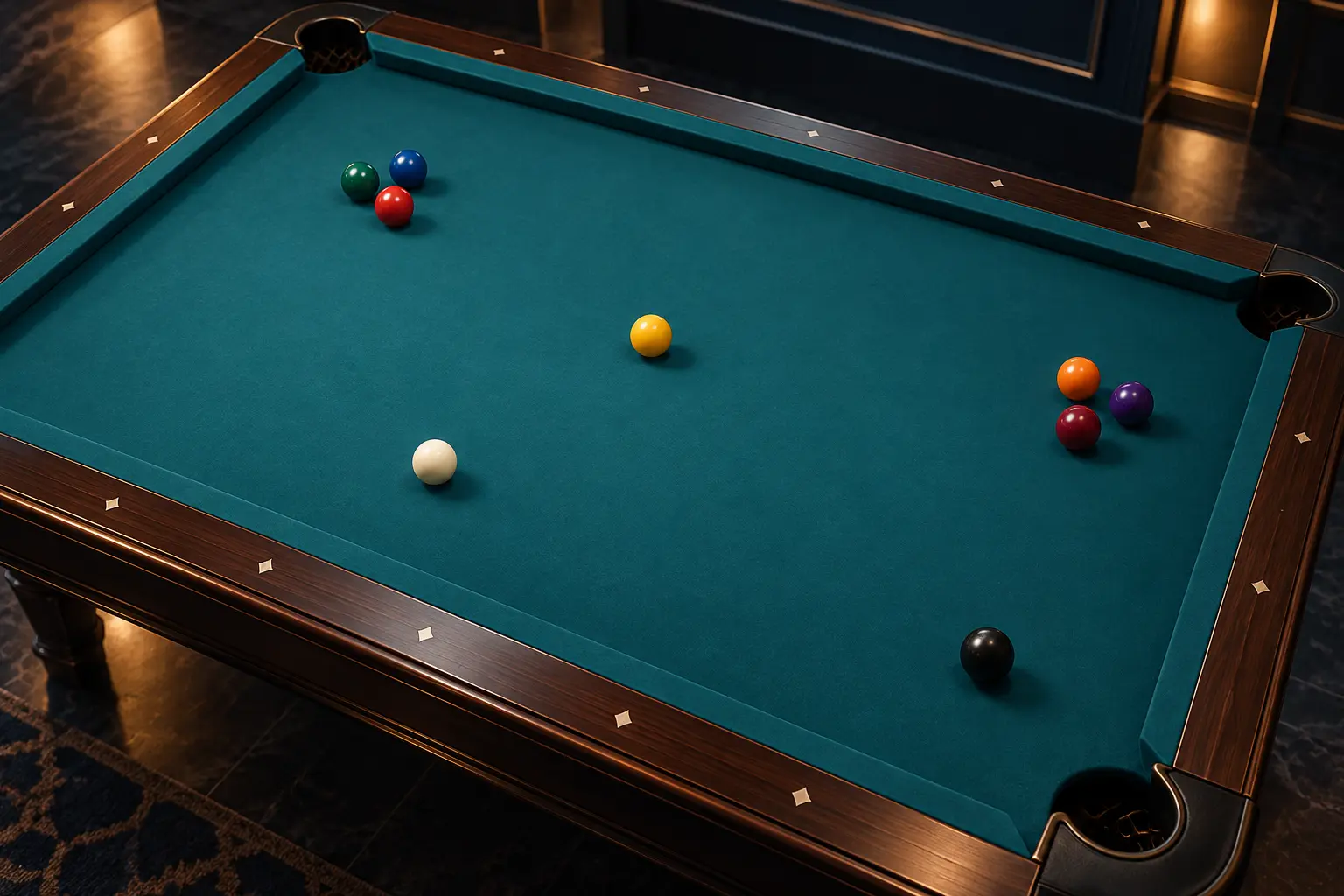
Establish the rule state before selecting a group
This resource uses WPA call-shot eight-ball, not every house or league variation. A legally called pot determines the group while the table is open; pocketing a ball on the break alone does not do that. Once assigned, first contact must satisfy the group rule. A declared safety ends the turn even if an object ball falls; it still needs a legal shot.
Check the organizer’s adopted version and local differences. The worked layout is a practice reconstruction after the break, not a legal rack arrangement or a substitute for asking a referee about uncertain contacts.
Review a broader practical training plan if basic called shots and legal contact are not yet repeatable.
Set a small layout with a visible dependency
Use ball-center coordinates on an illustrative 100×50-inch bed: x=0..8 along the length, y=0..4 across it, origin at the lower-left cushion-nose corner. Equal 2.25-inch balls have radius 0.09 and diameter 0.18 units. Intact-cushion center limits are 0.09..7.91 and 0.09..3.91; real pockets interrupt the boundary at four corners and (4,0),(4,4). Measure your actual bed, mouths and balls before scaling this example. Remove all measuring aids before shooting; do not mark a competition table.
Use C(2,1), solids 1(3,1), 2(6,3), stripes 9(4,1.6), 10(2,3), and 8(7,1). Treat other balls as already pocketed and the table as open for this practice question. Remove and replace the five objects and cue ball for each trial.
The line from 1 to upper-right P(8,4) passes exactly through 9, so that particular object-ball path is blocked. This does not make the 1 unpocketable in every pocket. The 2 has a clear object line to P before cue-ball access is considered. Check finite ball widths, not centerline crossings alone. The black ball’s later pocket and cue-ball access still require an actual leave.
Write two candidates before committing
These are candidates, not commanded cue inputs or complete predicted routes. For each, stand on the intended object line, locate its ghost center one diameter behind the object, then check cue access and likely scratch corridors. Add a third option for the stripes or a legal safety if both offensive plans have unresolved dependencies.
| Field | Candidate A | Candidate B |
|---|---|---|
| Opening ball and pocket | 1 to lower-right corner | 2 to upper-right corner |
| What remains | 2, then 8 if solids established | 1, then 8 if solids established |
| Unresolved question | Actual leave to 2; then approach to 8 | Which accessible pocket and approach solve 1? |
| What not to assume | A made 1 guarantees shape | The easiest visible object line is the best whole pattern |
Score the plan and execution without a fictional success rate
Make four reset trials of each offensive candidate: eight struck attempts. Before each, record called ball/pocket, next target/pocket, a chosen cue-center finish region, and the failure consequence. Afterward record legal called pot, actual leave and whether the next intended shot remains accessible. Continue a run only as a separate transfer, not inside the eight first-shot denominator.
An observable ledger has four planned fields per attempt: 32 possible completed entries, not 32 playing-ability points. Keep legal pots and useful actual leaves out of four for each candidate. Unknown contact or an obstructed view stays unknown; it never becomes a safety success.
Work the result and choose the next experiment
Hypothetical A: three legal pots, two accessible next shots. B: four legal pots, one accessible next shot. Those counts suggest checking B’s leave before praising its extra pot; they do not prove A wins more racks. A missed opening that clears a blocker for the opponent can cost more than the ledger’s pot column shows.
Repeat one candidate for four more strikes with one changed finish target, giving twelve first-shot attempts if all blocks were completed. Then play one partial rack from the actual leave, revising after every shot. Do not move the cue ball to rescue the plan and call it a successful run.
Plan a complete pattern backward after these first-shot dependencies are visible.
Switch the actual failed pattern to a defensive task when the original finish sequence disappears.
Sources and further reading
References support the specific factual information above. The practical checklists are Ariakon editorial guidance.