
Aiming · 4 min read
Aim Back-Cut Pool Shots Without Steering
A back cut can feel awkward because the incoming cue direction points well away from the pocket while the object must travel across that visual picture. The geometry is still a cut shot. The challenge is to trust a line that may look wrong from the final stance.
Recognize the back-cut picture
In this guide, a back cut means the incoming cue direction points away from the target pocket's visible direction. The object ball travels toward a pocket that lies back on the cue-ball side of the layout.
The cue and pocket can feel visually disconnected. Identify the shot while standing and walk around the table if necessary. Seeing the pocket-to-object-ball line first reduces the temptation to aim directly at the pocket.
Build the contact line backward
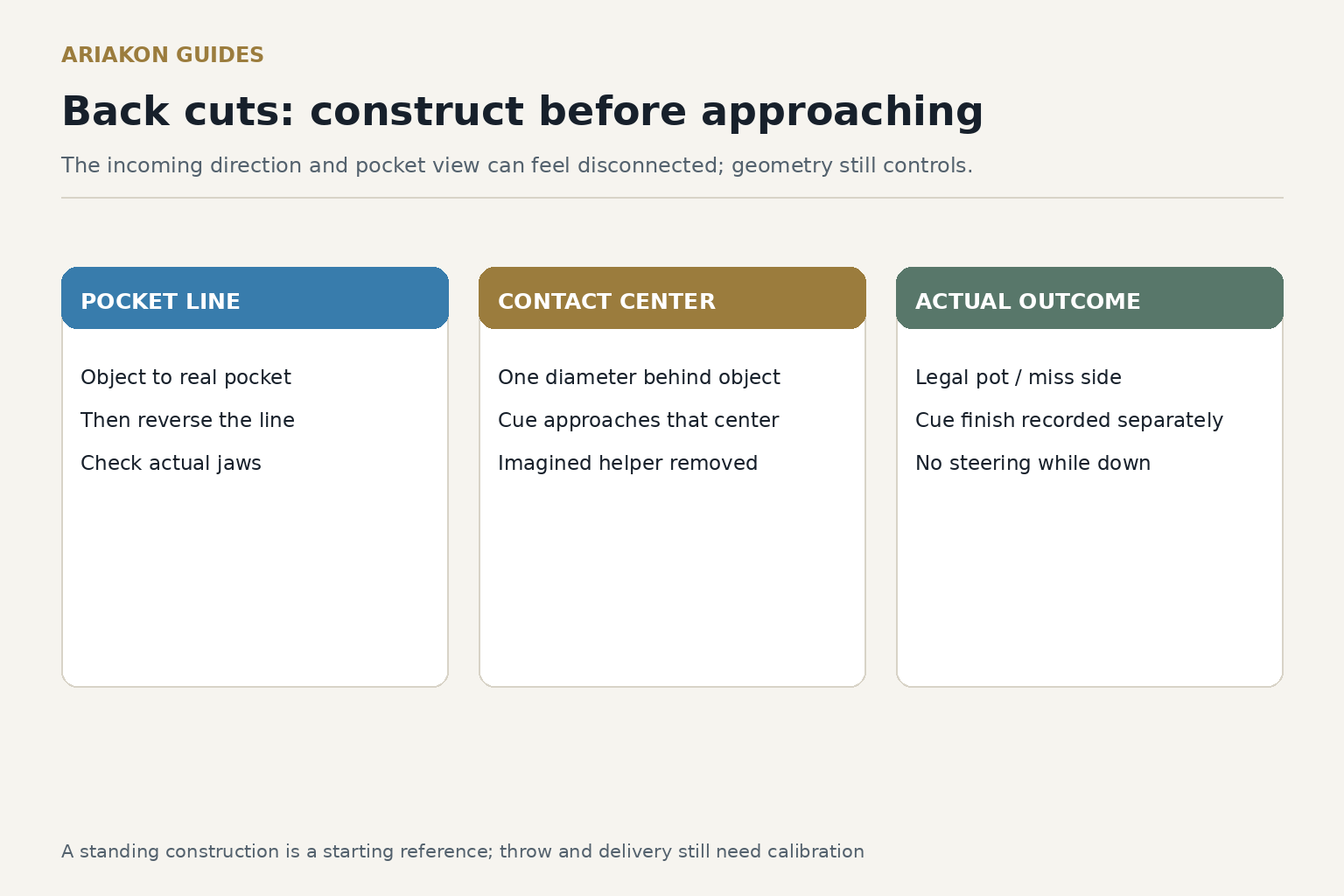
Start at the center of the pocket opening, pass through the center of the object ball and extend that line to the required object-ball contact point. Then imagine the cue-ball center at contact—the ghost-ball position.
The cue travels toward the ghost-ball center, not toward the object-ball contact point itself. For a thin cut, those visual targets can be far apart. Confirm which one you are using before stepping in.
Approach instead of twisting
Stand behind the cue-ball-to-ghost-ball line and bring the cue onto it during the approach. Avoid placing the feet first and then rotating the upper body until the cue appears to fit.
Once down, make only a small verification. If the cut suddenly appears impossible, stand up and view it again. Steering during the final stroke changes the line without improving the geometry.
Begin with center-ball speed
- Use a medium distance and a generous corner pocket.
- Start with a fuller back cut rather than an extreme thin hit.
- Strike the cue ball near center at pocket speed.
- Mark the starting positions and shoot a short set.
- Move one ball by a small amount only after the picture becomes familiar.
- Add position and sidespin after the pocketing line is dependable.
Account for throw without chasing it
Cut-induced throw can alter the object-ball direction, especially at slower speeds and certain cut angles. Spin can add spin-induced throw. Those effects are reasons to calibrate a repeatable setup, not reasons to make a different guess on every attempt.
Keep the balls and cloth reasonably clean, use one speed and observe a group of shots. If a consistent correction is needed, make it deliberately and retest.
Plan the cue ball too
Back cuts can send the cue ball on a natural path that approaches a side pocket or traffic. Trace the first cue-ball line before committing to the shot, and choose a safety when pocketing risk and position risk compound.
In practice, score both the pot and the cue-ball zone. A back cut you can pocket only by giving away the next shot is not yet a complete pattern skill.
Reset one genuine back-cut example
Use the illustrative 100 by 50 inch bed and 0..8 by 0..4 coordinate convention, with ball diameter 0.18 units. Set object O(4,2), real lower-right P(8,0), contact cue center G(3.839003,2.080498), and cue start C(2.899310,1.738478). The incoming direction is 20 degrees above+x while the object line is 26.565 degrees below+x: geometric cut 46.565 degrees. The cue ball starts nearer the lower cushion than the object and points away from the pocket-side view; it is not the straight shot pictured by the previous artwork.
Take eight reset attempts at one comfortable no-intentional-sidespin request. Record known legal pots 0/1, maximum 8, and signed jaw/miss side separately. For an optional position request choose a cue-center rest disk radius 0.3 at(4.196774,2.796040). That is an ideal tangent-side chosen finish, not guaranteed by center-height contact. Keep its observed pass count separate from pots.
Remove every setup aid before the strike and inspect actual mouths, cue access and scratch exposure. Mirror all centers and the pocket by x→8−x for four new attempts only after the first setup is comfortable; this transfer has its own four-pot maximum. Eight plus four is 12 actual strikes only if completed. A resting outcome cannot prove why the shot missed.
Sources and further reading
References support the specific factual information above. The practical checklists are Ariakon editorial guidance.