
Aiming · 4 min read
Compare Ghost Ball and Fractional Ball Pool Aiming References
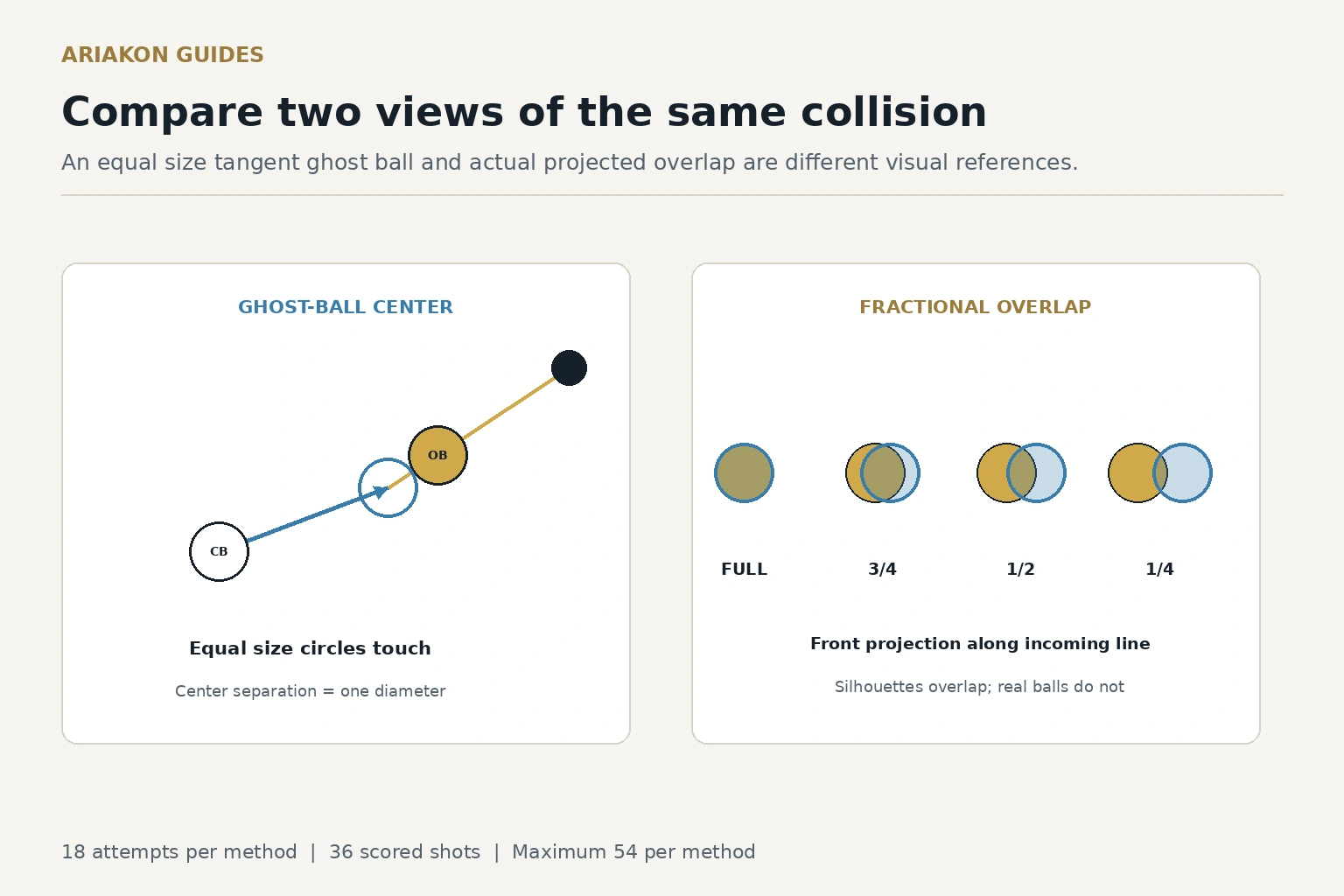
Ghost ball and fractional ball describe the same collision from different visual viewpoints. Ghost ball asks where the cue ball center must arrive. Fractional ball asks how much of the object ball the cue ball appears to overlap. Neither removes throw, squirt, swerve, table variation or stroke error. This protocol compares the references on identical shots instead of declaring a winner from preference.
Define the two references precisely
| Reference | Player visualizes | Useful cue | Limit |
|---|---|---|---|
| Ghost ball | Imagined cue ball center at object ball contact | Pocket line continued one ball diameter behind the object ball center | Center is not physically marked during play |
| Fractional ball | Visible overlap such as full, three quarter, half or quarter | Object ball edge relationships | Four named fractions are landmarks; intermediate cuts need intermediate overlap |
| Both | A geometric starting line | Center ball medium speed baseline | Collision effects still require calibration |
Review the broader aiming system comparison for contact point and cue based references beyond this two method test.
Build an eighteen shot comparison for each method
Use an object ball at (70, 15) with the upper right corner pocket at (100, 0), on a 100 by 50 playing surface. Continue the pocket line backward by one actual ball diameter to locate the ghost center. From that center, measure two diamond units backward at each listed angle to mark the cue ball start. Mirror the angle about the object ball pocket line, so each station has a left and a right cut. An angle guide is for practice setup only. Reset these exact marks for both methods. Each row supplies six attempts per method, so the full comparison is 36 scored shots, 18 per method.
| Station | Approximate cut | Ghost ball attempts | Fractional attempts | Control |
|---|---|---|---|---|
| A | About 20 degrees | 3 left + 3 right | 3 left + 3 right | Same marks and speed |
| B | About 30 degrees | 3 left + 3 right | 3 left + 3 right | Alternate method order |
| C | About 45 degrees | 3 left + 3 right | 3 left + 3 right | Center ball hit |
Construct before bending
For ghost ball, continue the pocket line behind the object ball center by one ball diameter. The imagined cue ball is the same size as the object ball and their circles are tangent. For fractional ball, view the balls along the incoming shot line and call the projected overlap. Full, three quarter, half and quarter mean 100, 75, 50 and 25 percent of one ball's width. They do not mean two real balls can overlap on the cloth. Use the same marks and speed for both methods.
Alternate which method goes first at each station. Give each method two unscored warm up shots at the beginning, then freeze the setup. This prevents one reference from receiving all of the table learning advantage.
Score outcome and signed bias
Freeze a personal speed band and tip contact before scoring. A deliberate change to either earns at most 2 and must be logged; a foul always earns 0. This keeps the 54 point comparison tied to matched attempts rather than an undefined cue ball target. If too many attempts change a control, repeat the comparison with a simpler shot.
| Points | Result | Record |
|---|---|---|
| 0 | Foul or invalid setup | Cause |
| 1 | Legal hit; object ball misses | Undercut or overcut |
| 2 | Clean pocket after an unplanned change to the frozen speed or tip contact | Changed variable; repeat outside the score |
| 3 | Clean pocket with the frozen speed and tip contact | Matched result |
Read totals without inventing superiority
Each method has eighteen scored attempts and a maximum of 54 points. Record left and right subtotals, undercuts, overcuts and median setup time measured only for your own routine. Repeat on a second day. A method earns a personal baseline only if it leads by at least 5 points on both days and does not create a one direction miss pattern.
A smaller or reversing difference means the evidence is not stable. Keep the simpler reference on routine shots and use the other as a standing cross check on the angles where it clarifies the picture.
Work one honest example
Suppose ghost ball scores 42 then 40, while fractional ball scores 39 then 41. The lead reverses and both totals are close. The conclusion is not that the systems are equal for everyone; it is that this player has not isolated a durable advantage. If both show repeated undercuts at Station C, the next task is a thinner angle calibration rather than switching labels.
Transfer the selected reference into five position shots only after the center ball comparison passes. Keep the pocketing reference and cue ball route as separate calls.
Sources and further reading
References support the specific factual information above. The practical checklists are Ariakon editorial guidance.