
Aiming · 3 min read
Use Pocket Width Without Overcutting the Object Ball
A pocket has width, but the whole visible mouth is not automatically available to every shot. Cut angle, speed, cushion facings, shelf depth and ball condition change the usable opening. This drill calls three visual entry corridors on one moderate cut and records whether an attempt was pocketed, entered the called corridor and produced the intended cue-ball finish. Its purpose is controlled use of margin—not aiming every ball at a jaw.
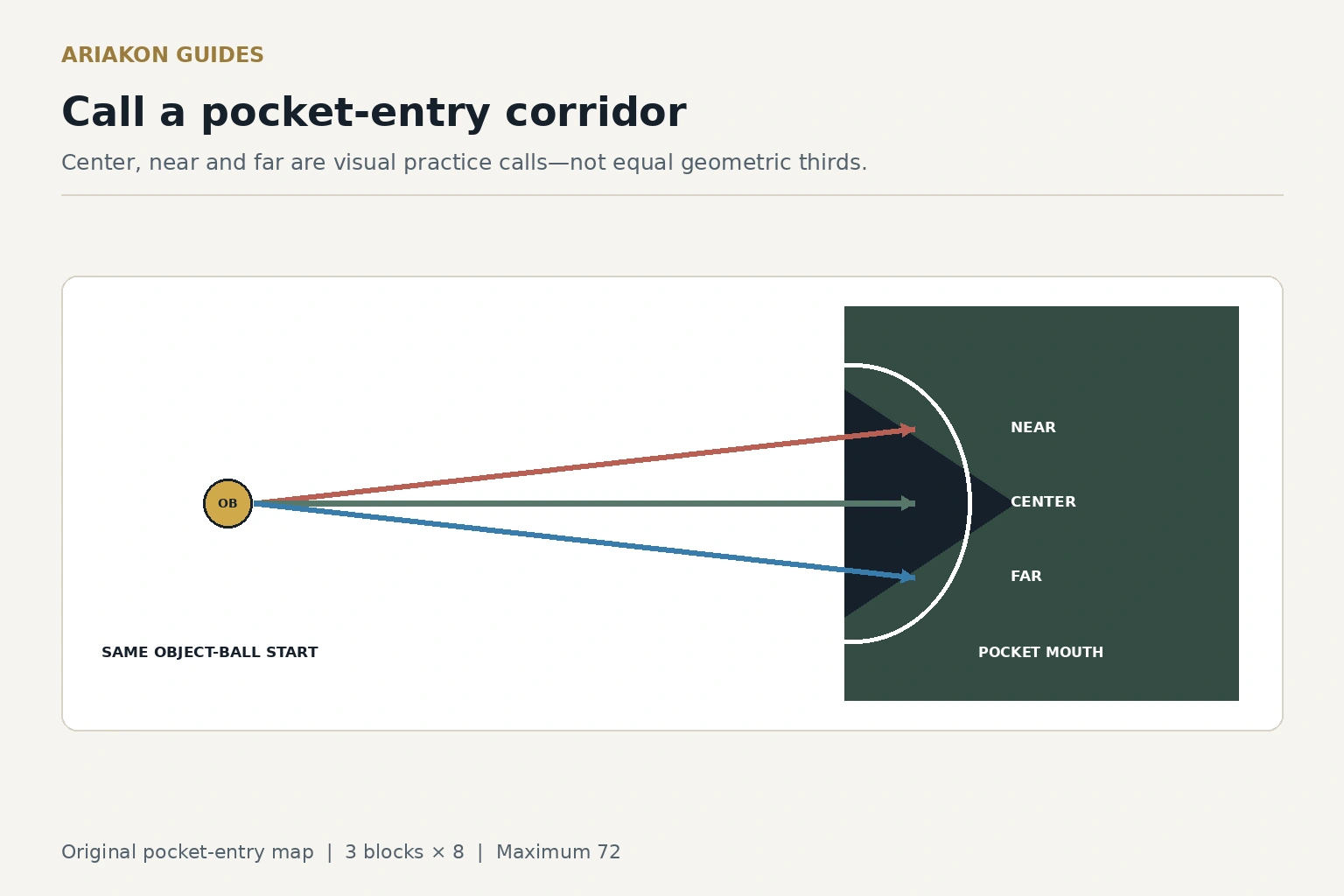
Define three visual corridors safely
Choose one foot corner. Place the object ball about one diamond from the short rail and one diamond from the long rail. Put the cue ball about two diamonds away on a moderate cut. Use a comfortable rolling speed and mark the ball centers.
From above the rail, identify a center-entry reference plus a near-side corridor and far-side corridor inside the pocket mouth. Near and far are named from the incoming object-ball path: label the nearer and farther visible sides from the incoming object-ball path and retain that convention; do not equate one side automatically with an overcut. Put optional sight references on the outside rail top only; never place coins, tape or other objects in the jaws, on the cloth or where a ball can touch them.
Learn the broad whole-pocket concept before assigning position goals to different entry lines.
Read pocket-point misses when jaw contact is the recurring clue.
Calibrate center before using the edges
Shoot four unscored center-entry balls. If the layout rattles at normal rolling speed, move the object ball slightly closer or make the cut fuller. The drill needs a usable margin; it is not a test of the table's maximum acceptance angle.
Call the corridor while standing. Do not change to near or far after dropping into the stance. Use center-ball cueing for the baseline so sidespin compensation does not become a second experiment.
Shoot twenty-four corridor calls
Observe the object ball crossing the pocket opening, not where it rests after falling. If the entry is hidden by the player's view, place a safe camera beyond the table boundary or have a partner record the corridor. Mark unknown rather than guessing.
| Block | Attempts | Entry call | Cue-ball task |
|---|---|---|---|
| A | 8 | Center corridor | Finish in a broad baseline zone |
| B | 8 | Alternate near and far | Use the same baseline zone |
| C | 8 | Draw center, near or far card | Call one of two practical position zones |
Score entry and position independently
Log each miss as near-jaw, far-jaw, short/rattle or unknown. A near-side call that hits the near facing is usually too ambitious for that setup, speed or table; it does not prove the player simply needs to cut thinner.
Worked example: center scores 20 of 24 points. Near/far alternation scores 13, with three near-jaw contacts on near-side calls. The random block scores 16, and cue-ball zone points do not improve on edge calls. The next action is a wider center corridor or softer near-side test—not progressively more overcut aim.
| Point | Requirement |
|---|---|
| 1 | Object ball is pocketed cleanly in the called corner |
| 1 | Observed entry matches the called visual corridor |
| 1 | Cue-ball center finishes in the called position zone |
| Maximum 72 | Twenty-four attempts |
Use an edge only when it buys something
For transfer, place three common position shots and shoot each twice: once with center entry and once with a called edge corridor. Record pocket, entry and position separately. Keep the edge option only where it produces a useful repeatable benefit.
| Question | Action |
|---|---|
| Does center entry already reach the position zone? | Use center; keep the larger margin |
| Does the edge call create a clear cue-ball benefit? | Test it at the same speed |
| Does the ball contact a facing repeatedly? | Return toward center or change speed before cutting thinner |
| Does the shot require sidespin? | Treat that as a separate compensation test |
| Is the entry corridor not visible? | Record unknown; do not award the point |