
Practice planning · 4 min read
Choose Your Next Pool Drill With a Skill Assessment Worksheet
Choose a drill because it answers an observed error, not because it appeared in a popular list. This worksheet records one first costly error per inning, distinguishes evidence from guesses, and turns the strongest useful finding into a drill contract. It is not a branded examination or a universal rating.
Collect ten innings without requiring ten mistakes
Use a familiar ruleset and observe ordinary play, with consent for any recording. An inning is one visit to the table, ending under that ruleset; a successful completed rack can have no observed costly error. Ten innings are the sample budget, not a claim that every visit contains a mistake.
A miss alone cannot identify delivery, and a disappointing score cannot diagnose pressure. Keep unclear cases unresolved. Preserve original notes if later evidence changes a classification; no earlier count is quietly deleted.
| Field | Record |
|---|---|
| Inning ID | 1 through 10; game and date |
| First lost opportunity | Shot, expected legal plan and actual outcome |
| Candidate category | Recognition, delivery, speed, position, recovery or pressure |
| Evidence | Observed setup, clip or specific outcome; not a guessed emotion |
| Final category | One supported first cause, unresolved, or no observed costly error |
| Later consequences | Notes only; no second count for that inning |
Use categories as working questions, not diagnoses
Categories can overlap in discussion, but the final tally is exclusive per inning. Assign the earliest supported costly cause, not the most dramatic last shot. If the only evidence is a failed escape, it stays recovery or unresolved; do not invent an earlier position error.
| Category | Evidence that could support it | Separate next resource |
|---|---|---|
| Recognition | A legal route or danger was overlooked before address | Pattern or route comparison |
| Delivery | An observable input changed during a familiar task | Fundamentals observation |
| Speed | Chosen route was usable but arrival was short or long | Controlled pace task |
| Position | The selected finish did not provide a usable next shot | Zone validation |
| Recovery | A needed recovery decision failed without an evidenced earlier cause in this inning | Legal escape task |
| Pressure | A repeatable context-linked change supported by comparable observations | Separate context record |
Observe delivery inputs when a familiar straight shot is the concrete issue.
Validate a position zone when the next line was unusable.
Separate kick and bank recovery tasks instead of grouping all escapes into one score.
Reassign labels without double-counting consequences
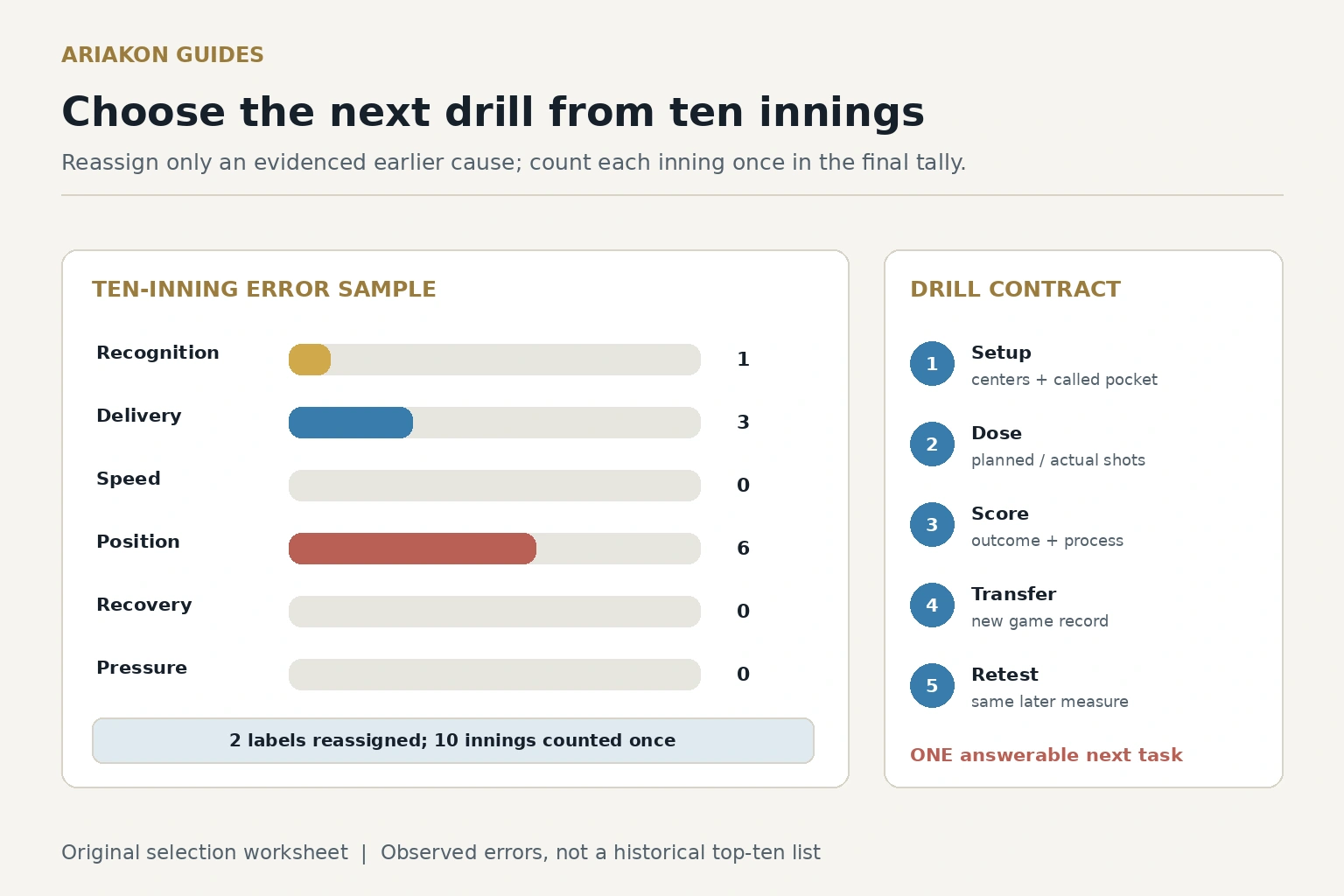
In this example, clips for the two recovery-labelled innings show an earlier failed position choice in the same inning. Reassign those two labels: 4+2=6 position, recovery 2−2=0. The final total is 1+3+0+6+0+0=10, not twelve. Keep the two later recovery events as consequence notes, not extra final counts.
This reassignment is conditional on those clips. Without evidence, the initial 4 position/2 recovery split cannot be turned into 6 position. In another sample, three clean and two unresolved innings could leave only five classified errors; do not manufacture the missing five.
| Category | Initial labels | Reassigned final labels |
|---|---|---|
| Recognition | 1 | 1 |
| Delivery | 3 | 3 |
| Speed | 0 | 0 |
| Position | 4 | 6 |
| Recovery | 2 | 0 |
| Pressure | 0 | 0 |
| Unresolved or no observed error | 0 | 0 |
| Total innings | 10 | 10 |
Choose one useful question from the supported tally
A frequent category is a candidate, not an automatic diagnosis. Check that the task can be reproduced safely and that solving it would address the recorded loss. With a tie, choose the earliest actionable evidenced cause or the clearer reproducible setup; write why. A rare unsafe or uncomfortable input takes priority over a popularity count.
The worked final tally points to position. Choose zone validation if the requested finish was unusable, or a speed task if the intended usable zone was consistently missed. Those are different hypotheses even when both appear under position. Do not prescribe every drill associated with the label.
Use the wider training guide as background while keeping this next-drill choice a separate worksheet.
Evaluate a proposed change after selecting a reproducible question.
Write a complete drill contract and a later retest
Use the linked complete setup rather than improvising a layout from the decorative chart. If six of ten attempts are struck, report actual 6 denominators with four unused allocations. Do not lower the success boundary after seeing results.
Retain the inning sheet, the final classification and the contract. If the retest does not reproduce the problem, reconsider the evidence rather than increasing workload indefinitely. Selection is complete when there is one answerable next task, not when every category has been assigned a drill.
| Contract field | Define before striking |
|---|---|
| Setup | Copy the exact centers, pockets and two rectangles from the linked zone guide; save version |
| Dose | Five broad-zone plus five narrow-zone first-shot attempts, ten planned |
| Score | First pocket, called zone and continuation as three separate flags |
| Stop | Miss or foul ends that continuation; unsafe reach or discomfort holds work |
| Transfer | Ordinary-game opportunities in a new record, not extra drill attempts |
| Retest | Same protocol on a separate occasion; reverse zone-block order |
Recreate the exact zone contract including ball-center geometry, corner checks and independent scoring.
Budget the chosen dose inside a real session end time.
Sources and further reading
References support the specific factual information above. The practical checklists are Ariakon editorial guidance.