
Practice · 6 min read
Five Pool Practice Games for When Drills Feel Stale
A game can change the decision you make while keeping the practice useful. Choose one card below, freeze its setup and finish its short allocation. These are original task cards, not renamed commercial games, random-ball clearance programs or a combined ability rating.
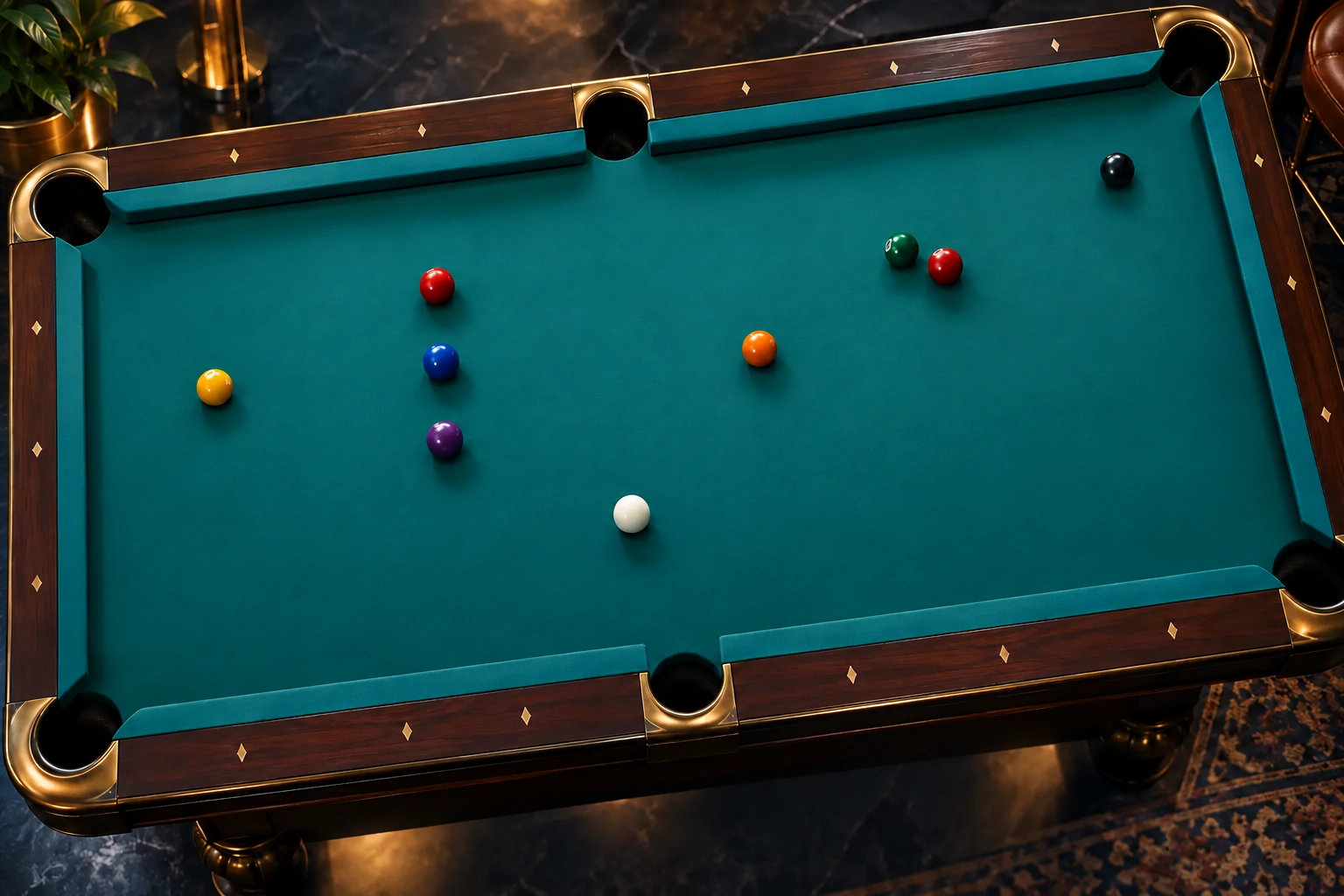
Choose a card by the question, not by boredom alone
Use ball-center coordinates on an illustrative 100×50-inch bed: x=0..8 along the length, y=0..4 across it, origin at the lower-left cushion-nose corner. One unit is 12.5 inches; equal 2.25-inch balls have radius 0.09 and diameter 0.18 units. Intact-cushion center limits are 0.09..7.91 and 0.09..3.91. Real pockets interrupt the boundary at four corners and (4,0),(4,4). Measure the actual bed, balls and pocket mouths before scaling. Remove measuring aids before shooting and never mark a competition table.
Use ordinary controlled strokes, minimum practical cue elevation and no intentional sidespin unless the chosen task explicitly requests it. Stop for discomfort, damaged equipment or loss of control. Reset only between allocated attempts unless a card explicitly allows a practice replay. These reset privileges are not match rules.
| Card | Question | Allocation | Ceiling |
|---|---|---|---|
| Pocket pair | Can the same routine travel to the other corner? | 6 strikes | 6 pot points |
| Window bid | Can a called pace reach the chosen rest disk? | 6 cue-only strikes | 6 window points |
| Bank checkpoint | Did the intended cushion event precede the pot? | 4 strikes | 8 nested route points |
| Safety and reply | Was the defense legal, and what did the actual reply achieve? | 3 exchanges, up to 6 strikes | 6 defense points;3 reply points |
| Recovery credit | Can one permitted replay recover the same task? | 3 rounds, up to 6 strikes | 6 round points |
Budget a focused solo session before choosing how many cards fit the available time.
Choose a task from observed errors if several cards look equally relevant.
Card 1: alternate the pocket, keep the routine
Object O(6, 3), real corner P(8, 4), intended first-contact cue center G(5.839003, 2.919502), cue start C(4.944576, 2.472288). G=O−0.18u, C=G−u, u=(2,1)/√5; the centers are collinear and tangency is one diameter apart.
The left station mirrors x→8−x: O(2, 3), P(0, 4), G(2.160997, 2.919502), C(3.055424, 2.472288). Shoot R,L,L,R,R,L: three strikes per side. Reset the two balls after every strike. Score one known legal called pot as 1, miss/foul as 0; maximum 6. A pre-strike reset is not another attempt.
Name the cue approach before settling and log any late plan change beside the pot result. Do not award extra points for the cue-ball leave or make the six shots into an uninterrupted runout. This tests switching a familiar routine between two pockets, not a named three-ball pattern game.
Preserve the selected line while entering the stance when the switch exposes visible entry drift.
Card 2: bid for a rest window
Remove every object ball. Start cue C(1,1) toward increasing x, without a required cushion. Call cue-center rest disks of radius 0.18 at T1(2,1), T2(4,1), T3(6,1). They are disjoint chosen targets, not predicted paths. Shoot target order 1,2,3,3,2,1, resetting C each time.
Before each strike call a personally familiar pace request. Score 1 only when the cue rests inside the called disk with no scratch, escaped ball or uncontrolled action; otherwise 0. Six known outcomes have a maximum 6. Record the actual finish or unknown separately. Do not widen a window after a miss or count hitting a different disk as a success.
Card 3: verify a bank checkpoint
Use bank object O(6, 2), cue C(5.616513, 0.884053) and first-contact G(5.941502, 1.829771). Reflect real lower-right corner P(8, 0) across center boundary y=3.91 to V(8, 7.82). The nominal object-center rebound is R(6.656357, 3.91); the corresponding physical nose point is N(6.656357, 4). Call an R_x±0.09 contact window, away from the side pocket. O→R→P has equal ideal reflection angles. Actual cloth, speed, transferred spin and jaws require calibration; this is not a measured table route.
Take four strikes from the same bank setup. Score 0 for a foul or an observed wrong required cushion/window;1 when the called cushion window is observed but the called pot fails;2 when that window and a legal called pot both occur. A pot with an unobservable cushion crossing leaves the nested score unknown, not 2. Maximum 8 only for four known scored attempts.
Keep the known called-pot count separately. If crossings recur consistently on one side of the chosen window, freeze one modest aim adjustment for a new four-strike card rather than altering the model after each attempt. The second card is a new comparison, not a repair of the original points.
Separate kick contact from object-ball bank response when the route construction itself needs work.
Card 4: let the actual reply test the defense
Use ordinary nine-ball contact/foul rules, not a break or push-out. Start cue C(2,1), lowest ball 1 at(6,2), higher ball 2 at(3.5,3). The defender attempts a legal nonpotting leave. The responder then takes exactly one shot from the actual resulting layout, attempting a legal result. Choose roles D,R,D for three exchanges, or play both roles alone and label the record.
If the defense fouls or pockets any object ball, the practice exchange ends after one strike and earns 0 defense points; a legal pot is a failed nonpotting task, not automatically a foul. Do not manufacture a reply, a ball-in-hand reset or a hidden snooker. Otherwise the reply uses the actual cue location and lowest remaining ball. It needs correct first contact and, if no ball is pocketed, a later cushion contact, without another foul.
Score defense 1 for a legal nonpotting leave followed by a known legal reply;2 for that leave followed by a known reply foul. Score the responder 1 for a known legal result,0 for a known foul, separately. Unknown legality stays unscored. Three exchanges have at most 6 strikes,6 defense points and 3 reply points; fewer replies lower that separate denominator. A blocked direct line earns no automatic bonus.
Practice the narrower safety-control task when creating a useful leave rather than testing its reply is the question.
Card 5: spend a replay without erasing the miss
Object O(6, 3), real corner P(8, 4), intended first-contact cue center G(5.839003, 2.919502), cue start C(4.944576, 2.472288). G=O−0.18u, C=G−u, u=(2,1)/√5; the centers are collinear and tangency is one diameter apart.
Play three rounds from this same two-ball setup. A first-strike legal called pot earns 2 and ends the round. A known miss may use one replay credit: restore both exact centers, repeat the task once, and earn 1 if that second strike legally pots. Two misses earn 0. A foul or safety concern ends the round at 0 without a replay. This allowance is a practice rule, not a match entitlement.
Record first and replay outcomes separately. Three first successes use only 3 strikes, not 6 imaginary attempts. Three first misses followed by three replay pots use 6 strikes and earn 3 of 6 round points. The round ceiling remains 6 because first success is worth 2. Do not report those 6 strikes as six first-try pots. These are hypothetical counts, not player results.
Close the card and return to ordinary play
Record the selected card/version, actual strikes, known scores and unused or unknown allocations. Retest a repeated failure with the same card before making it harder. Do not blend a cue-only rest score, a legal reply and a called pot into a single percentage.
Then take four separate ordinary straight attempts, using the mirrored left station, with one point per known legal pot: maximum 4. Those transfer attempts remain outside every game total. If no useful question survives the game, stop instead of inventing a sixth challenge or escalating force.
Sources and further reading
References support the specific factual information above. The practical checklists are Ariakon editorial guidance.