
Practice · 4 min read
Set Pool Practice Goals You Can Actually Measure
“Get better at pool” is a wish, not yet a practice plan. A useful goal names the skill, the setup, the evidence you will record and the point when you will make the drill harder. That structure keeps a new-year resolution—or any fresh start—from dissolving into unmeasured games.
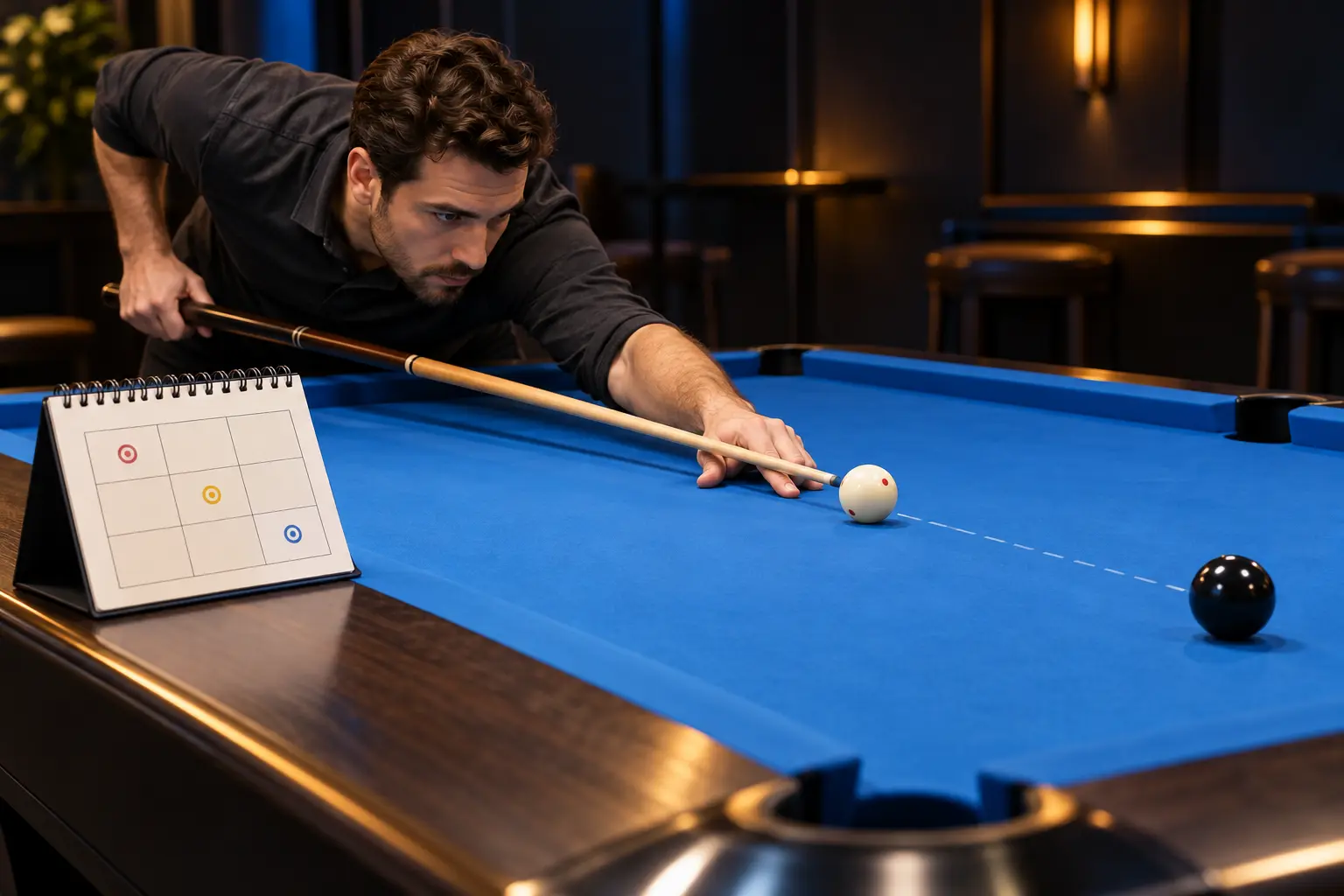
Choose one change you can observe
Begin with a result you can see without guessing: hold the cue ball inside a chosen virtual zone, complete the same pre-shot routine, make a particular cut or leave a legal safety. Avoid goals that depend on mood or an opponent’s mistakes.
Write the intended result before the first attempt. Narrowing the session to one skill also makes failure informative: repeated observations can select an aim, pace, contact or decision question without proving its cause instead of becoming a vague judgment about your whole game.
Build a repeatable test
Record ball-center coordinates and an overhead photograph with permission; remove physical layout aids before every strike. Use the same table end, pocket, distance and starting angle for a short set. Ten attempts are often enough to create a baseline without exhausting your attention.
Write the result in plain terms, such as six successful stops inside a hand-width zone out of ten attempts. Record the setup too. A score without distance, pocket and success definition is difficult to compare next week.
Set process and outcome goals together
- Process: stand behind every shot and choose the target and speed before bending down.
- Outcome: place the cue ball in the chosen virtual zone on seven of ten attempts.
- Constraint: use center ball until contact and speed are stable.
- Progression: move the object ball one diamond farther only after meeting the target twice.
- Stop rule: end the set when fatigue changes the routine or stroke.
Use a difficulty ladder
Start with a version you can complete often enough to notice small differences. Progress one variable at a time: distance, cut angle, speed, position-zone size or the number of balls in a pattern. Changing several variables together hides the cause of improvement.
A progressive drill should sometimes challenge you, but repeated failure at the first step usually means the step is too large. Move back to the last reliable setup, recover the motion, then try the harder version again.
Review the record without flattering it
Count only the success you defined before the shot. A pocketed ball with the cue ball outside the target zone is not a position success. A fortunate kiss does not prove the planned route worked.
At the end, add one sentence about the most common miss. That note is more useful than a dramatic promise to practice harder. It tells you whether the next session should repeat the test, simplify it or move to a new weakness.
Use a four-week cycle
Pick one primary skill and one maintenance skill for four weeks. Test the primary skill at the start, practice it in short focused blocks, and repeat the same test near the end. Keep ordinary games in the schedule so the skill has a chance to transfer into decisions and patterns.
Improvement is not always a straight line. Keep the setup and scoring honest, look for a trend across several sessions and choose the next goal from evidence. That is a sturdier resolution than chasing a different tip every time you miss.
Keep an exact ordinary baseline for this record
Coordinates are ball centers on an illustrative 100 by 50 inch bed: x=0..8 along length, y=0..4 across width, origin at the lower left cushion nose. One unit is 12.5 inches. For 2.25 inch equal balls, radius is 0.09 and diameter 0.18 units. Intact cushion center boundaries are x=0.09,7.91 and y=0.09,3.91; pockets interrupt the physical boundary at the four corners and (4,0),(4,4). Measure actual bed, balls and jaws before scaling. Remove every measuring aid before shooting; never mark a competition table.
Use O(6,3), real upper right corner P(8,4), intended contact cue center G(5.839003,2.919502) and C(4.944576,2.472288). With u=(2,1)/sqrt(5), G=O minus 0.18u and C=G minus u. The centers are collinear and the equal balls are tangent at G.
Choose a comfortable ordinary pace and keep equipment fixed. Record actual strikes, known legal pots and the task-specific observation separately. A chosen cue-rest window, when needed, is a radius 0.18 disk about G; it is not a guaranteed result. Unknown observations stay unknown, and a safety stop leaves later allocations unused. Use the exact mirrored setup x→8−x only in a separately dated transfer record.
Sources and further reading
References support the specific factual information above. The practical checklists are Ariakon editorial guidance.