
Practice · 3 min read
Turn Pool Practice Into Skill, Not Just Table Time
Natural coordination can make the first few months easier, but it does not tell you what to do at the table today. Improvement comes from choosing a specific skill, working near the edge of your current ability, reading the result and adjusting. Hours matter only when they contain useful attempts.
Define the skill before starting
Do not begin with a goal such as get better at pool. Choose an observable task: stop the cue ball inside a hand-sized zone, make seven of ten long cuts, or escape a one-rail hook without selling out. A narrow goal lets you tell whether the session changed anything.
Use a fixed layout for the first set. If ball positions change after every attempt, the result mixes execution with a new problem. Repetition becomes informative when the main variables stay stable.
Practice where mistakes teach you
A shot you make automatically provides little new information. A shot you almost never make may be too difficult to diagnose. Adjust distance, angle or target size until success requires attention but remains possible.
For this practice card, useful work means a defined task, safely repeatable attempts and readable feedback. That working definition is not a claim that hours alone explain expertise or erase differences in instruction, opportunity and motivation.
Give every miss a category
After each attempt, record an observable outcome such as object miss side, cue rest short/long, visible routine deviation or unknown. A missed pot alone cannot identify wrong tip contact, nerves or a mechanical cause. Choose one supported observation for the next test.
Change one variable for the next small set. If three balls overrun the zone on the same line, reduce speed. If they miss on alternating sides, stabilize alignment before touching the aim.
Measure groups, not highlights
Score ten attempts and record the whole set. One perfect shot does not erase nine uncontrolled results, and one miss does not invalidate a tight group. The group tells you whether the movement is becoming repeatable.
For an original local practice record, keep the layout, rules and scoring consistent long enough to compare sessions.
Mix skills after building a reference
Blocked practice is useful while learning the reference. Match play is variable, so finish by mixing the skill into decisions. After ten identical draw shots, scatter three balls and require the same draw only when it is the best route.
This second phase checks transfer. If the technique disappears as soon as you must choose a shot, simplify the layout and alternate one fixed attempt with one decision-based attempt.
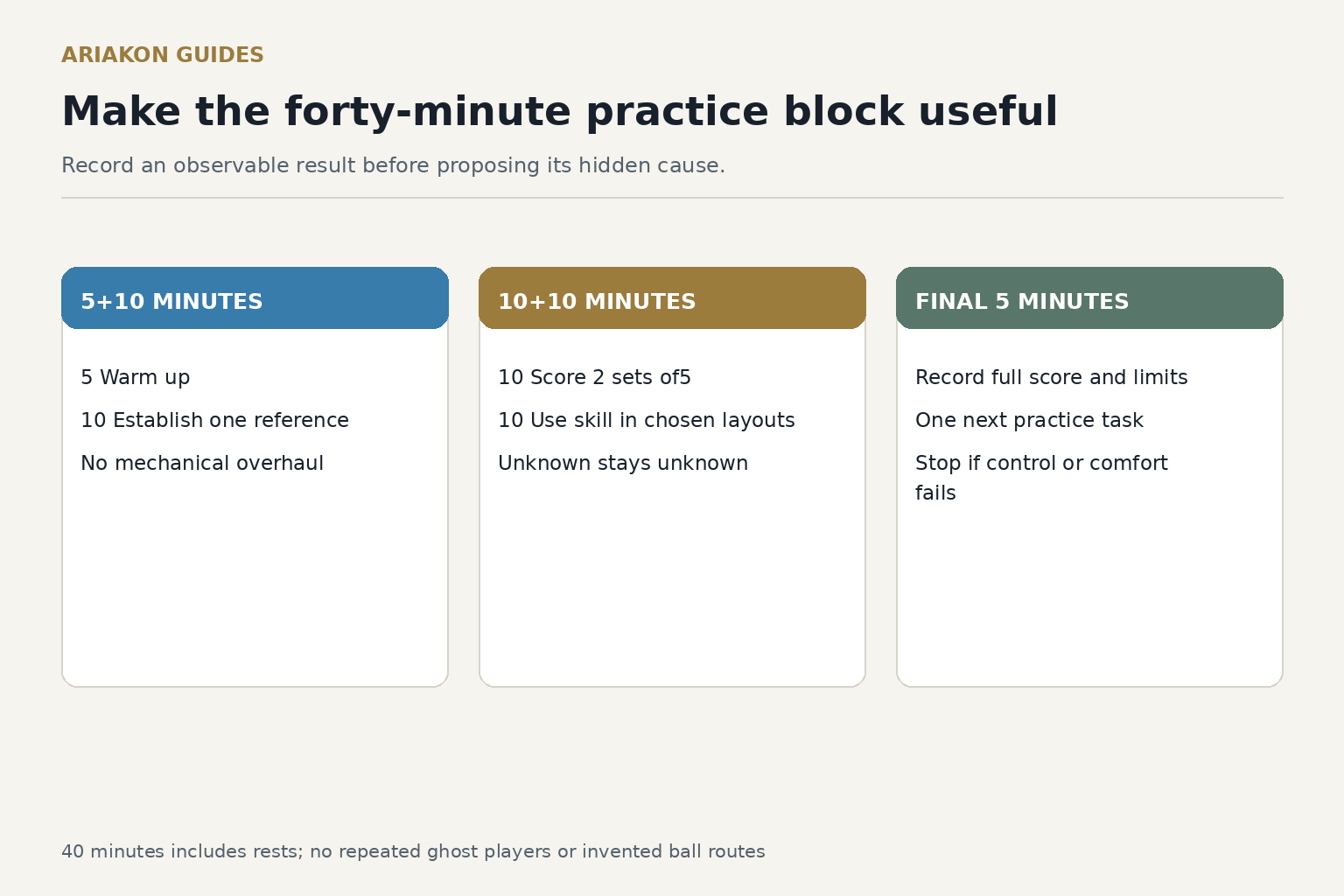
Use a forty-minute practice block
- Five minutes: warm up without changing mechanics.
- Ten minutes: establish the fixed reference shot.
- Ten minutes: score two sets of five and make one-variable corrections.
- Ten minutes: use the same skill in changing layouts.
- Five minutes: record the score, common miss and the first task for next time.
- Stop focused practice when attention or execution quality falls sharply; more tired repetitions are not automatically better.