
Practice · 4 min read
Calibrate Speed and Sidespin on Any Pool Table
A familiar stroke can produce a different finish when cloth speed, ball condition or cushions change. Calibration is the bridge between technique and today's table. The goal is not to map every possible route. It is to collect a few clean references for slow, medium and firm speed, then see how a small amount of sidespin changes them.
Separate speed from spin first
Begin on the vertical axis of the cue ball. Roll from a fixed start toward the foot cushion and back, using three comfortable stroke sizes. Note the finish for soft, medium and firm deliveries. Do not add English until those groups are recognizable.
This first pass tells you about cloth and cushion pace without the extra variables of squirt, swerve and spin transfer. If the center-ball results scatter, more sidespin trials will produce more noise rather than better information.
Freeze a safe cue-only reference
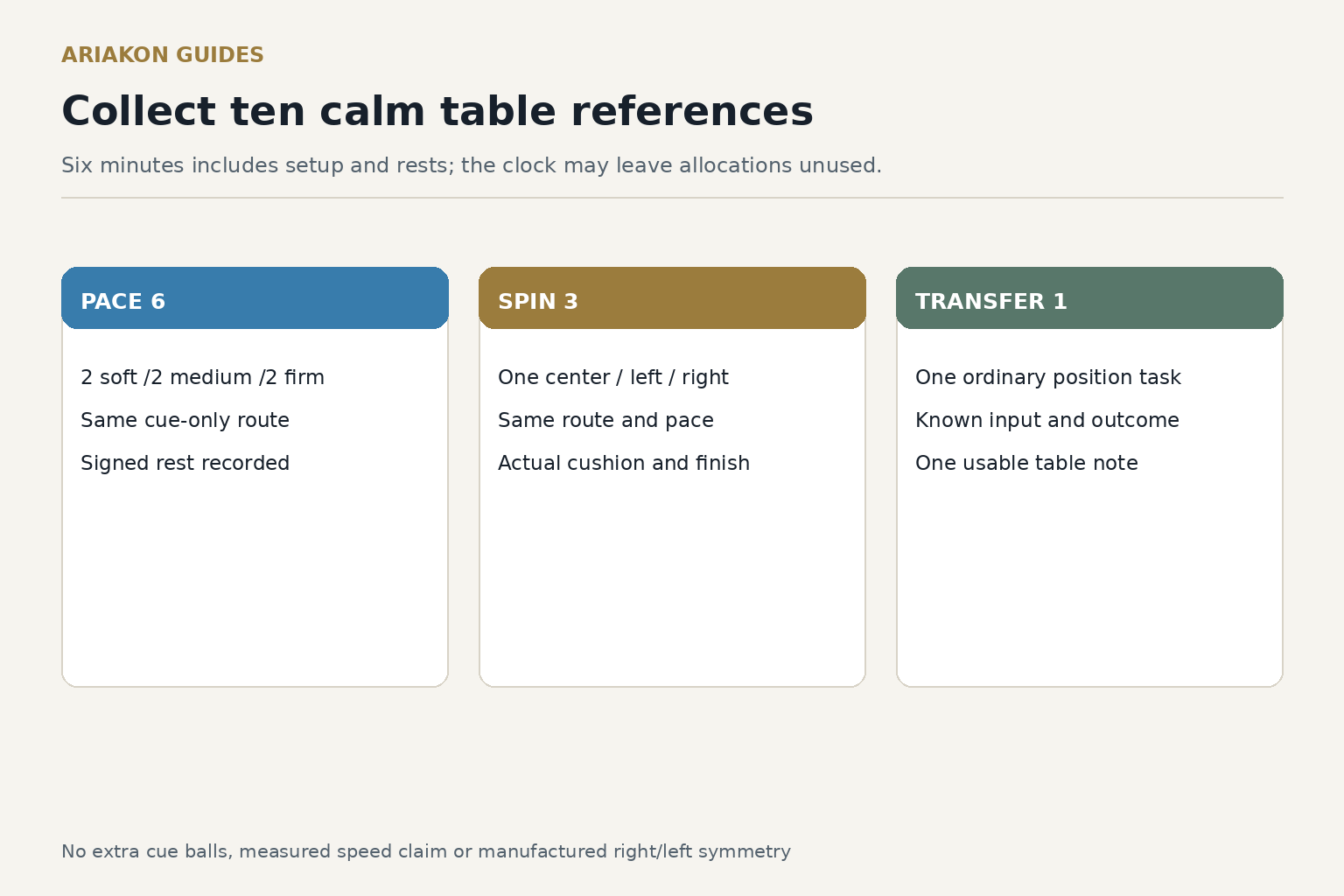
Use ball-center coordinates on an illustrative 100-by 50 inch bed, x0..8 along length,y0..4 across width, origin at lower left cushion nose. A2.25 inch ball has radius 0.09 units. Start cue C(2,1), nominally toward intact upper cushion center contact R(2,3.91), away from upper side pocket x4. No object ball or physical gate remains in the lane. Remove measuring aids before play.
Record the first postcushion crossing at y2 as x minus 2, and final center/rest or unknown. For the first six pace attempts use 2 soft,2 medium,2 firm controlled requests without intentional sidespin; they need not all reach the same number of cushions. Record the actual route, not a promise of a one-rail stop. Then compare center,left,right once each at one fixed permitted medium request. A left/right request is not verified delivered spin.
This is a ten-attempt ceiling inside six permitted minutes including resets and rests, not a requirement to rush. If there is time, the tenth attempt is an ordinary familiar position shot recorded separately; its exact centers, legal object and finish must be named before shooting. Missing time leaves unused allocations.
Create three visible landing zones
Choose broad zones such as near the center string, near the head string and near the head cushion. Try to land two consecutive cue balls in each zone. Use the minimum stroke change that moves from one zone to the next.
Think in ranges. Match position usually tolerates a window, and a calibration that depends on stopping on a coin is too fragile to carry into play. The zones should help you label today's table as faster, slower or similar to your normal conditions.
Add small left and right references
Use one medium-speed cushion route and shoot it first with center ball, then with a small repeatable left-tip offset and the same offset to the right. Record both the first cushion contact and the final line. Keep cue elevation as constant and level as practical.
Sidespin changes more than the rebound. It can alter the cue ball's initial path and curve later, so a landing difference may not come from the cushion alone. The complete result is what matters for planning.
Calibrate the shot, cue and table as a system
Tip offset labels such as half a tip are only useful if you place the tip consistently. Different shafts, cue elevation and stroke speeds can require different aim compensation. Treat a published system as a starting reference rather than a promise of a universal contact point.
If you change playing cues or move to a table with very different equipment, repeat the three-shot left-center-right set. A two-minute check is cheaper than carrying compensation from the wrong setup through an entire set.
Convert observations into match choices
Before the match, keep only two notes: the speed adjustment for ordinary position and whether running English opens more or less than expected. Those facts are actionable. A long list of tiny differences is hard to use under pressure.
During play, prefer broad zones until confidence grows. If an early sidespin route surprises you, reduce offset and use more vertical-axis routes. Calibration should simplify decisions, not pressure you to demonstrate every test.
Run the six-minute protocol
- Two center-ball lags at soft speed.
- Two center-ball routes at medium speed.
- Two center-ball routes at firm speed.
- One fixed route with center, small left and small right contact.
- One position shot that combines the speed and spin you expect to use most.
- Write down only the table-speed label and the cushion-spin adjustment.
Sources and further reading
References support the specific factual information above. The practical checklists are Ariakon editorial guidance.