
Practice · 3 min read
Use a 20-Minute Pool Tune-Up Before You Play
A short tune-up should answer practical questions: How fast is this cloth? Are you seeing the cut line? Is the cue ball rolling as expected? Twenty focused minutes can collect that information and settle your routine. It is not enough time to install a new stroke, so leave major technical changes for a separate practice session.
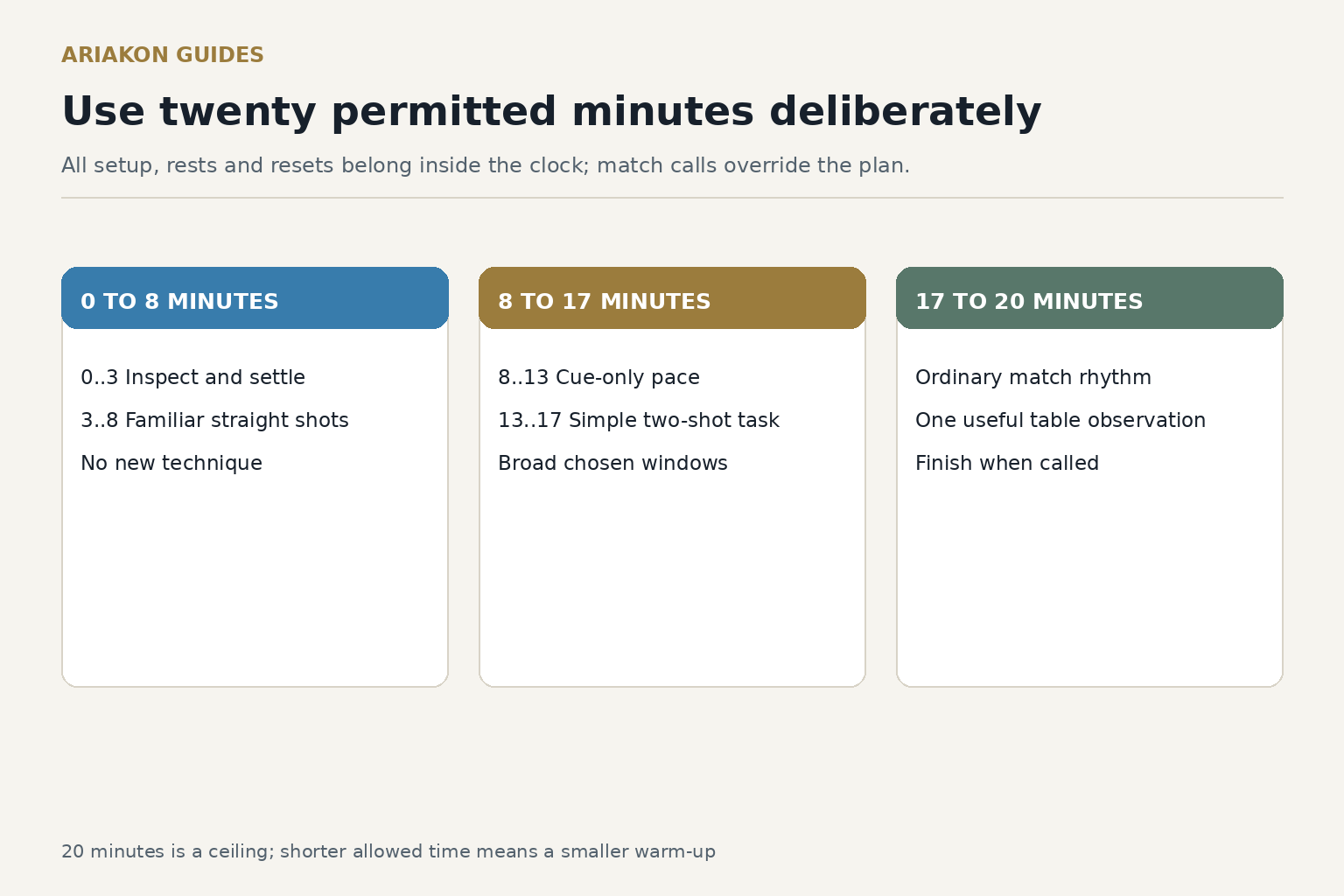
Minutes 0–3: inspect and settle
Check the table for obvious damage, dirty balls, loose objects and local rules about practice. Roll a few balls by hand only when the venue allows it, and notice table speed and cushion response without declaring the table defective from one result.
Make a few easy shots using your complete pre-shot routine. The purpose is to let the eyes, bridge and cueing arm settle, not to test the hardest shot you know.
Minutes 3–8: verify the straight stroke
Set a short straight-in shot. Pocket the object ball with a stop, then a small follow and a small draw. Use ordinary speed and watch whether the cue ball behaves consistently.
If contact is unreliable, simplify the shot and check alignment, tip condition and chalk. Do not spend the whole warm-up forcing draw from increasing distance.
Minutes 8–13: calibrate speed
Send the cue ball to a broad zone using one or two cushions. Try soft, medium and firm versions while keeping the route constant. This reveals more about the table than firing balls around without a target.
Judge the first cushion entry and final speed separately. A cue ball that reaches the right area after clipping traffic did not confirm the intended route.
Minutes 13–17: connect two shots
Choose a simple cut that sends the cue ball naturally toward a second ball. Play the pattern from both sides of the table if time permits. Work with broad position zones rather than one exact point.
This short pattern reconnects pocketing with decision making. If the position route is uncertain, reduce speed or choose a more natural angle rather than adding sidespin immediately.
Minutes 17–20: rehearse match rhythm
- Play one small open layout or a few random balls.
- Use the normal planning and pre-shot routine on every shot.
- Do not replay a miss unless the format allows practice.
- Notice the most useful table-speed fact.
- Finish on time and prepare for the match call.
Change the tune-up, not your identity
APA tournament preparation guidance distinguishes focused practice from casual play and recommends a clear objective. Use the tune-up to observe the day’s conditions and wake up familiar skills.
When time is shorter, keep an easy straight shot, one speed-control route and a brief match-rhythm sequence. When time is longer, add a specific known weakness. Save experimental mechanics and equipment changes for practice where a poor first result carries no match consequence.
Sources and further reading
References support the specific factual information above. The practical checklists are Ariakon editorial guidance.