
Practice · 3 min read
Balance Feel and Analysis in Your Pool Game
Players are not permanently divided into thinkers and feel players. Pool needs both modes. Analysis helps you choose and calibrate a solution; repetition turns that solution into a familiar visual and physical task. Trouble starts when you analyze without testing or try to perform while consciously controlling every joint.
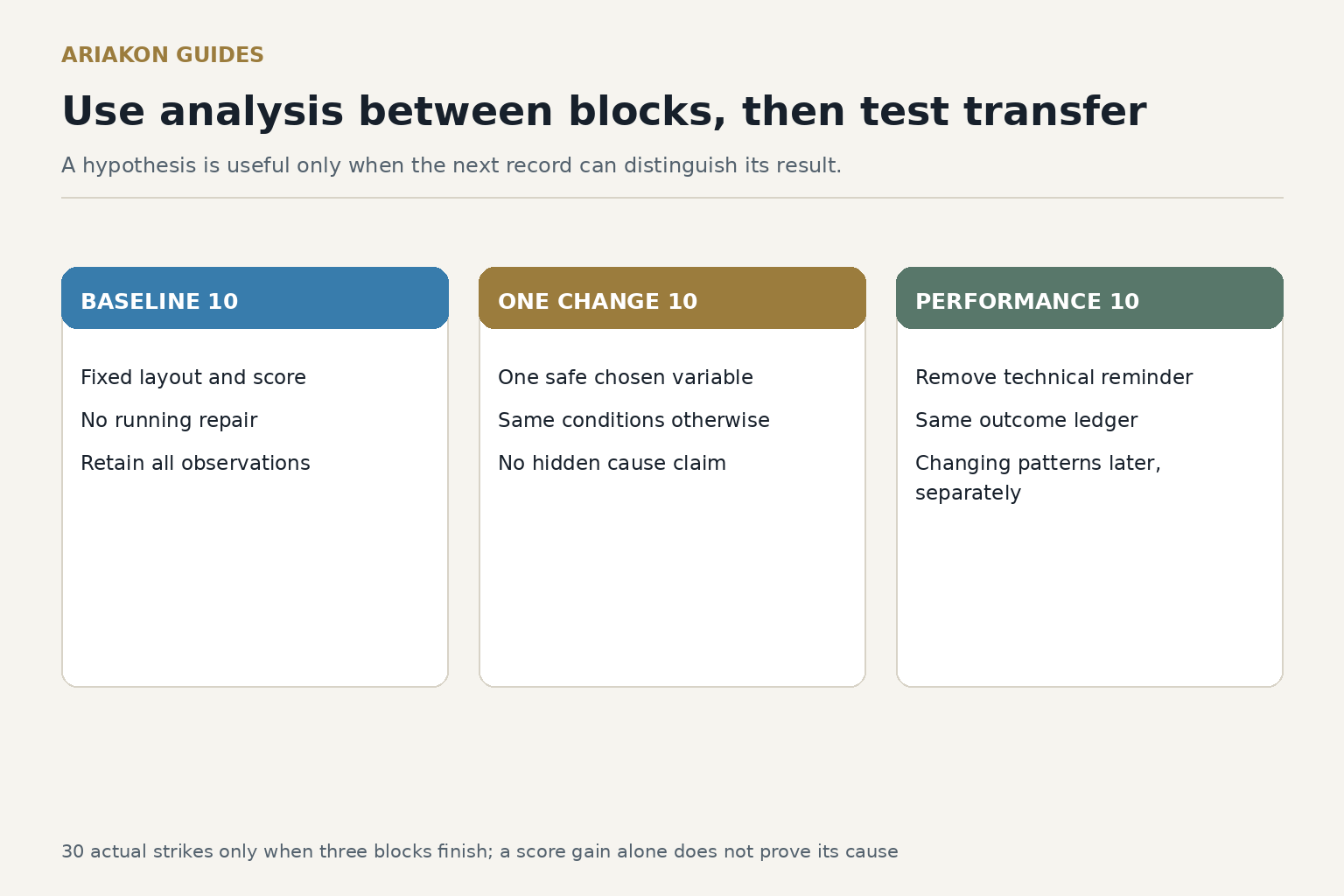
Use analysis to define the problem
When a shot fails repeatedly, identify one observable question: Was the aim line wrong? Did the cue ball finish short? Did unintended sidespin change the path? A specific question suggests a specific test.
Avoid replacing evidence with a full stroke rebuild. Video, a registered recording, target zone or scored drill can show whether an observable pattern repeats. An unregistered resting chalk mark cannot establish initial contact.
Use repetition to build recognition
Repeat the same layout long enough to recognize the line, speed and result. Then vary one dimension, such as distance or angle, so the skill does not depend on a single memorized position.
Begin with a short pattern you can reset exactly, then add one ball only after its current decisions remain understandable. That approach lets pattern recognition grow without hiding the decision inside a full random rack.
Separate practice mode from performance mode
Practice mode welcomes pauses, notes, video and technical adjustments. Performance mode needs a short plan, one cue and a committed stroke. Carrying a checklist of body parts into every competitive shot makes execution crowded.
Choose the shot while standing. Use one simple external cue, such as the object-ball contact or cue-ball landing zone, during the final setup. A recorded mark must retain freshness and ball-rotation registration before it can describe initial contact; otherwise call it unknown.
Build a three-pass session
- Pass one: play ten normal attempts and record the result without fixing anything.
- Pass two: take ten new attempts with one safe controlled adjustment. Keep the setup, scoring and pace request fixed unless that is the named variable.
- Pass three: remove the technical reminder and score ten performance attempts.
- Treat a higher score as a candidate for a second-day comparison, not proof that the proposed explanation caused it. Three complete passes have 30 actual strikes; later patterns are separate.
- Finish with three-ball patterns that require you to recognize when the skill applies.
Know when to ask for outside eyes
If your diagnosis changes every few shots or video contradicts what the stroke feels like, ask a qualified instructor to narrow the problem. A useful coach reduces variables rather than giving you more body positions to monitor.
The goal is not to become less thoughtful. It is to place thought where it helps: before the shot, between practice blocks and during review—not in the middle of the delivery.
Keep an exact ordinary baseline for this record
Coordinates are ball centers on an illustrative 100 by 50 inch bed: x=0..8 along length, y=0..4 across width, origin at the lower left cushion nose. One unit is 12.5 inches. For 2.25 inch equal balls, radius is 0.09 and diameter 0.18 units. Intact cushion center boundaries are x=0.09,7.91 and y=0.09,3.91; pockets interrupt the physical boundary at the four corners and (4,0),(4,4). Measure actual bed, balls and jaws before scaling. Remove every measuring aid before shooting; never mark a competition table.
Use O(6,3), real upper right corner P(8,4), intended contact cue center G(5.839003,2.919502) and C(4.944576,2.472288). With u=(2,1)/sqrt(5), G=O minus 0.18u and C=G minus u. The centers are collinear and the equal balls are tangent at G.
Choose a comfortable ordinary pace and keep equipment fixed. Record actual strikes, known legal pots and the task-specific observation separately. A chosen cue-rest window, when needed, is a radius 0.18 disk about G; it is not a guaranteed result. Unknown observations stay unknown, and a safety stop leaves later allocations unused. Use the exact mirrored setup x→8−x only in a separately dated transfer record.
Sources and further reading
References support the specific factual information above. The practical checklists are Ariakon editorial guidance.