
Video review · 4 min read
Film Cue Ball Contact for a Useful Slow Motion Review
Useful slow motion starts with a safe camera and a question the capture can answer. Preserve readable approach and first ball motion, then record the result separately. A clean recording of a miss can be diagnostically useful even though it earns no outcome bonus.
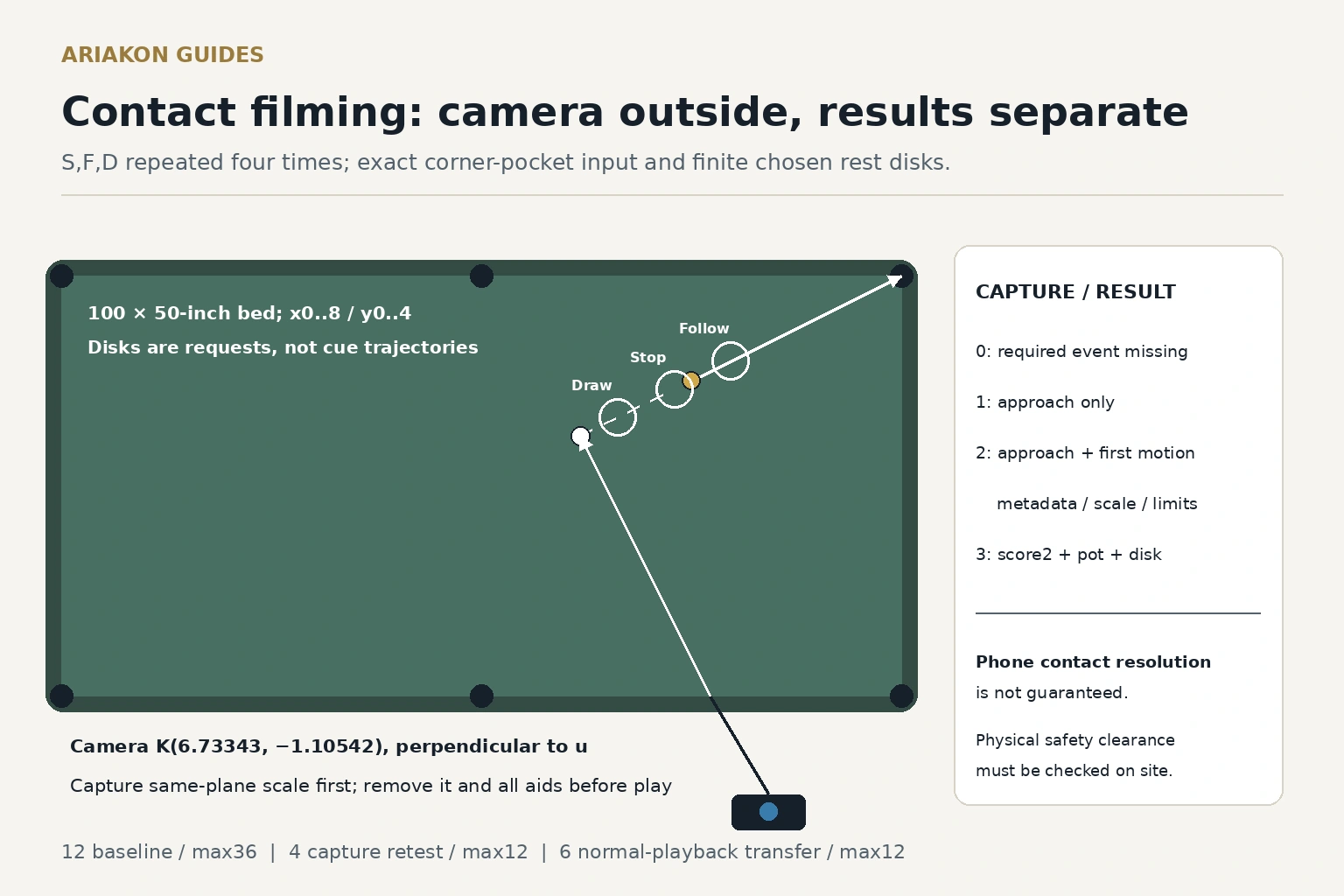
Set capture information before slowing playback
Keep an owned original file, documented capture rate, resolution and export/interpolation history. On supported phones, available slow-motion rates and resolutions depend on the model; check the device’s recording settings instead of assuming every phone records the same cadence. Playback speed is a different setting.
A readable approach and a first-motion bracket are achievable capture questions. Resolved physical tip contact, exact separation and peak compression are not promised by this protocol. If the event is absent between samples or obscured, record unknown.
Audit sampled compression and capture-interval bounds before claiming a contact duration.
Build a broader event-evidence ledger when several contacts matter to the clip.
Keep the camera outside the table and stroke path
Use ball-center coordinates on an illustrative 100×50-inch bed: x=0..8 along the length, y=0..4 across it, origin at the lower-left cushion-nose corner. Equal 2.25-inch balls have radius 0.09 and diameter 0.18 units. Intact-cushion center limits are 0.09..7.91 and 0.09..3.91. Six real pockets interrupt the boundary at the four corners and (4,0),(4,4). Measure the actual bed, balls and pocket mouths before scaling; remove measuring aids before shooting and never mark a competition table.
Set object O(6, 3), real upper-right pocket P(8, 4), intended first-contact cue center G(5.839003, 2.919502) and cue start C(4.944576, 2.472288). Direction u=(2,1)/√5 points toward that pocket; G is one ball diameter behind O. The chosen stop target is a cue-center rest disk of radius 0.18 at G. It is a practice tolerance, not a guaranteed result of a center-height strike.
For a schematic perpendicular view place the camera at K(6.73343, -1.105421) = C+4(u_y,−u_x). Its dot product with the shot direction is zero and its y is below the bed. Set the actual lens near contact height on a stable support outside the rail, with clearance from the backswing, walkways and possible escaping balls. Coordinate separation alone is not a physical safety guarantee.
Capture a registered scale reference in the relevant contact plane before play, then remove it and every loose measuring aid. Frame the whole cue ball and approaching tip; do not crop the contact edge. Keep hands, tripod, phone and lamps off the bed and out of the cue path. Lighting and exposure must make the moving edge readable, not merely brighten a blurred frame.
Run a twelve-shot contact study with three requests
Use the same C,O,G,P at every strike. Repeat Stop,Follow,Draw four times: twelve strikes, four per request. Use modest familiar vertical-axis contact requests with no intentional sidespin and comfortably controlled pace. Stop requires an intended stop state at object contact, not a universal center-height recipe; follow/draw heights are not prescribed in tip widths.
Call a cue-center rest disk of radius 0.18 for each request: Stop at G, Follow at G+0.6u, Draw at G−0.6u. No cushion is required before these nearby targets. Record requested height/pace, actual observable delivery and any missing information for the same attempt. Registered contact marks require a rotation trace; the final ball mark is not automatically initial offset.
| Request | Disk center | Strikes | Radius |
|---|---|---|---|
| Stop | (5.839003, 2.919502) | 4 | 0.18 units |
| Follow | (6.375659, 3.18783) | 4 | 0.18 units |
| Draw | (5.302347, 2.651173) | 4 | 0.18 units |
Register the mark and the ball rotation before estimating initial contact from residue.
Use nested capture and outcome points
Score 2 does not certify resolved physical tip contact. A well-recorded miss can score 2; a good pot with missing required capture cannot earn 3. If the capture requirements for 2 are met but the shot outcome is unknown, retain capture score 2 and mark the outcome unknown, without inventing an outcome bonus.
A pre-strike safety or comfort problem leaves an unused allocation, not a fabricated miss. Do not continue just to fill the twelve rows. Record actual struck attempts and applicable maxima, retaining original clip IDs and the S,F,D order. NIST’s general uncertainty guidance supports reporting the method and limits, not a claim that this phone is a calibrated contact instrument.
| Points | Established evidence |
|---|---|
| 0 | Required approach or first-motion event missing/obscured |
| 1 | Readable approach, but first motion not bracketed usefully |
| 2 | Readable approach and first-motion bracket; stable view, capture metadata and registered scale/limits recorded |
| 3 | Score 2 plus known legal object pot and cue resting in the called disk |
Retest capture and transfer without changing the baseline
Fix one capture problem and make four new attempts using one selected request, retaining its exact input and nested score: maximum twelve. Do not change pace and tip height while testing a new camera view.
Then take six ordinary normal-playback transfer attempts at the same straight setup, choosing one comfortable request and scoring only 0 miss/foul, 1 legal pot, 2 pot plus that request’s disk: maximum twelve. Baseline 12 + retest 4 + transfer 6 equals twenty-two actual strikes only if completed; maxima 36,12,12 remain separate.
For whole-body stroke review use the broader stroke-video task. This protocol is for safe contact capture and its limitations, not a diagnosis of every delivery feature or an endorsement of a proprietary video series.
Review the whole stroke with broader camera views when the delivery rather than the contact recording is the next question.
Sources and further reading
References support the specific factual information above. The practical checklists are Ariakon editorial guidance.