
Equipment care · 4 min read
What Pool Chalk Transfer Can Tell You
A fresh chalk mark can be useful evidence only when you know which strike made it and how the ball rotated. This ledger prevents a visible mark at rest from becoming a false map of the initial tip contact. It is a documentation task, not another chalk comparison or application lesson.
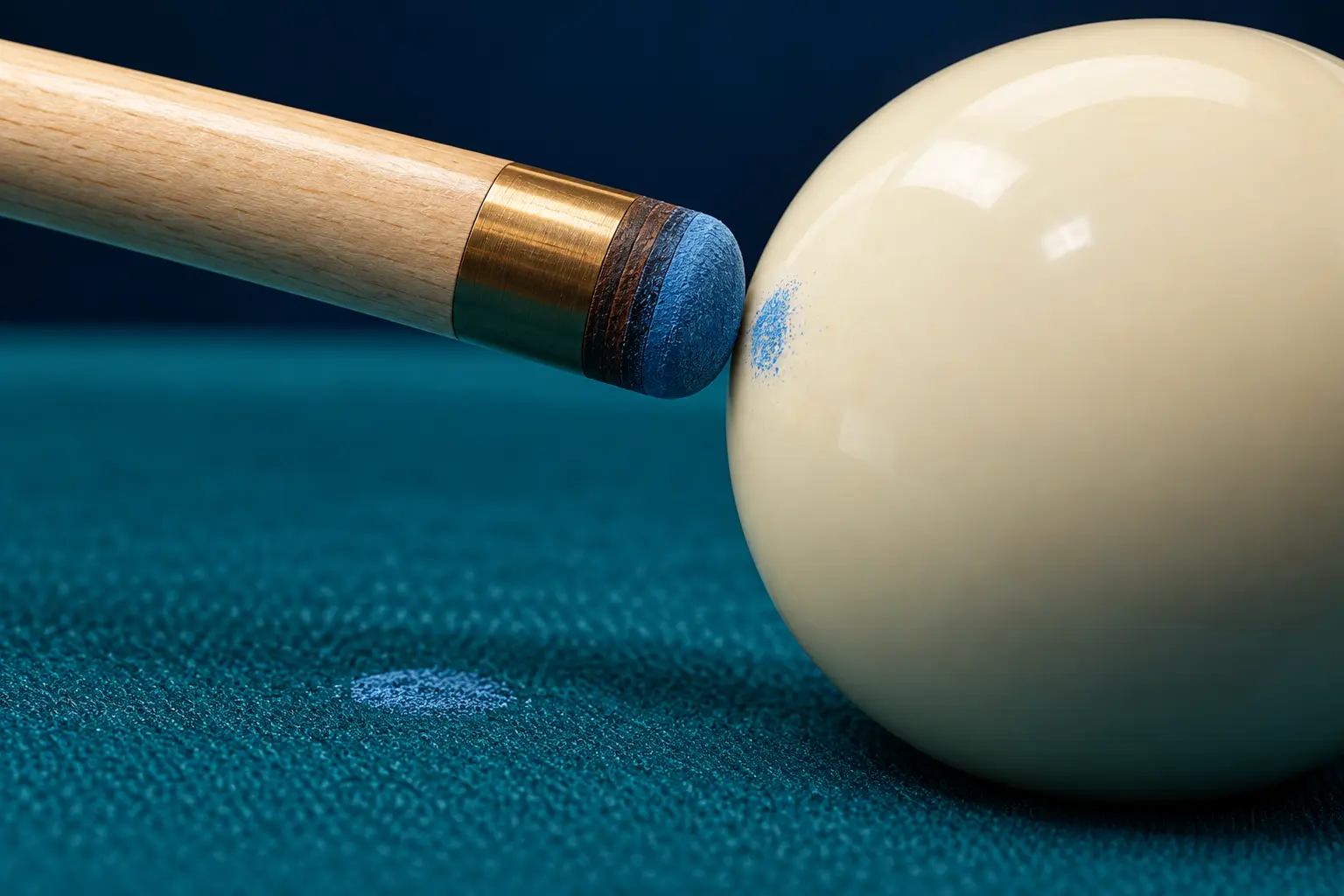
Separate freshness from orientation
Chalk travels with the surface carrying it. After a cue ball rolls or spins, a resting mark’s position is not the original contact position in table coordinates. A fresh mark with unregistered rotation is still insufficient for initial left/right or height diagnosis. Smears and old marks add another ambiguity.
WPA permits chalk to reduce miscues, not as an aiming marker. Do not add paint, marks or fixtures to a match ball for this worksheet. Use existing permitted practice-ball features and an appropriate practice recording if orientation needs to be registered.
| Question | Required record | What it cannot establish alone |
|---|---|---|
| Which strike made it? | approved clean/dry baseline and fresh pre/post images | where initial contact lay in table coordinates |
| How did the ball rotate? | visible existing features tracked continuously from contact to rest | that a smear was made by the current tip strike |
| What did the material do? | contact, slip and controlled-input evidence beyond residue | friction, durability or equipment superiority from a photograph |
Make an eight-strike provenance record
Use ball-center coordinates on an illustrative 100×50-inch bed: x=0..8 along the length, y=0..4 across it, origin at the lower-left cushion-nose corner. Equal 2.25-inch balls have radius 0.09 and diameter 0.18 units. Intact-cushion center limits are 0.09..7.91 and 0.09..3.91. Six real pockets interrupt the boundary at the four corners and (4,0),(4,4). Measure the actual bed, balls and pocket mouths before scaling; remove measuring aids before shooting and never mark a competition table.
Use one cue ball at C(2,1), nominally toward intact upper cushion center contact R(2,3.91), with no object balls. Take eight ordinary controlled centerline requests. Keep cue, tip, chalk, pace request, practical elevation and lighting fixed. This is not an eight-product test.
Before each strike use the ball owner’s approved cleaning/drying method and record the visible pre-state. Record four fields: pre-state/freshness; intended request and tip coverage; post-strike mark and possible alternative source; orientation trace and any loss of registration. Photograph the existing surface without adding markers. Four fields × eight strikes is thirty-two planned documentation cells, not thirty-two friction points.
Where a field cannot be observed, write unknown. If recording cannot continuously register rotation, retain the image as residue evidence only. Do not infer contact location by looking at the resting mark before picking up the ball; it has already rotated.
Apply chalk and inspect coverage as a separate procedure before the provenance block, without changing technique mid-block.
Build a repeatable preparation habit when inconsistent preparation is the actual question.
Count the intersection, not the most flattering column
Hypothetical eight-attempt ledger: attempts {1,2,3,4,5} have identifiable fresh marks; attempts {1,2,6,7} retain an orientation trace. Only {1,2} satisfy both requirements: two candidate contact-location observations, not five or four. Even those two need adequate resolution and an unsmeared footprint before estimating an offset.
The other six attempts remain in the record with their specific limitation. Do not average unavailable offsets as zero, count a registered old mark as fresh or award skill points for filling a box. These are made-up set counts, not test results.
Use residue for the question it actually answers
Loose powder on cloth or a large smear may justify a preparation or cleanup check. It does not quantify useful friction or prove that less visible transfer is better. Follow the ball and cloth owners’ approved maintenance methods; this page supplies no new cleaner recipe.
If product comparison is warranted later, design a separate controlled comparison and preserve its setup. Changing the chalk now would turn an observation repair into an uncontrolled equipment experiment.
Compare chalk choices with a separate evidence task instead of interpreting this ledger as a product ranking.
Rebuild the no-intentional-sidespin reference when the requested delivery itself is uncertain.
Repair one missing observation and retest
Take four new strikes after fixing only one documentation problem, such as camera registration or approved pre-state capture, retaining the same equipment and shot. Eight baseline + four retest = twelve actual strikes only if completed. Record how many marks now meet freshness, orientation and readability together, with no invented percentage of successful contact.
Keep baseline and retest separate. A remaining unknown is a useful boundary on the evidence, not a reason to call the chalk or tip defective.
Sources and further reading
References support the specific factual information above. The practical checklists are Ariakon editorial guidance.