
Fundamentals · 4 min read
Find and Strike the Center of the Cue Ball
A no-sidespin reference is useful even when the camera cannot prove the exact delivered contact. Separate the ball’s geometry, your view and the observed path. A pocketed ball or a straight cushion return alone cannot certify that the tip struck a true zero.
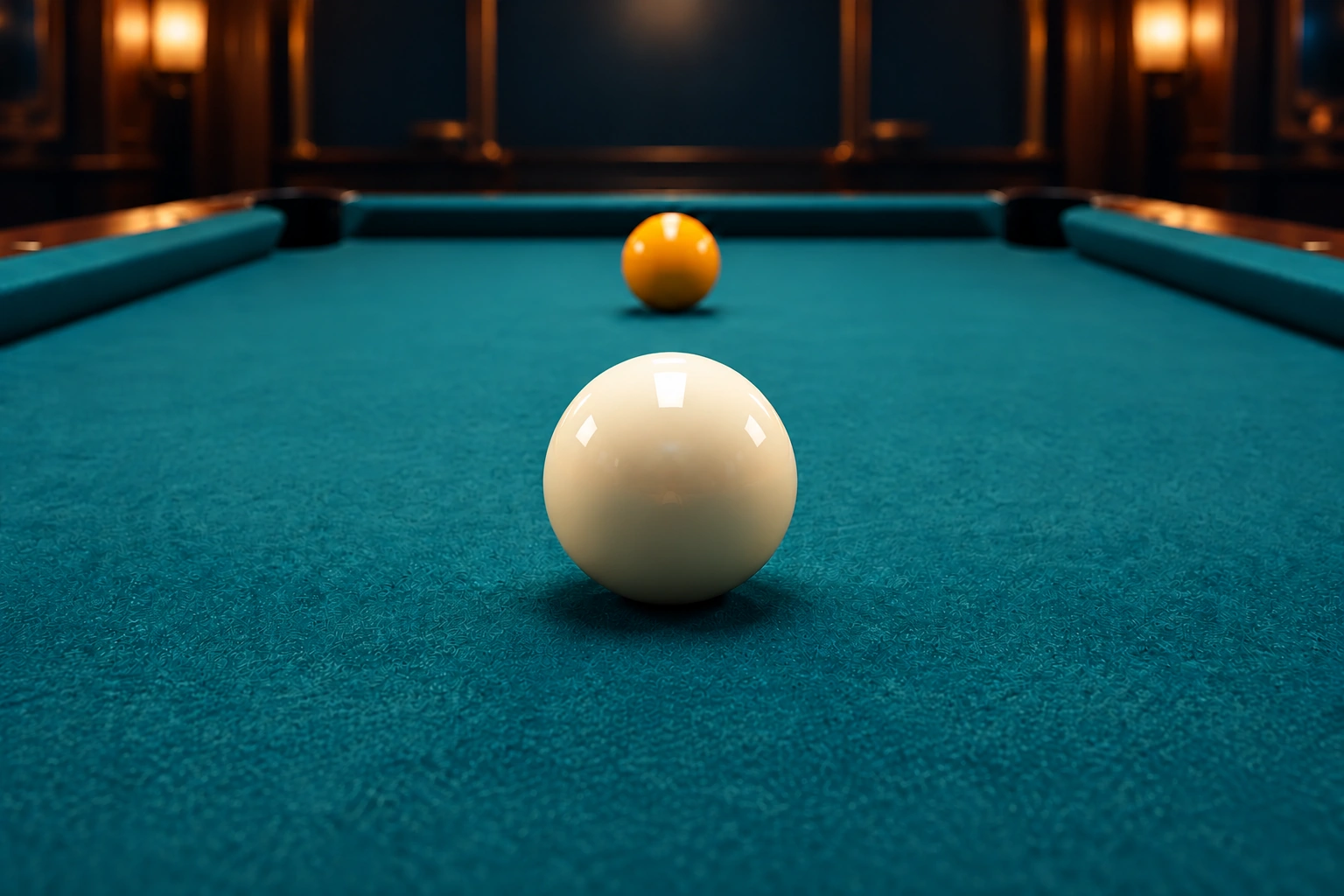
Define the reference before using a highlight
The geometric center is inside the sphere. The vertical contact plane contains that center and the chosen shot direction; no intentional left/right offset is the reference here. Follow and draw requests can stay in that plane while changing height. The bright reflection is set by lighting, not by the ball’s zero-contact geometry.
The midpoint of the visible outline from an elevated viewing position is not a universal physical contact-height marker. Cue elevation also matters: in an ideal central-axis construction a downward cue at angle θ reaches the rear surface above the sphere center by R sinθ. With R=1.125 inches and θ=5°, that height is about 0.098 inch (2.49 mm). This is illustrative geometry, not a contact prescription or a guarantee of zero delivered sidespin.
Use minimum practical elevation and a comfortable repeatable view. Set the cue line and stable bridge before approaching the ball; do not steer the tip sideways at the last moment to repair the address.
Find a repeatable personal vision center for the distinct head-position task.
Check bridge support readiness if the cue does not settle on its intended line.
Observe six cue-only returns
Use ball-center coordinates on an illustrative 100×50-inch bed: x=0..8 along the length, y=0..4 across it, origin at the lower-left cushion-nose corner. Equal 2.25-inch balls have radius 0.09 and diameter 0.18 units. Intact-cushion center limits are 0.09..7.91 and 0.09..3.91. Six real pockets interrupt the boundary at the four corners and (4,0),(4,4). Measure the actual bed, balls and pocket mouths before scaling; remove measuring aids before shooting and never mark a competition table.
Place only cue center C(2,1), with nominal direction toward the intact upper cushion at center contact R(2,3.91). That point is away from the upper side pocket at x=4. Take six ordinary controlled strikes with no intentional sidespin. At the return crossing y=2, record signed residual x−2; call a ±0.09-unit window before shooting and remove all measuring aids.
The ideal square return crosses x=2, but cloth, cushion condition, speed, delivery and observation error all affect the result. A return inside the window does not prove zero sidespin. Record actual cue-axis visibility and any unknown crossing separately.
| Attempt | Return crossing | Observation result |
|---|---|---|
| 1..6 | signed x−2 at y=2 | 0 outside chosen window; 1 inside; unknown unscored |
Keep six object-ball outcomes in a second block
Set object O(6, 3), real upper-right pocket P(8, 4), intended first-contact cue center G(5.839003, 2.919502) and cue start C(4.944576, 2.472288). Direction u=(2,1)/√5 points toward that pocket; G is one ball diameter behind O. The chosen stop target is a cue-center rest disk of radius 0.18 at G. It is a practice tolerance, not a guaranteed result of a center-height strike.
Take six ordinary straight-in attempts at a comfortable repeated pace, still with no intentional sidespin. For this reference block score only a known legal object pot as one point, miss/foul as zero: maximum six. Record cue-ball departure and rest separately; center-height contact can develop forward roll before object contact, so a stop is not required here.
The complete baseline has twelve struck attempts and two separate six-point ceilings. Example cue-only crossing x=2.06 gives residual +0.06 units, or +0.75 inch on this bed, within the chosen window. That made-up row shows arithmetic, not measured accuracy or proof of a perfect strike.
Require orientation before interpreting a contact mark
An existing permitted practice-ball feature can help register orientation in a recording. A mark on the ball at rest has moved with the ball’s rotation; it cannot be read as initial left/right contact without that registration. Unregistered or smeared marks belong in unknown, not a contact-location average.
Use a clear cue view, path and properly registered mark as complementary observations. If they disagree, improve the observation or repeat the condition; do not erase the inconvenient field or immediately rank equipment.
Keep a chalk-mark provenance and orientation ledger before assigning a mark to the initial contact location.
Separate precontact path from later ball-contact effects when intentional sidespin becomes the next task.
Retest a supported address change
Choose one repeated visible address issue and take four new attempts in the relevant cue-only or straight block, retaining that block’s 0..1 result scale. Twelve baseline + four retest = sixteen actual strikes only if completed; retest maximum four stays separate.
A consistent no-intentional-sidespin request is a starting reference, not an equipment test. Delay deliberate offsets until the ordinary task is comfortably repeatable and the observation limitations are understood.
Sources and further reading
References support the specific factual information above. The practical checklists are Ariakon editorial guidance.