
Aiming fundamentals · 3 min read
Find a Repeatable Vision Center for Pool
Your vision center is the head position that makes a correctly aligned cue and shot line look straight to you. It is a practical calibration, not a universal point under the dominant eye or chin. Find a comfortable candidate, test it on the table and keep it only when your sight picture and delivery repeat from both directions.
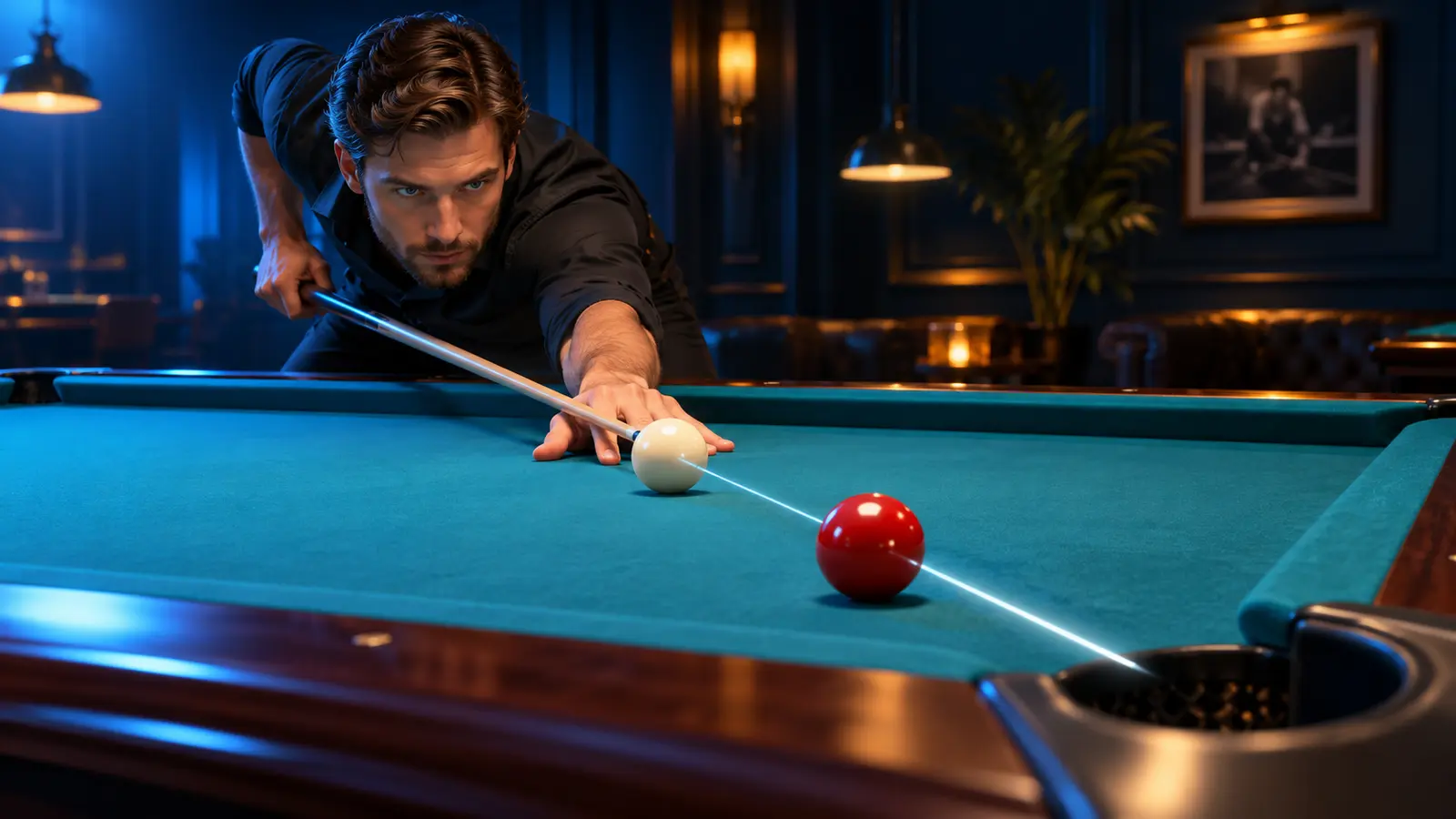
Separate vision center from eye dominance
Eye dominance may influence sighting, but it does not prescribe one head position for every player. Test the position that makes the known straight line and intended cue-tip contact look accurate while preserving comfortable delivery.
Do not force your face over a textbook location. The useful position must also permit a balanced stance, a free cueing arm and a level sight picture.
Build a trustworthy straight reference
Place the cue ball and an object ball on a known straight line to a center pocket. Use table diamonds, a removable alignment aid or carefully placed reinforcement rings; do not tape or mark cloth without the table owner's permission.
Stand behind the line before lowering into the stance. Move your head slightly left or right until the cue, cue-ball center, object-ball center and pocket line look stacked without tilting.
Lower without moving the sight line
Keep the chosen head position over the line as you step into the shot. Let the body arrange itself around that sight picture rather than placing the feet first and pulling the eyes onto the cue afterward.
Take several warm-up strokes and check whether the tip still appears centered on the cue ball. If the view shifts during the stroke, pause and rebuild from standing.
Test left and right cut shots
Use mirrored moderate cuts from the same distance and speed. Shoot sets from both sides while keeping the candidate head position and pre-shot approach unchanged.
A position that feels perfect on one cut direction but produces a stable bias on the other needs more testing. Check alignment and cue delivery before assigning every miss to vision.
Record a range, not a magic millimeter
Note where the cue appears relative to the chin, nose or glasses only after repeated results. Those landmarks help you return to the same area; they are not proof by themselves.
Recheck on another day and table. If the position is uncomfortable, unstable or requires neck strain, stop forcing it and ask a qualified instructor to observe your approach and delivery.
Use a twenty-shot calibration
- Five straight shots at pocket speed.
- Five straight shots at a slightly firmer speed.
- Five moderate cuts to the left.
- Five mirrored cuts to the right.
- Record miss direction and cue-ball finish.
- Retest before making a permanent stance change.