
Aiming fundamentals · 3 min read
Where to Look When You Aim a Pool Shot
Looking near and far serves different jobs. Make those jobs deliberate without turning one player’s gaze sequence into a rule for every player. This card checks a usable preparation routine; ordinary phone footage cannot certify an exact fixation duration.
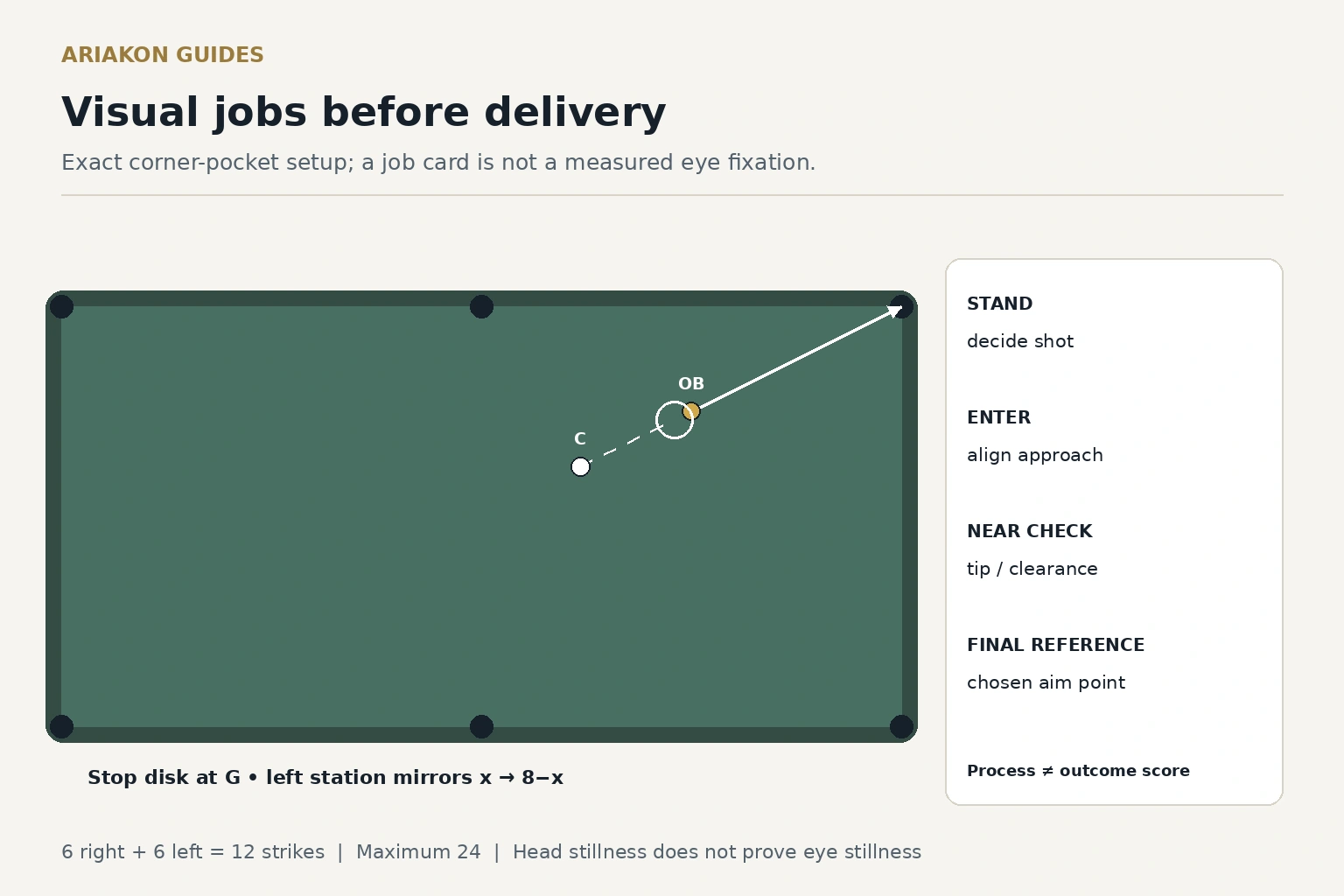
Assign a job to each look
You may revisit near/far references while checking alignment. Choose a final reference that fits your method; this is not a universal object-ball-last command. If the plan changes after settling, stand up and rebuild it instead of steering during delivery. No exact number of looks or compulsory pause length is prescribed.
| Job | Useful reference | When to reset |
|---|---|---|
| Standing plan | Object-to-pocket line, intended contact and next cue region | The shot or intended leave is not yet decided |
| Enter the stance | Cue approach aligned to the chosen shot line | The cue or comfortable support cannot reach the line |
| Near verification | Tip gap and intended cue-ball contact during safe warm-ups | Unexpected offset or obstructed cue clearance |
| Final aim reference | One chosen precise external aim reference before delivery | Attention changes the shot plan after settling |
Write a usable pre-shot plan before deciding where visual attention belongs.
Run two exact straight stations
Use ball-center coordinates on an illustrative 100×50-inch bed: x=0..8 along the length, y=0..4 across it, origin at the lower-left cushion-nose corner. Equal 2.25-inch balls have radius 0.09 and diameter 0.18 units. Intact-cushion center limits are 0.09..7.91 and 0.09..3.91. Six real pockets interrupt the boundary at the four corners and (4,0),(4,4). Measure the actual bed, balls and mouths before scaling; remove measuring aids before shooting and never mark a competition table.
Right station: O(6, 3), pocket P(8, 4), first-contact cue center G(5.839003, 2.919502), cue start C(4.944576, 2.472288). Left station mirrors x→8−x: O(2, 3), P(0, 4), G(2.160997, 2.919502), C(3.055424, 2.472288). Call a cue-center stop disk of radius 0.18 at each G. The initial object lines point to actual upper corner pockets, not the middle of a short cushion.
Take six right and six left attempts using one chosen visual-job routine. Keep cue, surface, comfortable pace and setup version fixed. Twelve actual attempts are the baseline. The mirrored station is not a second six-shot block for each bridge or each eye pattern.
Separate result points from process evidence
Next to the score record intended final reference, whether you changed the plan late, and a reset before striking. A reset is useful process information, not a failed strike. A self-report is not a measured gaze trace. An observer can note visible head movement or cue alignment but cannot infer eye fixation merely because the head appears still.
The indexed billiards gaze study investigated fixation behavior and task constraints with measurement equipment. Its findings do not validate a universal phone-video timing prescription. Keep camera claims within what the recording actually resolves. Unknown pot/finish results remain unscored and reduce the maximum by two each.
| Points | Known result |
|---|---|
| 0 | Miss or foul |
| 1 | Legal pot, cue outside called stop disk |
| 2 | Legal pot plus cue in called stop disk |
Use a modest cut as a separately scored transfer
For six transfer attempts use O(6, 2), P(8, 4), G(5.872721, 1.872721) and C(5.562138, 0.71361). Call the finite finish disk A(5.519167, 2.226274) of radius 0.18, without promising it will be reached by the routine alone. Score legal pot and joint finish as above: maximum twelve transfer points. Eighteen strikes occur only if both blocks finish; keep baseline 24 and transfer 12 separate.
If pots improve but late replanning persists, keep the useful result and work on the process separately. If the near tip check causes a new alignment problem, rebuild the stance rather than skipping clearance verification. The timing-comparison page tests pause patterns; this page assigns visual jobs and bounds the evidence.
Compare pause-pattern timing as a different experiment after the aim reference is clear.
Calibrate the chosen cut finish distance without attributing it solely to gaze.
Sources and further reading
References support the specific factual information above. The practical checklists are Ariakon editorial guidance.