
Aiming · 3 min read
Test Eye Pattern Timing Without Changing Your Stance
An eye-pattern test becomes unreadable when the player also changes feet, head height, bridge length or stroke speed. Freeze the physical setup, give each look one job and compare a small number of timings. The broad eye-pattern guide explains near and far targets; this protocol tests when those checks occur without prescribing one universal rhythm.
Register the shot and freeze the stance
Mark a comfortable straight-in shot: object ball one diamond from a corner pocket and cue ball three diamonds away on the same line. Mark the bridge-hand area and both foot positions with removable references where permitted. Use center-ball contact and pocket speed.
Stand up and restart whenever the line looks wrong. Do not twist the head or cue to rescue a trial. The stance marks are controls for this experiment, not permanent instructions for every shot or body.
Build a consistent eye pattern to understand the near and far visual jobs.
Coordinate the final look and forward stroke after choosing a candidate timing.
Compare three timing patterns
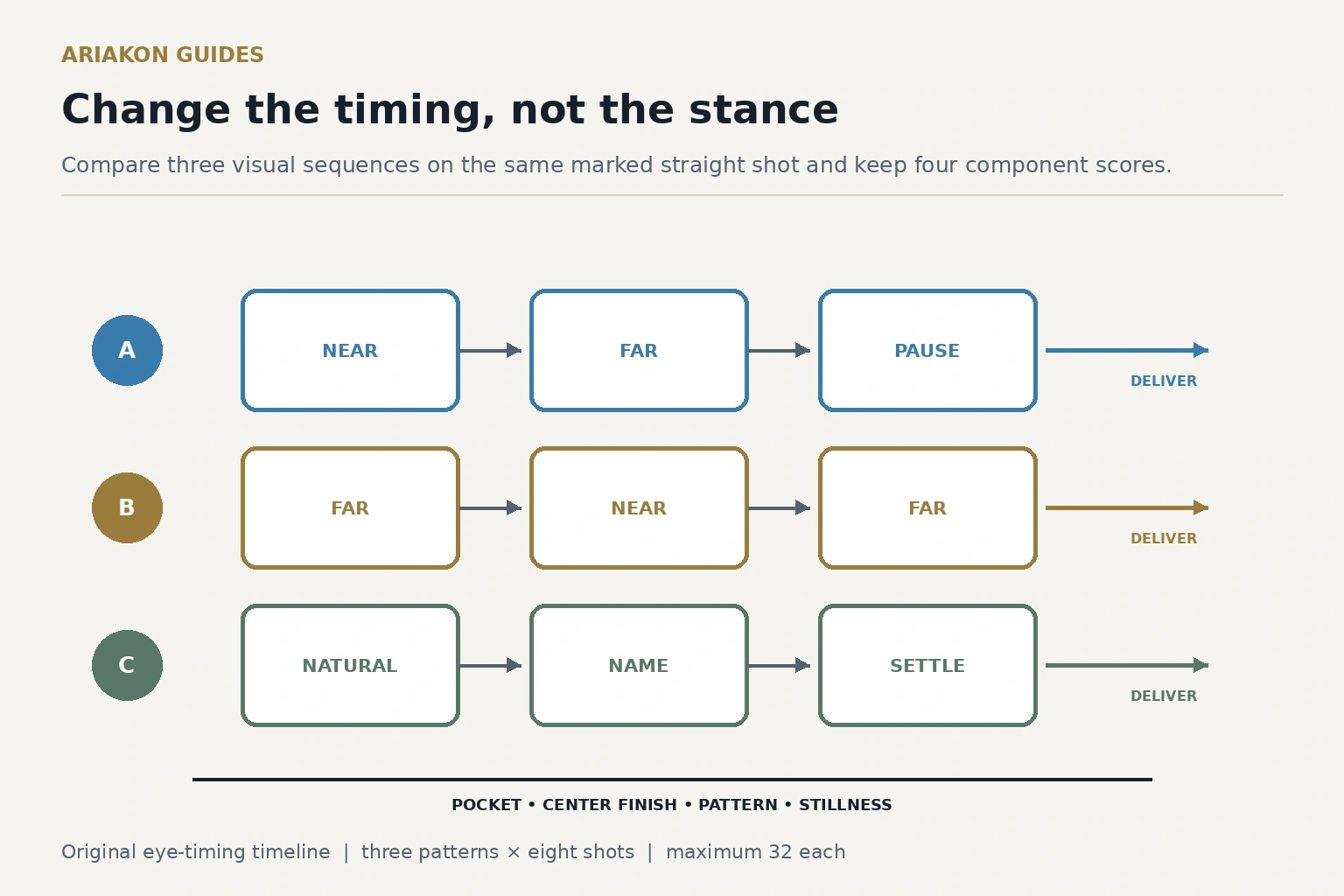
Randomize the order as C-A-B, then B-C-A on later blocks so fatigue does not always favor the first pattern. A partner may call only the pattern letter before the player approaches; no coaching occurs while the player is down.
| Pattern | Eight attempts | Final visual job |
|---|---|---|
| A — Early far | Cue ball check, object ball check, pause, deliver | Target line settles before final backswing |
| B — Late near | Object ball check, cue ball check, return far, deliver | Tip contact is verified late, then gaze returns |
| C — Natural count | Use present sequence but name each check | Baseline comparison without forced timing |
Score outcome, contact and stillness separately
Each pattern has a maximum of thirty-two. Keep the four component totals. A high pocket score with repeated extra looks may be a result to retest, not a clean timing candidate.
Quiet-eye research in billiards describes the final fixation on a task-relevant target before movement and found differences associated with expertise, task distance and successful trials. It does not establish one mandatory count for every player, which is why this protocol compares personal repeatability.
| Point | Evidence |
|---|---|
| Object ball enters the intended pocket | |
| Center finish | Cue ball remains inside a hand-width corridor after contact |
| Pattern | Named sequence completed without an extra searching look |
| Stillness | Head remains quiet through cue-ball contact on video or partner observation |
Worked comparison
A hypothetical player scores A: 25/32, B: 21/32 and C: 24/32. Pattern A has seven stillness points and no extra looks; C pockets one more ball but includes four late searches. The player retains A for another two matched blocks instead of declaring it permanently superior after eight shots.
If every pattern misses to the same side, timing is probably not isolated as the main constraint. Return to standing alignment or cue-delivery diagnosis while keeping the best-understood eye sequence unchanged.
Transfer without changing everything
After two retained blocks, use the candidate pattern on six modest cut shots and six routine position shots. Keep the verbal sequence but allow the stance to fit the shot naturally. Score pattern completion and outcome separately.
If the timing collapses only under more difficult geometry, shorten the final-look task rather than adding eye movements. If visual discomfort, double vision or headaches occur, stop and consult an appropriate eye-care professional.
Sources and further reading
References support the specific factual information above. The practical checklists are Ariakon editorial guidance.