
Aiming · 3 min read
Coordinate Your Final Look With Your Forward Pool Stroke
A full eye pattern organizes every near and far check. This narrower guide tests the handoff from the last useful look to the forward stroke. Research supports the value of a settled final fixation in aiming tasks, but it does not establish one universal count or final target for every pool player. Use a matched trial and retain only a pattern that improves observable delivery.
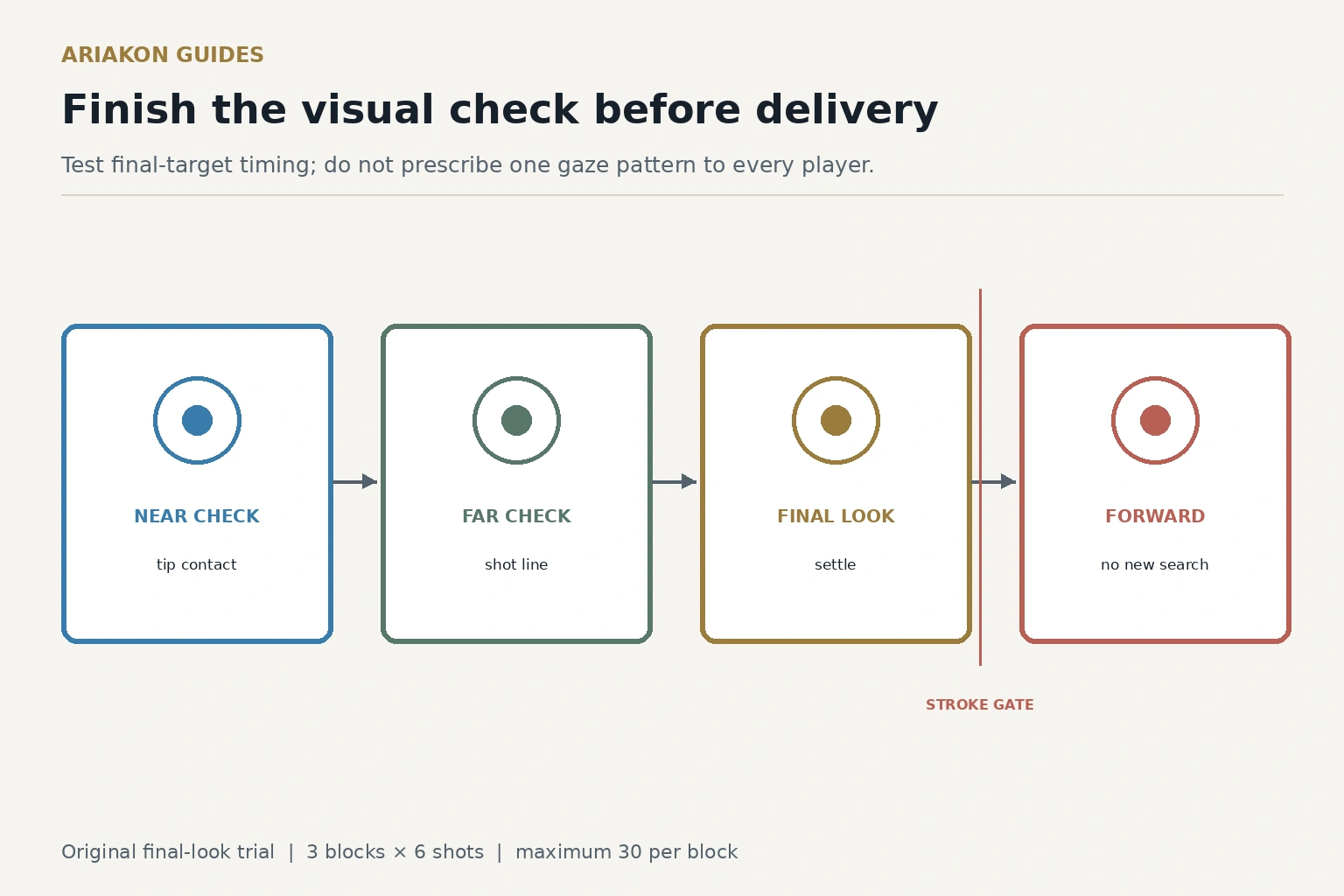
Give each look one job
The existing eye-pattern guide covers the complete sequence. Here, the measured variable is only what happens immediately before and during delivery.
A phone camera can show the pause and gross head movement, but not exact fixation location. Final-target records are player reports unless proper eye-tracking equipment is used.
| Phase | Visual job | Cue job |
|---|---|---|
| Near check | Confirm tip contact on the cue ball | Warm-up strokes may continue |
| Far check | Confirm object-ball target and pocket line | Cue returns to set |
| Final look | Settle on the chosen external target | Cue remains still |
| Forward stroke | Avoid a new search or correction | Deliver through the chosen contact |
Review the complete eye pattern before isolating the final look.
Use a set-position readiness pause to separate checking from delivery.
Build one easy reference shot
Place the object ball one diamond from a corner pocket on its center line and the cue ball one diamond away, straight in. Mark both centers. Use center ball and a speed that sends the object ball cleanly to the pocket without requiring position play.
Complete five unscored warm-ups. Choose a comfortable number of warm-up strokes and keep it through all test blocks. If the shot is not routinely makeable, shorten it before testing vision.
Test three final-look patterns
Award one point each for correct tip setup, final gaze settled before the backswing, no reported gaze switch during the forward stroke, object ball pocketed and cue ball staying inside a one-ball-width lateral corridor. Maximum score is thirty per block.
The self-selected block is not automatically the winner. Compare component totals and retest on another day. A one-shot difference in six attempts is too small to support a strong conclusion.
| Block | Final target | Attempts |
|---|---|---|
| A | Object-ball contact or pocket line | 6 |
| B | Cue-ball tip-contact point | 6 |
| C | Player-selected pattern after A and B | 6 |
| Order | Alternate A/B order on the next session | 18 total per session |
Diagnose timing before changing the target
| Pattern | First check | Next action |
|---|---|---|
| Eyes still alternate as the cue moves forward | Set pause is missing | Finish visual checks earlier |
| Head lifts to follow the object ball | Result watching begins too soon | Hold finish until impact sounds |
| Tip contact varies by block | Near check is incomplete | Add one deliberate near check before final look |
| Pocketing stable but lateral drift rises | Cue delivery, not only gaze | Run a straight-stroke corridor test |
| Both fixed patterns feel forced | Personal rhythm mismatch | Return to the best self-selected sequence |
Worked comparison and retention rule
A hypothetical player scores 25/30 with a far final look, 21/30 with a near final look and 27/30 self-selected. The near block loses four lateral-corridor points and three “no gaze switch” points. The next session reverses A and B order; far scores 24 and self-selected 26.
The player keeps the far final look for ordinary straight shots because it survives the retest, then checks it on moderate cuts. If performance worsens under a different task, the player records the exception rather than declaring a universal eye rule.
Sources and further reading
References support the specific factual information above. The practical checklists are Ariakon editorial guidance.