
Equipment guides · 4 min read
What Cue Tip Compression Video Can Actually Demonstrate
A compression clip can show a visible shape change while leaving the inputs needed for comparison unknown. Preserve the capture information and separate sampled appearance from continuous physical contact. This worksheet is for interpreting a clip, not choosing a hardness label from a dramatic frame.
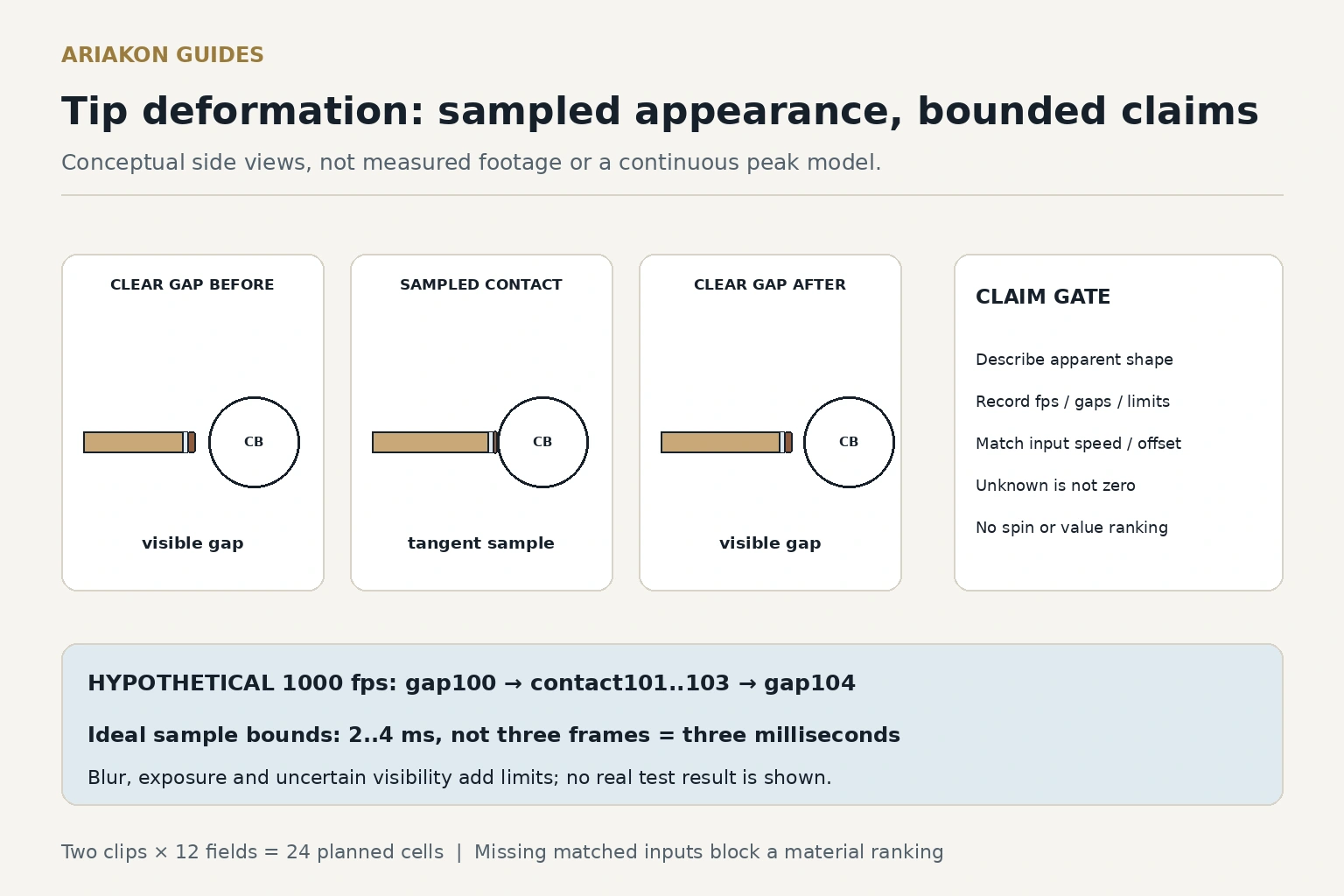
Separate observed shape from product claims
Describe apparent deformation at the captured sample, not the true continuous peak between samples. A larger visible change does not by itself establish more spin, force, durability or value. Unknown input speed, delivered offset, geometry and viewing conditions block an isolated material comparison.
Use footage you own or have permission to inspect. Keep the original file; do not republish another creator’s frames as original artwork or substitute Ariakon for a named product’s specifications. A construction choice and a matched playing trial are different tasks.
Compare delivered playing outcomes without universal hardness claims for the separate controlled on-table task.
Compare layered and single-piece construction without turning layer count into a hardness measurement.
Complete a twelve-field comparison worksheet
For two clips there are twenty-four planned fields. An illustrative nine documented fields in clip A plus eight in clip B gives seventeen documented cells, not seventeen comparable measurements. If cue input speed or delivered offset is missing, a filled worksheet still cannot isolate tip material performance.
Use same-plane scale only when it is registered to the relevant geometry. Perspective, blur and deformation can make a pixel boundary ambiguous; record the method and uncertainty rather than manufacturing precision. NIST’s 1994 reporting guidance is a general measurement reference, not certification of this worksheet or a billiards test.
| Field | Required entry |
|---|---|
| File identity / permission | owned or permitted original, no borrowed frame republication |
| Cue configuration | shaft, joint and tip record; no guessed specifications |
| Tip geometry / condition | shape, dimensions, preparation and wear when known |
| Ball / chalk condition | documented pre-state and ordinary preparation |
| Intended / delivered offset | request is not verified contact |
| Cue input speed | known measurement or explicitly unknown |
| View / same-plane scale | registration, perspective and resolution limits |
| Capture cadence / export | capture fps, interpolation and editing history |
| Last clear gap before | frame/time and visibility limit |
| First / last sampled contact | sample indices, not a continuous peak |
| First clear gap after | frame/time and visibility limit |
| Supported claim / missing controls | visible observation, alternatives and blocked inferences |
Count capture intervals rather than contact frames
Hypothetical constant capture at 1000 frames/s: frame 100 is the last clear gap, 101 the first sampled contact, 103 the last sampled contact and 104 the first clear gap after. Under the ideal discrete-sample visibility assumptions, onset lies between 100 and 101 and separation between 103 and 104. Duration is bounded by two to four milliseconds, not automatically three milliseconds because three contact frames are visible.
Those bounds ignore additional uncertainty from exposure duration, rolling shutter, blur, interpolation and uncertain gap/contact classification. State those limits. If a required gap is obscured, the example’s bounds cannot be assigned to that clip. These numbers are invented arithmetic, not an observed equipment test.
At 240 capture frames/s adjacent samples are about 4.167 milliseconds apart. A brief contact may occur entirely between useful samples; slow playback cannot recover it. Do not promise that a phone will resolve tip compression, and do not confuse playback fps with capture fps.
Use a claim gate before comparing two clips
If the comparison gate fails, retain both clips as observations and write the missing inputs. Do not turn an unknown into a zero, rely on a soft/medium/hard label as a measured variable or invent an independent test that was never performed.
| Evidence | Permitted conclusion | Blocked conclusion |
|---|---|---|
| Readable apparent shape at a sample | visible sampled deformation under that setup | continuous maximum or measured force |
| Registered gaps and documented cadence | stated event brackets with stated limits | exact duration from frame count alone |
| Unmatched speed, offset or configuration | two recorded appearances, controls missing | hardness, spin, durability or purchase winner |
Audit the broader product-demonstration evidence when the question extends beyond contact deformation.
Separate shaping and scuffing functions when condition rather than material is the supported next issue.
Choose a restrained next action
A useful result can be a request for an unedited clip, documented configuration and matched inputs. If on-table comfort or maintenance is the real purchase question, use a separate task-specific trial and service record; the clip is not a substitute.
Keep the twelve-field ledger and original-file identity privately with the decision. Do not reproduce proprietary exercises, brand claims or source media as an Ariakon invention.
Sources and further reading
References support the specific factual information above. The practical checklists are Ariakon editorial guidance.