
Equipment guides · 4 min read
Does Cue Tip Hardness Change Cue Ball Spin?
A softer label does not by itself promise more usable spin. Tip contact away from the ball center provides rotational impulse; delivered speed, actual offset, cloth travel and arrival state also matter. Use a small control comparison to decide what you can deliver, not a photo or a loud hit to rank maximum spin.
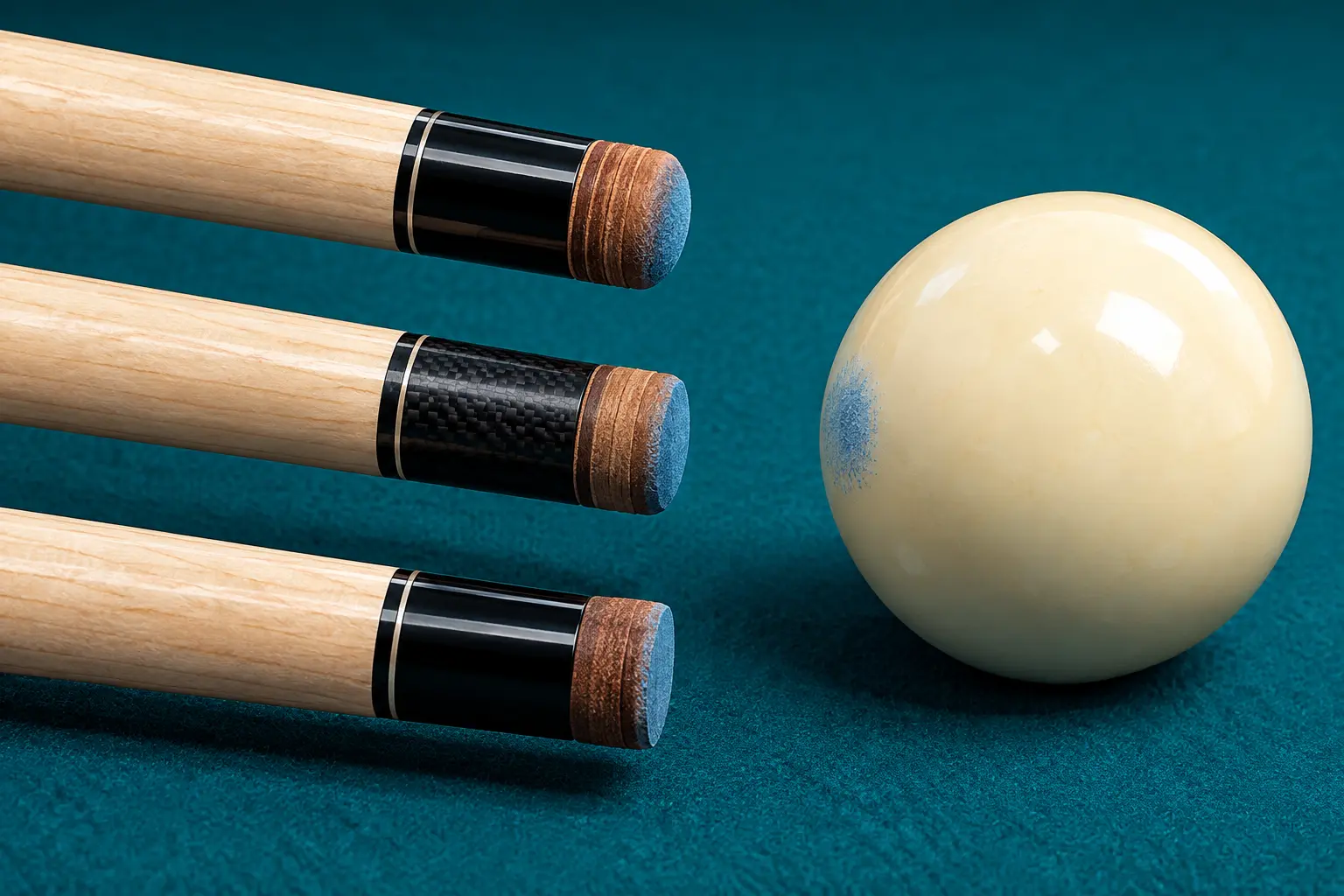
State what the comparison can and cannot isolate
Within ordinary playing-tip choices, hardness alone is not a reliable extra-spin control. Changing a tip may also change feedback, condition, crown, height or energy transfer; changing a whole cue adds shaft and weight differences. Equal requested strokes are not proof of equal cue-ball speed or offset.
Use sound, feel and maintenance notes as preferences, not spin instruments. Do not assume every hard tip retains chalk identically, every soft tip is safer, or every construction shares an identical miscue threshold. Break-tip materials and maximum-offset testing are outside this ordinary playing-cue task.
Compare layers and single-piece construction separately rather than using layer count as a hardness reading.
Inspect and maintain the contact end conservatively before comparing a damaged or poorly chalked sample.
Freeze one shot and two finite finish requests
Use ball-center coordinates on an illustrative 100×50-inch bed: x=0..8 along the length, y=0..4 across it, origin at the lower-left cushion-nose corner. Equal 2.25-inch balls have radius 0.09 and diameter 0.18 units. Intact-cushion center limits are 0.09..7.91 and 0.09..3.91. Real pockets interrupt the boundary at four corners and (4,0),(4,4). Measure your actual bed, balls and pocket mouths before scaling. Remove measuring aids before shooting and never mark a competition table.
Use O(6,3), real P(8,4), contact G(5.839003, 2.919502) and C(4.944576, 2.472288). Choose a familiar straight follow delivery and a familiar straight draw delivery, both on the vertical axis with comfortable modest offsets. Record the intended offset and pace for each before starting; do not increase offset until a miscue occurs.
For follow call a cue-center finish disk radius 0.18 at (6.375659, 3.18783). For draw use the same radius at (5.302347, 2.651173). These are attainable practice preferences, not predictions from a hardness label. The finish combines delivery, collision and cloth action; it is not direct measurement of the spin at impact.
Build a twenty-four-strike equipment record
Use only serviceable ordinarily chalked equipment with permission. Do not repeatedly replace glued tips during a session. Label sample configuration, installation/condition, table and ball. Alternate A/B within each request, resetting C and O; retain requested pace and note any necessary adjustment. If only one cue is available, make a twelve-shot baseline and do not fabricate a second sample.
Record legal called pots, target-disk finishes, observed miscues and actual struck attempts separately. A scratch or miscue stays an attempted outcome. Unknown tip offset stays unknown. Ordinary phone footage can observe travel but may not resolve contact offset or rotation; a chalk mark without registration is not enough.
| Sample | Follow | Draw | Total |
|---|---|---|---|
| A | 6 attempts | 6 attempts | 12 |
| B | 6 attempts | 6 attempts | 12 |
| Planned total | 12 | 12 | 24 |
Interpret a result without inventing a hardness test
Hypothetical follow A: five pots and three target finishes out of six; B: five pots and four target finishes out of six. Draw A: four pots/two targets; B: four pots/three targets. These counts give 18 pots and 12 target finishes across 24 strikes, but keep all four cells visible. A target finish is counted only with a legal pot for this worksheet.
The record might favor B for these delivered requests. It cannot prove B spins more at an equal speed and actual offset, and two different cues cannot isolate hardness. Do not turn a one-target difference into a laboratory claim, percentage improvement guarantee or a product endorsement.
Use the comparison to make a restrained next decision
If both samples support familiar shots, decide from comfortable feedback, reliable care and a documented installation rather than a promised spin upgrade. If control fails, first inspect condition, chalk coverage, replacement accuracy and actual delivery. Structural damage, an opening bond or repeated uncontrolled contact ends the test.
Take four separate retest strikes on one request after one documented change, making 28 total only if the comparison was completed. Keep retest and baseline apart. A proper spin study would need matched actual speeds, verified offsets and rotational measurement; this original worksheet deliberately does not claim those instruments.
Recheck arrival state on an exact stop task when the cue ball result is the uncertain part.
Sources and further reading
References support the specific factual information above. The practical checklists are Ariakon editorial guidance.