
Cue tip care · 2 min read
Compare Cue Tip Shaping and Scuffing Functions
A shaper changes curvature and consumes height. A scuffer changes only the crown's surface texture. Packaging both functions together does not make them a sequence. Use the SHAPE–SCUFF comparison to name one observed condition, select one function and set its inspection interval before touching leather.
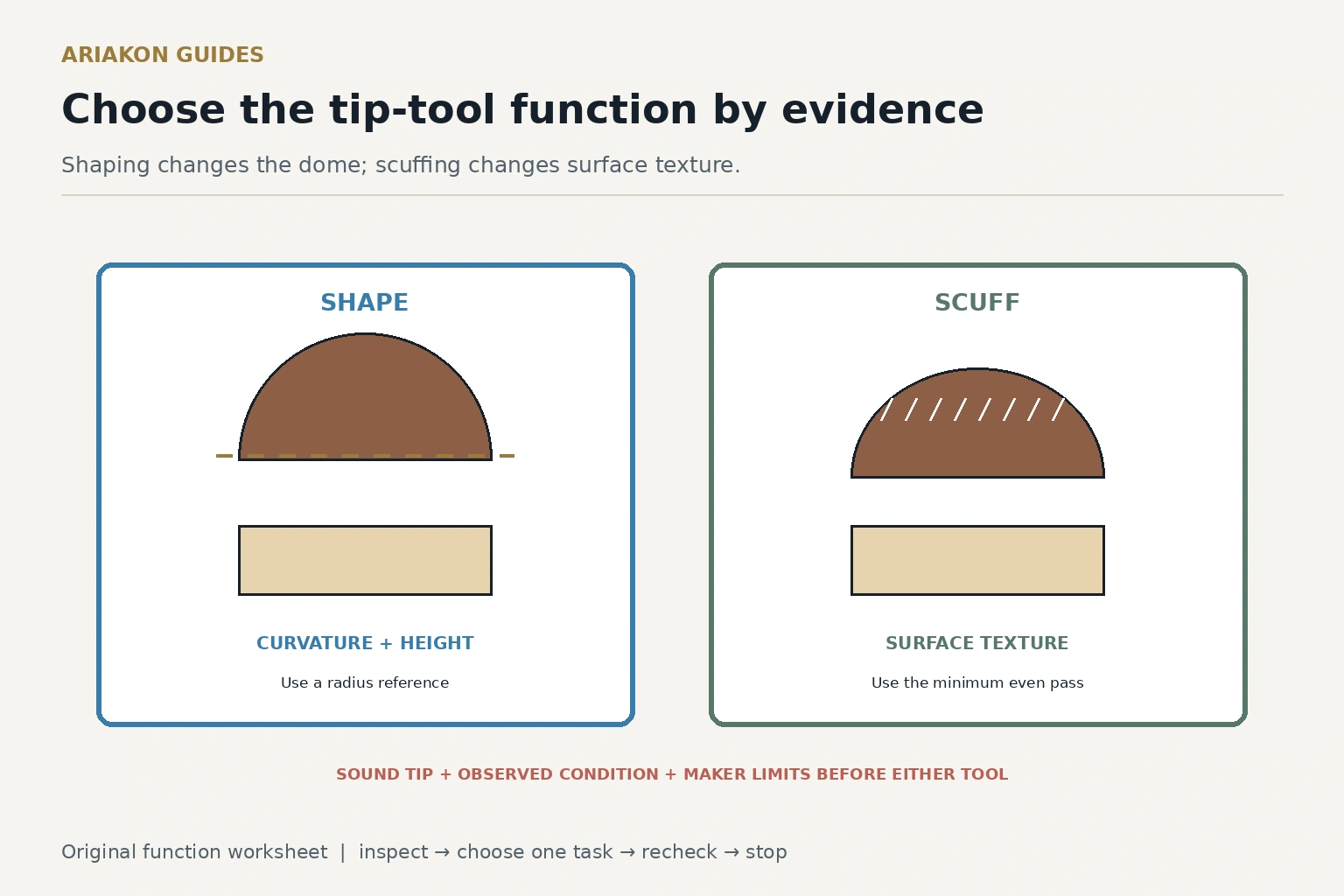
Choose by evidence, not by the tool in hand
| Observed condition | Shape | Scuff | Stop path |
|---|---|---|---|
| Dome is even; a smooth patch resists chalk | No | Possible if permitted | Stop if a light pass does not help |
| Surface accepts chalk; dome misses the recorded radius | Possible if height and instructions permit | No | Technician for major or asymmetric correction |
| Dome and coverage are both sound | No | No | Leave the tip alone |
| Leather projects beyond the supported diameter | No | No | Use the separate mushroom decision |
| Tip moves, cracks, opens or is too low to assess | No | No | Repair or replacement assessment |
Preserve a chosen radius when the dome itself is the documented problem.
Evaluate aeration separately when compression, not ordinary glaze, is suspected.
Compare what each function can change
Record dimensions in millimeters and keep the measuring tool and resolution in the service note. The exact tool and tip instructions control the permitted motion; this comparison does not create a universal number of passes.
| Function | Intended change | Measure before | Primary overuse risk |
|---|---|---|---|
| Shape | Crown curve and remaining height | Four-quarter radius and minimum sidewall | Short, off-center or flattened tip |
| Scuff | Top-surface texture | Chalk coverage and fiber condition | Unnecessary leather loss or torn crown |
| Neither | No change | Bond, layers, pad and ferrule | Treating damage as maintenance |
Complete a twelve-point preflight
Proceed only at 12/12. A missing item is not a minor deduction; it is the fact to resolve before the tool is used.
| Area | Four confirmations |
|---|---|
| Condition | Crown photographed; sidewall visible; bond sound; chalk coverage tested |
| Compatibility | Construction known; instructions current; one function chosen; profile or texture target recorded |
| Control | Ferrule protected; light motion planned; inspection interval set; stop sign written |
Use one-function cycles
| Stage | Shape path | Scuff path |
|---|---|---|
| Baseline | Compare four quarters with the selected profile | Map the chalk-resistant patch |
| Cycle | Use the documented light motion around the full circumference | Use the documented minimum even pass |
| Recheck | Curve, center and height | Texture, fibers and coverage |
| Accept | Recorded profile reached without structural change | Even coverage without torn fibers |
| Reject | Flat, low, off-center or uncertain | Persistent glaze, tear or unknown coating |
Worked comparison
An even dome has one polished patch and still matches the recorded profile. The card selects scuffing only. After the permitted minimum pass, coverage is even and the player stops; no shaping cycle follows.
A second tip accepts chalk but is taller at one quarter. The card selects measured shaping, but remaining height cannot be confirmed. The preflight therefore fails and the cue goes to service rather than using scuffing to disguise the asymmetry.