
Cue tip care · 3 min read
Use a Two-Face Tip Tool Without Flattening the Dome
A compact two-face tip tool can combine a flat texture surface and a concave radius surface without making them a two-step routine. Flattening happens when pressure stays on one point, the crown is dragged across the wrong face or shaping follows a texture-only diagnosis. Use TEXTURE OR RADIUS, never both by habit.
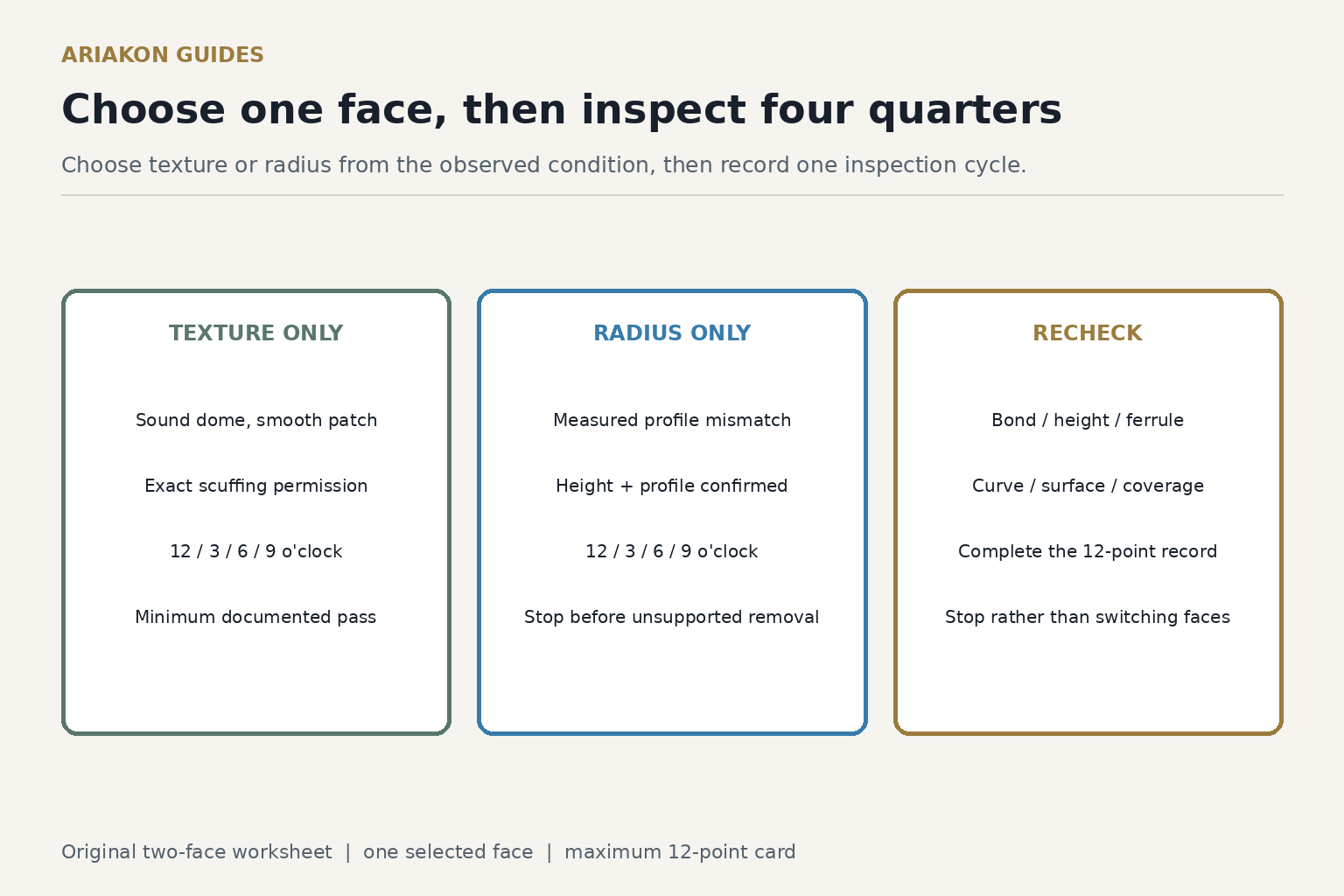
Choose one face from the observed condition
| Observation | Texture face | Radius face | Stop path |
|---|---|---|---|
| Even dome; smooth patch resists chalk | Possible if permitted | No | Stop if minimum pass does not help |
| Surface accepts chalk; four-quarter curve is uneven | No | Possible if profile and height are documented | Technician for major correction |
| Dome and coverage are sound | No | No | Leave the tip alone |
| Desired profile does not match the tool face | No | No | Use the correct documented profile |
| Tip is loose, cracked, low or separating | No | No | Repair or replacement assessment |
Choose and preserve a cue-tip radius before using a concave face.
Compare shaping and scuffing functions when the visible condition is unclear.
Register four clock positions
Photograph the clean tip square-on and from the side. On a paper record—not the leather—mark 12, 3, 6 and 9 o'clock. Compare curve, height and surface condition at each quarter. Record the tool's stated radius profile, abrasive condition and current instructions.
Protect the ferrule and work over a clean tray away from table cloth. If the profile, remaining height or exact face cannot be identified, close the tool and stop.
Use one four-quarter cycle
One cycle is an inspection interval, not a required amount of removal. Do not concentrate on a high area with heavier pressure. A new flat island, torn fiber or uncertain height ends the attempt.
| Quarter | Texture path | Radius path |
|---|---|---|
| 12 | Minimum light stroke on the documented face | Minimum light profile stroke |
| 3 | Rotate cue; repeat once | Rotate cue; repeat once |
| 6 | Rotate cue; repeat once | Rotate cue; repeat once |
| 9 | Rotate cue; repeat once | Rotate cue; repeat once |
| Recheck | Brush loose fibers; test coverage | Compare all four quarters with the target profile |
Score a twelve-point result
Maximum: 12. Anything below 12 triggers inspection before play. A 12/12 is the stopping condition, not permission to polish further.
| Area | Three confirmations |
|---|---|
| Before | Sound bond; enough height; one face selected |
| Control | Light pressure; four quarters visited; ferrule untouched |
| Result | Even curve; even surface; no torn fibers |
| Stop | Loose debris removed; condition retested; no evidence-free extra cycle |
Worked two-face decisions
A sound tip matches its recorded profile but has one glazed patch. The worksheet selects the texture face, completes one four-quarter cycle and stops at 12/12 when chalk covers evenly. The radius face remains unused.
A second tip is taller at 3 o'clock than at 9 o'clock. One permitted light radius cycle reduces the mismatch, but minimum height cannot be verified. The correct endpoint is a technician, not repeated pressure on the high quarter.