
Cue tip care · 3 min read
Cue Tip Aeration Tools: When to Use Them and When to Stop
Aeration is a narrow surface-maintenance decision, not a repair. Small pins may open a compressed leather crown only when the exact tip and tool instructions permit it. They cannot restore height, correct the dome, close a loose bond or reconnect a layer. Use the COMPRESS–PERMIT–BOUND–RECHECK record below and treat every unknown as a stop.
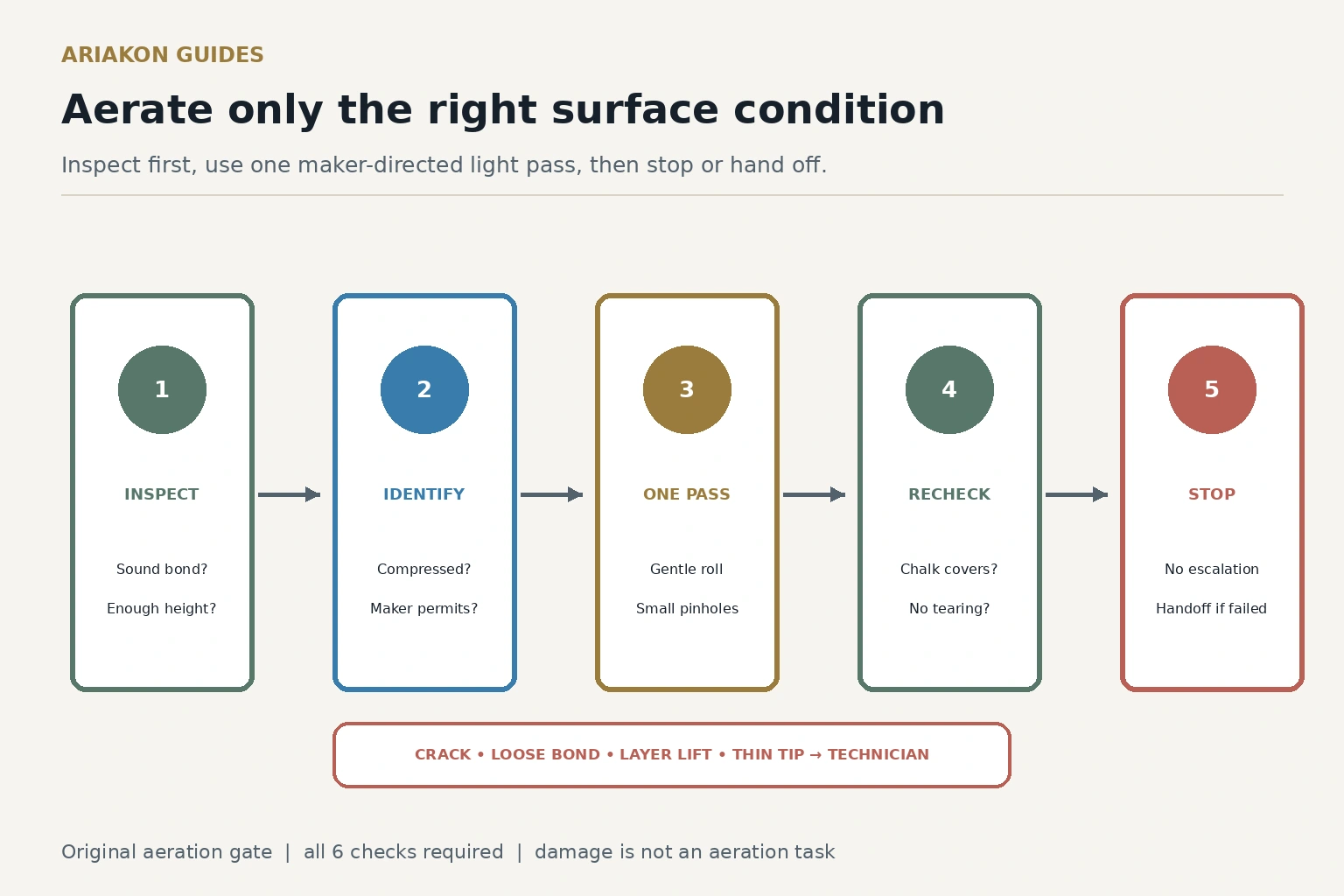
Prove that compression is the actual condition
| Observation | Matching task | Aeration decision |
|---|---|---|
| Sound, even dome; smooth compressed patch resists chalk | Surface-opening assessment | Continue to permission gates |
| Sound dome; light roughening restores coverage | Scuff only | Do not aerate |
| Flat, asymmetric or off-center dome | Radius assessment | Do not aerate |
| Mushroomed sidewall | Supported-diameter assessment | Do not aerate |
| Loose bond, crack, open layer or missing leather | Repair or replacement | Technician |
| Tip, pad or remaining height is unknown | Identify and measure | Stop |
Compare shaping with scuffing when the visible condition may be curvature or texture rather than compression.
Use the broad tip-tool safety record before any abrasive, pin or cutter reaches leather.
Pass six gates before exposing pins
Six of six is permission to try one bounded cycle, not evidence that aeration is necessary or beneficial. The competition equipment specification defines a material and width boundary for covered play; it does not approve a maintenance tool.
| Gate | Proceed evidence | Stop evidence |
|---|---|---|
| Identity | Tip construction and installed part are documented | Unknown tip or recent unrecorded service |
| Permission | Current tip and tool instructions allow aeration | Missing, conflicting or model-mismatched instructions |
| Structure | Bond, layers, pad and ferrule are sound | Movement, opening, crack or lift |
| Height | Remaining leather exceeds the documented service limit | Low or unmeasurable sidewall |
| Tool | Pins are clean, straight and guarded until use | Bent, dirty, loose or exposed in storage |
| Control | The documented motion can stay on the full crown | A slip path crosses the edge, ferrule or hand |
Use one documented cycle
- Photograph the clean crown and sidewall under fixed light.
- Record the exact tool face, motion and cycle limit from its current instructions.
- Support the shaft away from the table and protect the ferrule and pad.
- Apply one light, even maker-directed cycle across the whole permitted surface.
- Remove loose debris without digging, then inspect every quadrant.
- Retest chalk coverage only after the structure and shape remain unchanged.
Score the result with an override
Any structural zero overrides the score and ends play. A score below 8 ends owner maintenance; record the evidence and hand the cue off. An 8/8 means stop successfully—never repeat the cycle merely because the tool is already out.
| Check | 0 | 1 | 2 |
|---|---|---|---|
| Structure | movement, opening or tear | uncertain | unchanged |
| Surface | deep holes or raised fibers | uneven | light and uniform |
| Shape | new flat or asymmetry | uncertain | unchanged |
| Coverage | worse | partly improved | even film |
Worked decisions
A sound single-piece leather tip has full height, an even dome and one compressed patch. Exact instructions permit one light rolling cycle. All six gates pass, the post-cycle check is 8/8 and chalk covers evenly, so maintenance stops without a spin or performance claim.
A layered tip shows a narrow opening at one layer edge. It fails the structure gate before pins are exposed. The photo and service record go to a qualified technician; the aerator is not used to hide or test the separation.
Sources and further reading
References support the specific factual information above. The practical checklists are Ariakon editorial guidance.