
Cue tip care · 3 min read
Trim Cue Tip Mushrooming Safely: Tool Limits and Stop Points
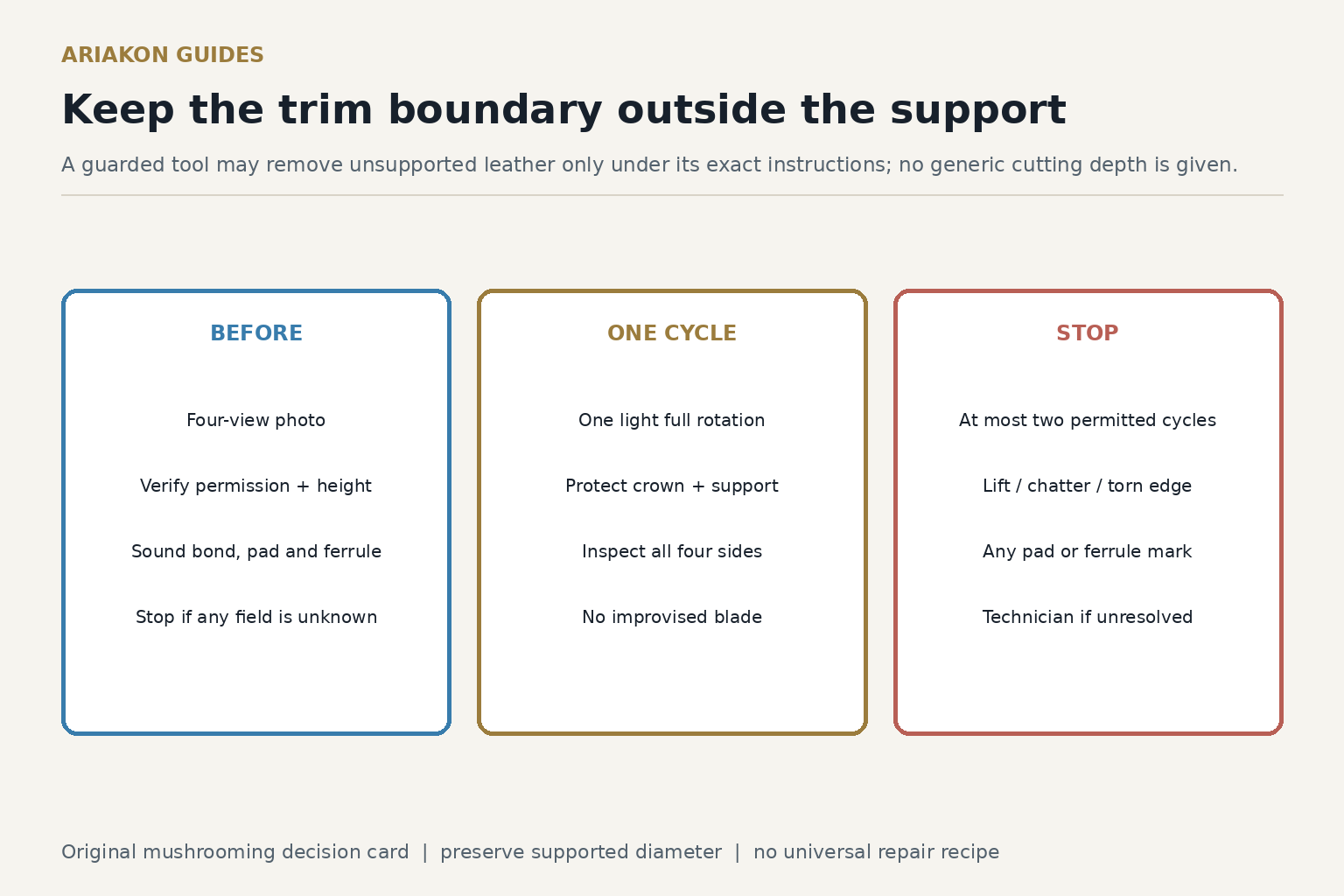
Mushrooming is leather that projects beyond the supporting ferrule or required pad. A stable cosmetic bulge is different from a loose bond, layer separation or low sidewall. Use the OBSERVE–GATE–BOUND–CHECK card to decide whether one tip can be left alone, receives a strictly bounded trim under its exact instructions, or goes to a qualified technician.
Measure the overhang before deciding
Clean away loose chalk, rotate the shaft under diffuse light and photograph all four quadrants. Do not use a fingernail, blade or abrasive as the measuring probe. Repeat after one normal session if the structure is sound and the overhang is only cosmetic.
| View | Record | Stop evidence |
|---|---|---|
| Crown | centered radius ___; chalk coverage ___ | crack, torn surface or off-center crown |
| Sidewall | minimum height ___ mm | too low for documented limit |
| Bond line | closed / uncertain / open | movement, gap or layer separation |
| Overhang | largest projection ___ mm at clock position ___ | ferrule or pad damage |
| Construction | single-piece / layered / unknown | unknown trimming permission |
Classify the tool function first before any abrasive or cutter approaches the sidewall.
Pass every gate or hand the work off
| Gate | Proceed evidence | Stop evidence |
|---|---|---|
| Permission | Exact tip and cue instructions permit trimming | Missing or conflicting instructions |
| Structure | Tip, layers, pad and ferrule are sound | Lift, gap, crack or movement |
| Height | Sidewall exceeds documented minimum | Low crown or unknown minimum |
| Tool | Clean guarded tool and complete instructions | Exposed improvised blade |
| Control | Guide can stay square and stable | Slip path crosses ferrule, shaft or hand |
Define the trimming boundary
The target is unsupported leather that projects beyond the supporting diameter. The target is not a smaller tip, thinner sidewall or newly polished edge. Preserve the crown, supported diameter, pad and ferrule. Set and test any guard away from the cue according to its own instructions.
Use the specified direction and pressure for one light full rotation only. Stop, remove loose debris and compare all four views with the baseline. A hard spot, chatter, torn edge, unstable guide or ferrule mark ends the attempt.
Use a two-cycle ceiling
More than two cycles means the problem exceeded this owner-maintenance boundary. Record the date, tool, cycle count and final photographs for the technician rather than continuing until the evidence disappears.
| Stage | Allowed action | Required check |
|---|---|---|
| Baseline | No cutting | Photos, height, bond, overhang and permission |
| Cycle 1 | One light full rotation | Ferrule unchanged; high area smaller |
| Cycle 2 | One further light rotation only if still permitted | Supported diameter preserved |
| Finish | Documented edge finish only | No coating hides a defect |
| Acceptance | Ten gentle center-ball shots | No movement, opening or rapid new bulge |
Preserve a separate scope from radius care
This guide treats supported diameter and mushroomed sidewall. Radius care treats the crown. Tip replacement treats a failed or unsuitable installation. Keeping those tasks separate prevents a sidewall concern from becoming unnecessary crown removal or an unsafe repair.
Check crown radius without excess removal after the sidewall decision is complete.
Use the model-gated replacement workflow when any structural stop appears.