
Cue tip care · 4 min read
Choose and Maintain a Cue Tip Radius Without Removing Excess Leather
Radius describes the crown curve; it does not describe tip hardness, sidewall bulge or surface texture. Preserve a sound centered crown that accepts chalk. When the profile genuinely needs attention, compare it with a recorded reference, verify material and remaining height, and remove no more leather than the exact instructions permit.
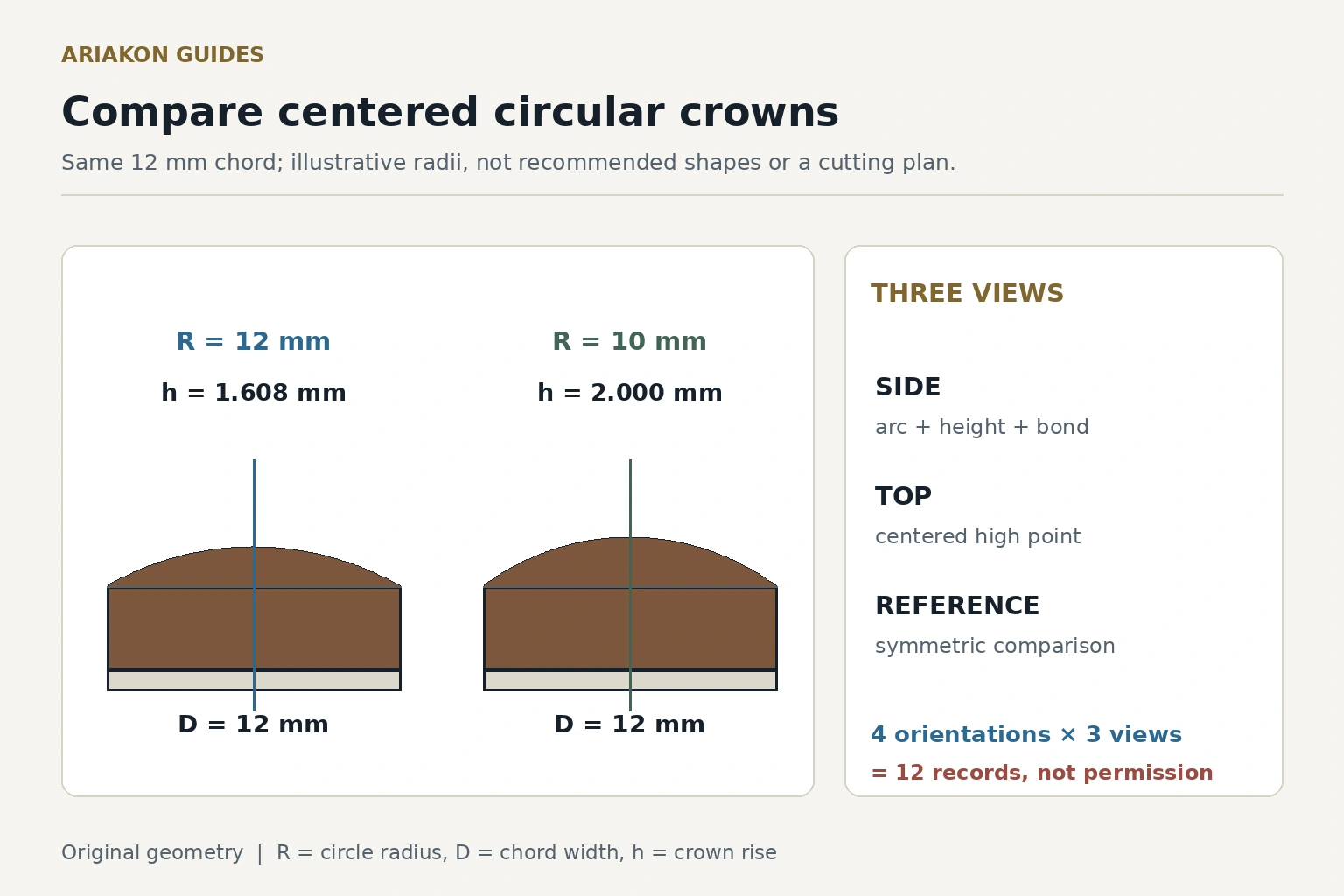
Separate radius from diameter and roughness
The tip diameter is the width across the supported tip. The radius of an ideal circular crown is the radius of a larger circle from which that crown is a segment. A smaller radius makes a more strongly curved segment over the same width. Real leather need not form a perfect circle, so a radius gauge is a comparison aid, not a universal pass/fail instrument.
The PBIA manual lists curvature and tip care among equipment topics. It does not prescribe this worksheet, a best radius or a universal safe sidewall height. The tip, shaft and tool instructions govern the actual equipment. A material that cannot be identified is not permission to apply leather-tip methods.
Compare leather-tip construction separately because layered and single-piece tips have different inspection concerns.
Distinguish shaping from scuffing when chalk coverage, not crown geometry, is the problem.
Calculate what the profile drawing actually shows
For a circular segment, h = R − √(R² − (D/2)²), with all values in the same units and R at least D/2. The drawing uses the same width and scale for both examples. It does not say that converting an installed crown will consume exactly that height: the starting shape, retained sidewall and tool path matter.
Do not choose a radius because an illustration looks capable of more spin. Record the existing sound profile or the documented intended profile. A deliberate change needs the exact equipment instructions and, when those are missing or the correction is large, a technician.
| Tip chord D | Circle radius R | Crown rise h | Meaning |
|---|---|---|---|
| 12 mm | 12 mm | 12 − √(144 − 36) ≈ 1.608 mm | Flatter of these two centered profiles |
| 12 mm | 10 mm | 10 − √(100 − 36) = 2.000 mm | Rounder of these two centered profiles |
| Same 12 mm chord | Difference | 2.000 − 1.608 ≈ 0.392 mm | Difference in ideal segment height, not a removal allowance |
Make a twelve-record inspection before touching a shaper
There are twelve descriptive records, not twelve points that permit a repair. View the crown after loose chalk has been removed by a permitted method. Photograph it against the same background and lighting. Do not force a gauge onto leather or press on the bond to test it.
A mushroom is a supported-diameter and sidewall task. Do not grind the crown to conceal it. A glossy patch on an otherwise sound profile is a surface task, not evidence that the radius should change.
| View at 0°, 90°, 180°, 270° | Write in each record | Stop signal |
|---|---|---|
| Side | Arc, usable sidewall and visible interface | Low or uncertain height; gap; torn layers |
| Top | High point centered or visibly shifted | Off-center installation or uneven support |
| Reference | Symmetric comparison with the recorded profile | Gauge would require cutting one edge into the sidewall |
Assess sidewall mushrooming separately instead of turning a diameter issue into crown removal.
Use an observation-first maintenance boundary
Proceed only when the material, tip bond, remaining height, pad or plate requirements, tool fit and exact instructions are known. Set a clean stable support and a tool motion that cannot cross into the ferrule, pad or shaft. If that boundary cannot be maintained, stop before contact.
Use the tool maker’s permitted light motion, with an inspection interval no longer than one complete turn through four quarter orientations. The interval is a ceiling for rechecking, not a required number of abrasive passes. A tool requiring a shorter interval takes precedence. After each interval, remove loose debris and repeat side, top and reference views.
This worksheet ends after at most two inspection intervals. If the profile remains uncertain, leave further correction to service. Stop sooner for tearing, layer lift, moving bond, ferrule contact, loss of usable height or a growing asymmetric crown. Never remove a required pad to reach a drawn arc.
Work two different maintenance decisions
Example A: a centered leather crown accepts chalk and differs slightly from a loose gauge. The three-view records show no structural change. The decision is leave it alone and preserve the reference photograph; gauge perfection is not a maintenance objective.
Example B: the top view is shifted and the smallest sidewall height cannot be compared with a documented limit. The decision is no shaping. The twelve-record packet and the exact tip/shaft identities go to a technician. The circle calculation explains the picture but cannot resolve this missing service fact.
Record the outcome without claiming a performance gain
This page owns crown-reference geometry and minimal maintenance. The tool-function comparison, sidewall trim and installation guides remain separate resources. No best radius, new spin limit or universal minimum height is claimed.
- Record date, material identity, chosen reference and reason for intervention.
- Record zero, one or two inspection intervals and the exact permitted motion.
- Preserve before/after side, top and reference photographs.
- Keep sidewall, pad, bond and ferrule observations distinct from crown radius.
- Return to ordinary play only if the structure and model instructions permit; stop if a defect appears.
Plan replacement when the tip is no longer serviceable instead of consuming more height.
Sources and further reading
References support the specific factual information above. The practical checklists are Ariakon editorial guidance.