
Cue maintenance · 3 min read
Use Pool Cue Tip Tools Without Damaging the Tip
A cue-tip tool is a set of functions, not permission to use every surface. The safe decision is DIAGNOSE–SELECT–LIMIT–RECHECK: name the defect, select only the matching function, define a removal limit before contact, then stop and inspect. This brand-neutral workflow does not replace the exact tool, tip, shaft or warranty instructions.
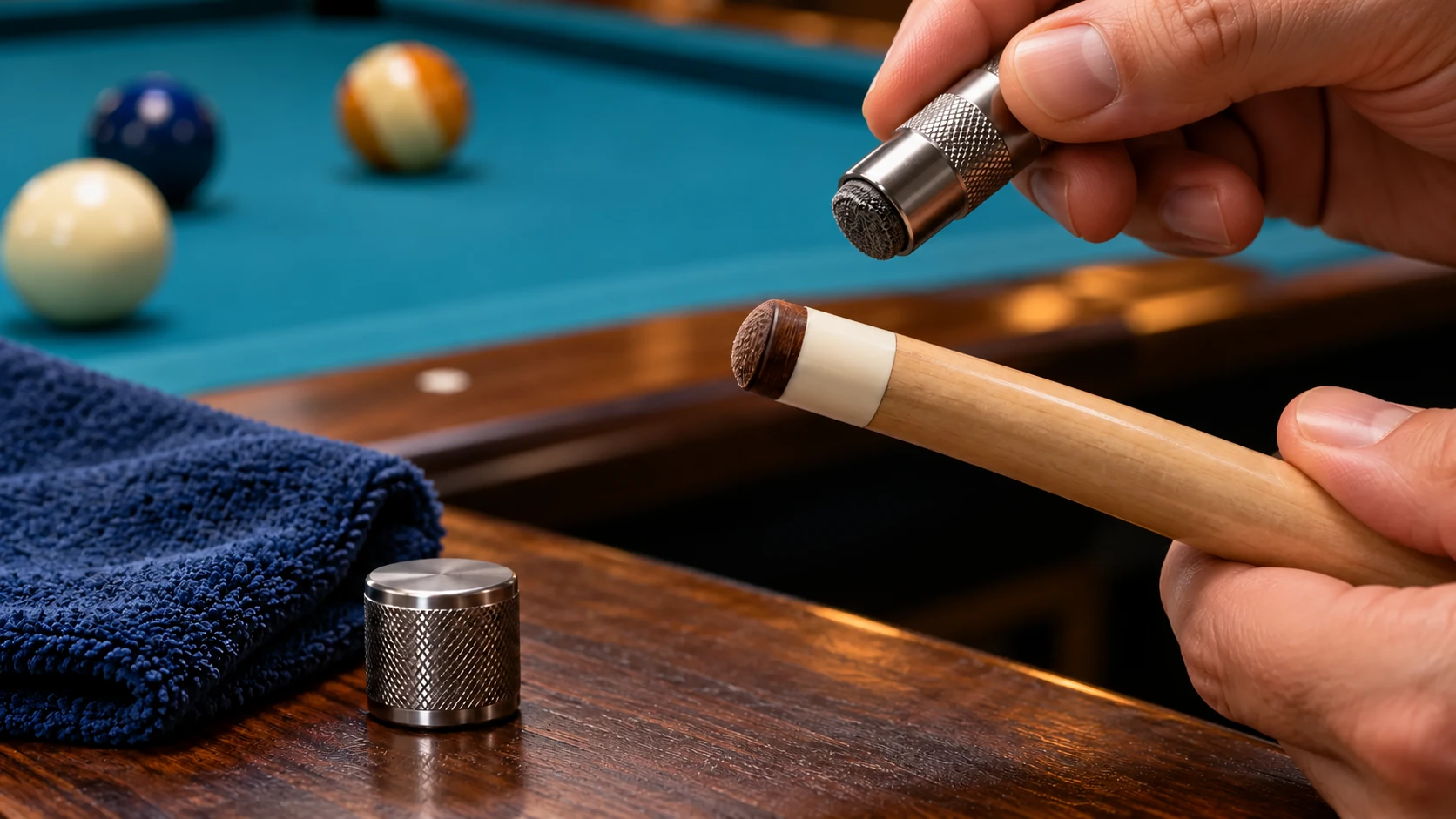
Classify the tip before choosing a function
| Observation | Possible function | Do not assume | Stop path |
|---|---|---|---|
| Chalk will not cover a smooth intact crown | very light surface refresh if permitted | a new radius is needed | crack, lift or unknown coating |
| Dome is measurably flat or uneven | controlled shaping with a radius gauge | rougher is better | major correction or low sidewall |
| Leather projects beyond the ferrule | separate mushroom decision | a shaper safely trims an edge | bond, pad or ferrule concern |
| Tip is hard or compressed | diagnose first | pins are universally safe | unknown construction or instructions |
| Layer opens, tip moves or ferrule is damaged | none | maintenance can repair structure | qualified technician |
Use the separate mushrooming gates when leather projects beyond the ferrule.
Choose service or replacement for bond, height or construction uncertainty.
Set a measurable limit before touching leather
- Photograph the clean crown and full sidewall under steady light.
- Record tip construction if documented, remaining sidewall height and present radius.
- Choose one function for one observed defect; cover or ignore every unused function.
- Limit the first cycle to two light full-circumference passes or the tool maker's lower limit.
- Protect the ferrule, pad and shaft finish; keep cutters and pins away from them.
- Stop if you cannot hold the shaft and tool square without a slip path.
Use four two-pass cycles at most
Rotate around the circumference rather than grinding one point. Count passes; visual impatience is not evidence. Aeration, edge trimming and aggressive material removal remain outside this generic sequence unless the exact instructions explicitly authorize them.
| Cycle | Action | Inspect | Continue only if |
|---|---|---|---|
| 0 | No tool | shape, height, bond, coverage | structure is sound |
| 1 | Two light even passes | full crown and ferrule | defect remains and no new mark |
| 2 | Two light even passes | radius gauge and sidewall | change is controlled |
| 3 | Two light even passes | chalk coverage and symmetry | one small high area remains |
| 4 | Final two-pass ceiling | compare with Cycle 0 photo | stop regardless; escalate if unresolved |
Score the result without rewarding removal
Any structural zero overrides the total. A 7/8 with an uncertain bond is a technician handoff, not a successful tune-up. Record the final photograph, passes and next inspection date so repeated maintenance does not silently consume the tip.
| Check | 0 | 1 | 2 |
|---|---|---|---|
| Structure | movement, opening or damage | uncertain | bond and adjacent parts unchanged |
| Shape | worse or off-center | partly improved | centered target radius |
| Surface | torn or deeply punctured | uneven | light uniform texture |
| Coverage | persistent bare zone | improved | even chalk film |
Keep maintenance distinct from replacement
Shaping and surface refresh preserve a sound installed tip. Bond repair, ferrule work, pad decisions, very low sidewalls and unfamiliar construction are service tasks. The equipment specification describes the permitted tip material boundary for covered play; it does not certify a tool or maintenance method.