
Cue tip care · 3 min read
Use a Multi-Function Tip Tool Without Overworking the Leather
Putting several working faces on one body creates a selection problem, not permission to use every face. This operating record is for a sound installed leather tip and an identified tool with current instructions. Its job is to keep the unused abrasive or pins away from the cue while one justified task is completed.
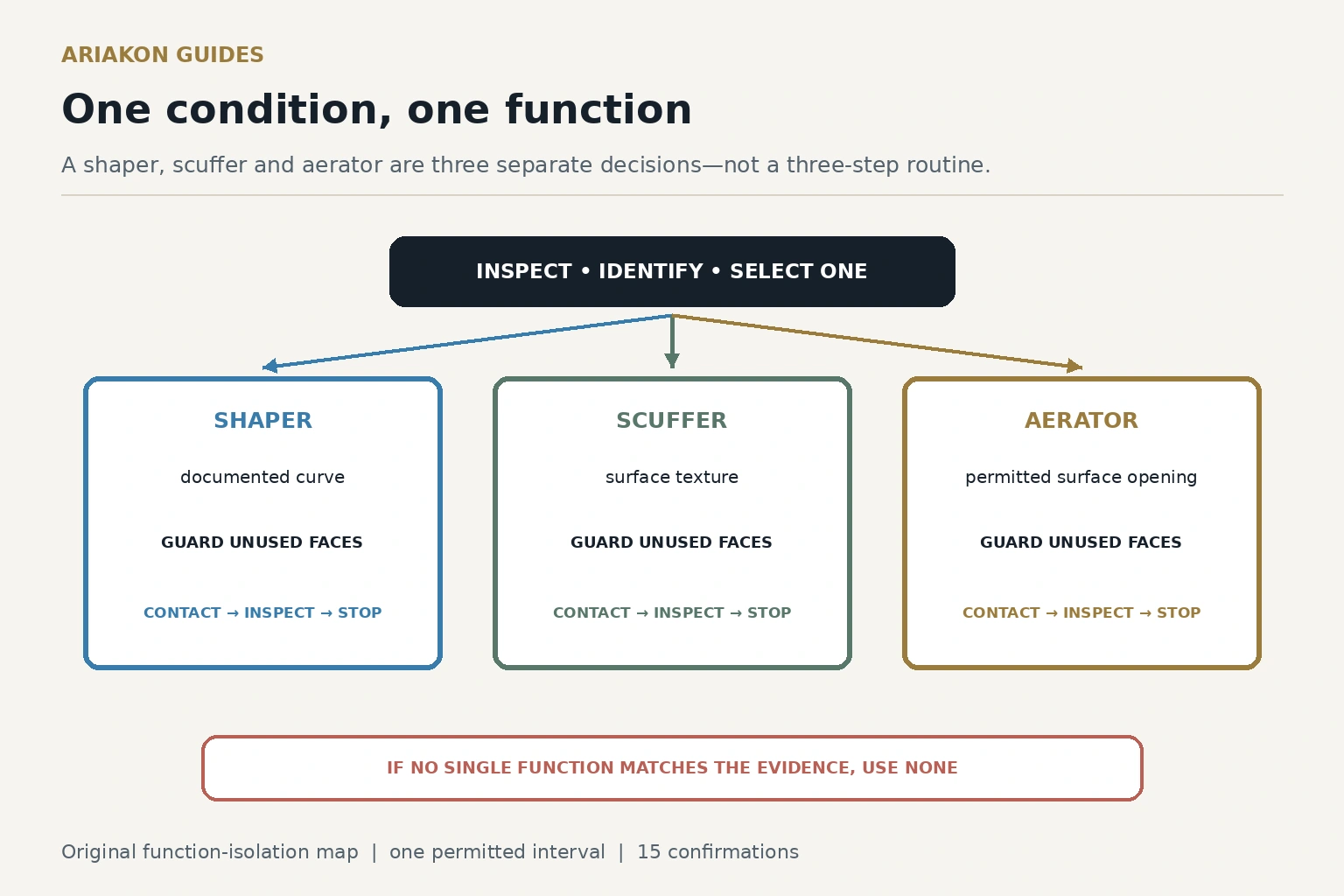
Assign a single task to the visible condition
| Observation | Possible task | Before contact |
|---|---|---|
| Even dome; chalk coverage is already uniform | None | Close and store the tool |
| Sound dome; a smooth patch remains after correct chalking | Texture refresh | Confirm scuffing permission |
| Curve differs from the documented profile | Radius adjustment | Confirm height, profile and shaping permission |
| Compressed surface; exact instructions permit surface opening | Aeration assessment | Use the separate pin-safety gate |
| Loose bond, opened layer, crack or unknown height | Service | No face contacts the tip |
Compare shaping and scuffing to separate curvature from texture.
Use the aeration permission card before exposing any pins.
Map and isolate every face
Read the exact tool instructions and label its functions on a paper sketch. Record the selected face, its condition, allowed motion and remaining-height limit. A familiar shape or package claim is not a radius specification. Do not borrow another tool’s instructions.
Cap or otherwise guard unused faces as instructed. If a safe hold would expose a hand, pad, ferrule or shaft to another edge, stop. Work over a clean tray away from table cloth; remove loose chalk first so debris cannot conceal the leather boundary.
Set the inspection interval before contact
One cycle means one predeclared inspection interval, not a universal rotation or pass count. End it earlier if the task is complete or a defect appears. For this worksheet, a failed first interval ends owner maintenance; do not escalate to a different face to rescue the result.
| Task | Write before starting | Inspect before more contact |
|---|---|---|
| Shape | Exact permitted profile and motion; shortest documented interval | Curve in four views and remaining height |
| Scuff | Exact permitted minimum surface pass | Uniform light texture; no new flat |
| Aerate | Exact permitted pin motion and minimum interval | Fibers, layer edges and surface marks |
| No task | No contact | Identity or service evidence |
Complete fifteen checks without trading safety for points
Maximum: 15 confirmations. All five Before items are required before contact. Any failed During item ends contact immediately. A completed record requires 15/15; a count does not certify repair, prove performance or override a damaged bond.
| Stage | Five required confirmations |
|---|---|
| Before | Identity; intact bonds; adequate documented height; named condition; one permitted function |
| During | Unused faces guarded; stable hold; documented motion; leather-only contact; no force escalation |
| After | Debris cleared; shape checked; edges intact; coverage retested; stop decision recorded |
Two complete worked decisions
An identified sound tip has even curvature and one smooth patch. Its instructions permit scuffing. The player records the minimum surface pass, guards the other faces and completes 5 Before, 5 During and 5 After confirmations. Uniform coverage returns, so the tool closes at 15/15; shaping and pins remain unused.
An apparently similar tip has a visible layer-edge opening. Its Before count is at most 4/5 because intact bonds cannot be confirmed. The tool stays closed. The condition photos and exact part record go to a qualified technician; no score can authorize testing the separation with pins.
Audit what a multi-tool can replace for packing decisions rather than tool operation.
Use the two-face crown worksheet when the permitted tool has only texture and radius faces.