
Cue ball control · 4 min read
Control Cue Ball Follow Before Adding More Speed
Follow is useful because the cue ball continues generally forward after striking the object ball. The goal is not maximum topspin. It is a predictable rolling condition, clean contact and enough speed to reach a chosen position zone without sending the cue ball farther than the pattern requires.
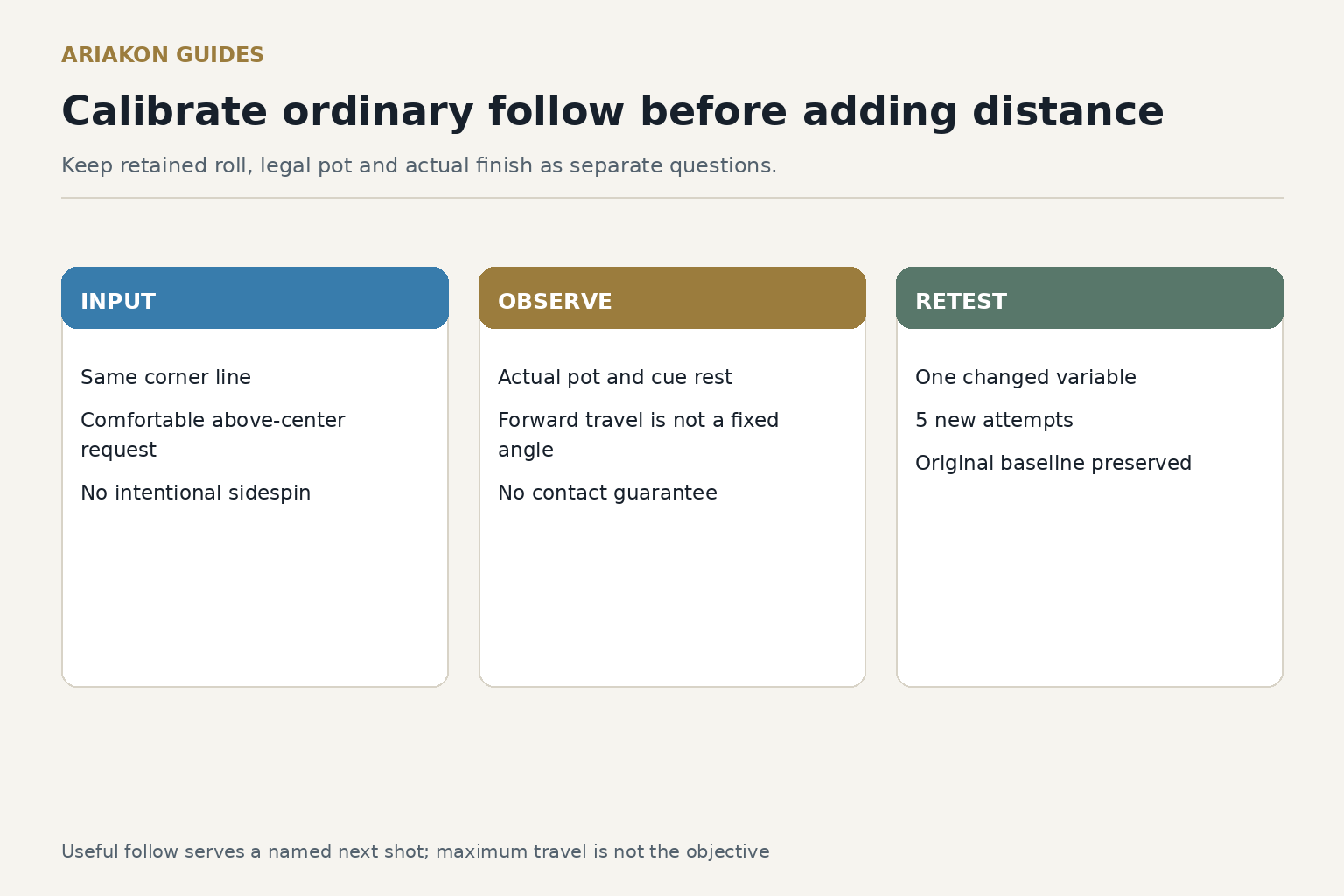
Know what follow means
A cue ball has follow when it is rolling forward at object-ball contact. Striking above center can create that rotation sooner, but cloth friction can also turn a sliding cue ball into natural roll during its trip down the table.
This distinction matters because tip height alone does not determine the final path. Shot distance, speed, cloth and ball conditions influence how much sliding remains when contact occurs.
Predict the first route
On a straight shot, retained forward rotation can carry the cue ball forward after collision. On a cut, its later rolling path curves away from the initial near-tangent departure. Do not treat one fixed angle as an exact path for all cuts.
The rule is a planning aid, not a guarantee. Cut angle, speed, spin, throw and cushion contact all affect the actual route. Stand up and distinguish the cue-center impact location from the object center before estimating the later cue path before lowering into the stance.
Build follow in small steps
- Place the cue ball and object ball in a straight line to a pocket.
- Begin at a comfortable distance with a modest above-center hit.
- Mark a broad target zone beyond the object ball.
- Shoot five balls while holding tip height constant and changing only speed.
- Then hold speed constant and make small, safe changes in tip height.
- Stop before experimenting so close to the edge that miscues become routine.
Separate stroke quality from force
A smooth accelerating stroke and a level cue help deliver the intended tip contact. Grabbing the cue or punching at the ball can change the tip height and cue direction, even when your plan was correct.
If the cue ball follows too far, first reduce speed or choose a shorter route. Do not automatically strike closer to center; that may change when roll develops and make the result less predictable.
Add cut angles and rails
Move from straight follow to half-ball and thinner cuts. Before each shot, name the first rail and a broad landing zone. Compare the actual cue-ball route with the rolling-ball estimate rather than grading only whether the object ball dropped.
When a rail is involved, enter a generous part of the cushion. A route that relies on clipping a pocket point is fragile. Use less speed when the natural line already reaches the zone.
Choose follow because the pattern wants it
Follow is often simpler than draw when the forward route stays away from scratches, traffic and unwanted cushions. It can also leave a larger speed window because the cue ball is moving with its natural roll.
It is not automatically the percentage choice. Check the tangent and scratch lines, blockers and next-shot angle. The best follow shot is the one that leaves an easy next decision, not the one that travels farthest.
Keep an exact ordinary baseline for this record
Coordinates are ball centers on an illustrative 100 by 50 inch bed: x=0..8 along length, y=0..4 across width, origin at the lower left cushion nose. One unit is 12.5 inches. For 2.25 inch equal balls, radius is 0.09 and diameter 0.18 units. Intact cushion center boundaries are x=0.09,7.91 and y=0.09,3.91; pockets interrupt the physical boundary at the four corners and (4,0),(4,4). Measure actual bed, balls and jaws before scaling. Remove every measuring aid before shooting; never mark a competition table.
Use O(6,3), real upper right corner P(8,4), intended contact cue center G(5.839003,2.919502) and C(4.944576,2.472288). With u=(2,1)/sqrt(5), G=O minus 0.18u and C=G minus u. The centers are collinear and the equal balls are tangent at G.
Choose a comfortable ordinary pace and keep equipment fixed. Record actual strikes, known legal pots and the task-specific observation separately. A chosen cue-rest window, when needed, is a radius 0.18 disk about G; it is not a guaranteed result. Unknown observations stay unknown, and a safety stop leaves later allocations unused. Use the exact mirrored setup x→8−x only in a separately dated transfer record.
Sources and further reading
References support the specific factual information above. The practical checklists are Ariakon editorial guidance.