
Position play · 4 min read
Use Stop-Shot Patterns to Reduce Unnecessary Cue-Ball Travel
A stop shot is useful because it removes a route, not because every position should end with zero travel. Use it when the cue ball can reach the first object ball on a straight line and the next shot already exists from the collision point. These three fixed stations isolate pocket line, stop control and the next decision.
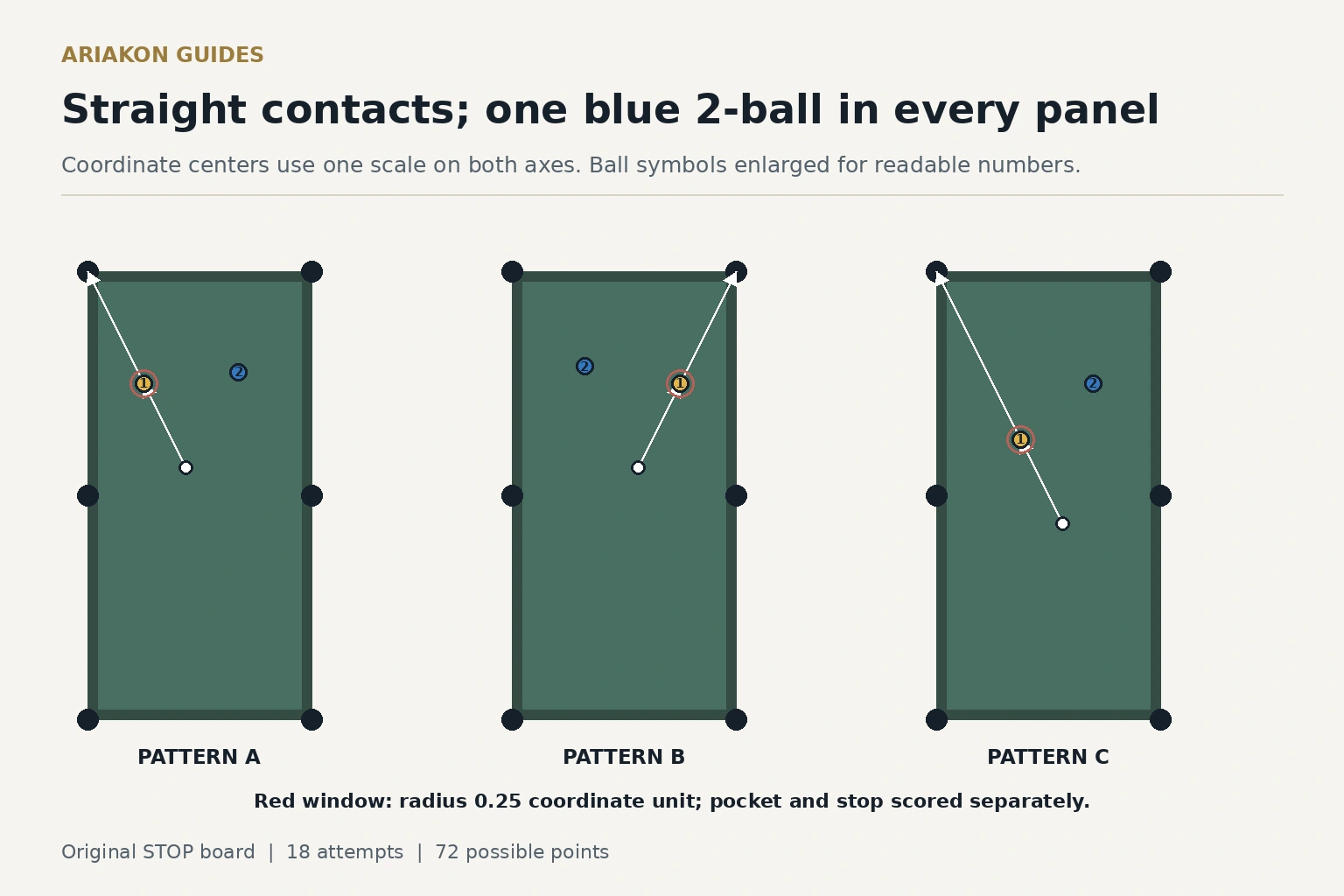
Mark three geometrically valid stations
Use a normalized four-by-eight playing surface measured between cushion noses, with the lower-left corner at (0,0). Ball coordinates are centers. Pattern A calls the upper-left corner (0,8): cue ball (1.75,4.50), 1-ball (1.00,6.00), 2-ball (2.70,6.20). Pattern B calls the upper-right corner (4,8): cue ball (2.25,4.50), 1-ball (3.00,6.00), 2-ball (1.30,6.30). Pattern C calls the upper-left corner: cue ball (2.25,3.50), 1-ball (1.50,5.00), 2-ball (2.80,6.00).
For A and B, the vector from cue ball to 1-ball is one-half of the vector from 1-ball to its called corner. For C, both segments share the same slope of negative two. That collinearity creates a straight center-ball stop-shot baseline. Move a station if a physical marker, ball or cue would interfere.
Review cue-ball control fundamentals before using the stop shot as a position choice.
Practice follow and draw after the stop baseline when the next angle requires intentional travel.
Shoot the stop, then read the next angle
Use vertical-axis cue-ball contact and the slowest speed that reliably pockets the 1-ball. The red zone is a measurement window, not a claim that cloth and ball conditions are identical. Replace every ball after each attempt from the same coordinate reference.
| Pattern | Called line | Stop-zone test | Next decision |
|---|---|---|---|
| A | CB (1.75,4.50) → 1 (1.00,6.00) → pocket (0,8) | Cue-ball center finishes within 0.25 table unit of (1.00,6.00) | Read the cut from the stop point to ball 2 at (2.70,6.20) |
| B | CB (2.25,4.50) → 1 (3.00,6.00) → pocket (4,8) | Cue-ball center finishes within 0.25 table unit of (3.00,6.00) | Read the cut from the stop point to ball 2 at (1.30,6.30) |
| C | CB (2.25,3.50) → 1 (1.50,5.00) → pocket (0,8) | Cue-ball center finishes within 0.25 table unit of (1.50,5.00) | Read the cut from the stop point to ball 2 at (2.80,6.00) |
Score pocketing and stopping separately
Shoot six attempts on A, six on B and six on C. Award two points when the 1-ball enters the called corner, one point when the cue-ball center finishes inside the stop zone and one decision point when you name the next-ball cut side before standing up. Maximum: 24 points per pattern and 72 for the board.
A scratch or wrong pocket scores zero pocket points. A made 1-ball with a cue ball outside the zone still earns the two pocket points, preserving the diagnostic difference between aim and stop control. Record short, long, left and right misses instead of changing aim after one result.
Diagnose the first repeated failure
| Evidence after six attempts | Likely first check | Next set |
|---|---|---|
| Pocket line varies both directions | Delivery line or object-ball contact | Six center-ball shots through a narrow gate |
| Pocketed balls, cue ball rolls forward | Residual top spin or excess speed | Calibrate a small lower vertical-axis contact at the same speed |
| Pocketed balls, cue ball draws back | Contact below vertical center | Return to a marked vertical-axis contact |
| Stop is good, next decision is late | Pattern reading rather than stroke | Name ball 2 cut side before every stance |
| Results change by pattern only | Setup transfer or visual alignment | Recheck coordinates and called pocket |
Worked example: choose less movement
A player scores 20 on A, 17 on B and 21 on C. Pattern B has five made 1-balls but only two stop-zone finishes, both drifting forward. The next action is a six-shot B set at the same comfortable speed with a slightly lower vertical-axis contact, checking for sliding arrival rather than demanding backward travel. Slowing the shot alone can allow more forward roll before impact.
After the retest, use the second ball only as a decision prompt. The drill does not award the 2-ball. Its job is to teach that a stopped cue ball can already own a playable angle, so extra rails and speed are unnecessary risk when the layout does not demand them.
Sources and further reading
References support the specific factual information above. The practical checklists are Ariakon editorial guidance.