
Cue ball control · 3 min read
Score a Draw Distance Ladder Without Changing the Setup
Moving the cue ball farther from the object ball changes two things at once: delivery distance and required draw. This ladder does the opposite. The straight setup stays fixed while the player calls progressively longer return bands. Signed misses show whether the problem is pocket line, low contact quality or draw distance, and the score never pretends that one session is a universal standard.
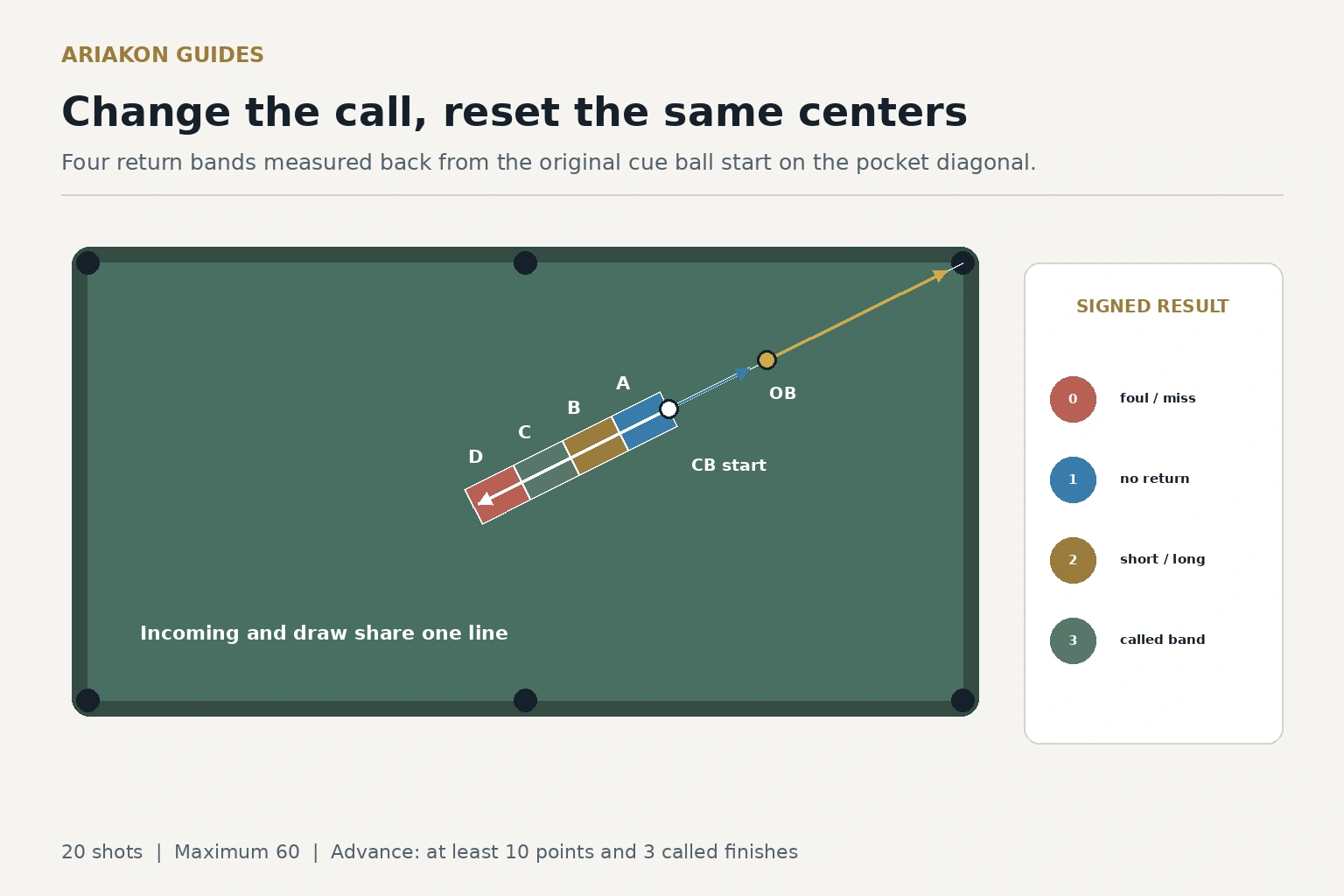
Mark one straight setup and four return bands
Use the upper right corner pocket on a 100 by 50 playing surface, with x along playing length and y across width. The pocket is (100, 0), the object ball is (77.64, 11.18) and the cue ball is (66.46, 16.77). These centers share one diagonal line. One diamond unit is one eighth of playing length measured along that line. Return bands extend from the original cue ball center away from the pocket: A is more than zero through 0.5 unit, B more than 0.5 through 1, C more than 1 through 1.5 and D more than 1.5 through 2. Boundaries belong to the shorter band. A finish exactly at the original start is not a return.
Use a level cue, clean balls and a sound tip. Backward rotation must remain at object contact for a straight draw return. Keep aim fixed and adjust either low contact or speed in a recorded block, never both at once. Make each band two ball diameters wide across the diagonal and score the final center. Practice marks require the table owner's permission.
Build clean draw mechanics first before using distance bands as a scoring task.
Reset the same two centers for twenty attempts
| Stage | Called final band | Attempts | First control | Advance target |
|---|---|---|---|---|
| A | More than 0 through 0.5 diamond back | 5 | Low contact; comfortable speed | 3 zone finishes |
| B | More than 0.5 through 1 diamond back | 5 | Slightly lower contact or more speed | 3 zone finishes |
| C | More than 1 through 1.5 diamonds back | 5 | One chosen variable | 3 zone finishes |
| D | More than 1.5 through 2 diamonds back | 5 | Same chosen variable | 3 zone finishes |
Score pocket line and landing distance
| Points | Object ball | Cue ball | Record |
|---|---|---|---|
| 0 | Foul or miss | Any | Left/right miss or scratch |
| 1 | Pocketed | Does not pass the original cue ball start | Stop/forward |
| 2 | Pocketed | Returns but lands short/long | Signed distance |
| 3 | Pocketed | Passes the start and finishes in the called band | Clean zone |
Use a sixty point evidence gate
Twenty attempts have a maximum of 60. Record each stage out of 15. A passed personal stage needs at least 10 points, three clean pockets and three called band finishes. These are the same advance criteria at every stage. Stop if two attempts in a row miscue or jump unintentionally; inspect tip condition, elevation and contact before resuming.
Do not lower the contact point and add speed on the same scored attempt. Change one variable for the next five shot block, write it down, and compare that block with the same stage rather than with a different target.
Diagnose direction before adding force
| Repeated result | Inspect first | Next five shots | Hold fixed |
|---|---|---|---|
| Object ball misses one side | Alignment and cue delivery | Return to Band A | Tip height and speed |
| Pocketed; no return | Low contact quality | Shorten bridge; use current speed | Aim |
| Pocketed; consistently short | Draw remaining at impact | Choose one small height or speed change | Setup |
| Pocketed; consistently long | Excess draw/speed | Reduce the chosen variable | Setup and aim |
Transfer the passed band to one position shot
Place a second object ball so the center of the hardest passed band leaves a natural next shot. Shoot five attempts from the unchanged first shot setup. Score 0 for a foul, 1 for legal contact, 2 for pocketing the first ball and 3 for pocketing it while leaving the second ball playable; maximum 15.
If the game transfer fails only when sidespin is added, return to the no sidespin baseline. Sidespin compensation is a separate task; the ladder's purpose is honest draw distance evidence from one fixed geometry.
Sources and further reading
References support the specific factual information above. The practical checklists are Ariakon editorial guidance.