
Fundamentals · 4 min read
Choose Open or Closed Bridges With a Side by Side Test
Choose a bridge for a repeatable task, not for a universal label of superior technique. Once both shapes are comfortably usable, compare them under matched conditions and keep shot points separate from support, drag and discomfort.
Confirm readiness before comparing outcomes
An open bridge supports the shaft in a thumb/index groove. A closed bridge adds a comfortable finger loop while retaining a stable support base. Neither should pinch the shaft or make the hand painful. Do not force a loop to fit a diagram; stop or use suitable qualified guidance if comfortable support is unavailable.
Keep cue, bridge length, intended contact, surface, ordinary chalking and stance reach fixed within a station. Record support movement, shaft drag and comfortable clearance as observations, not extra performance points. The prerequisite bridge guide teaches support readiness; this page compares outcomes after that readiness check.
Build a stable comfortable bridge first before a side-by-side performance comparison.
Compare bridge length as a separate variable without changing length invisibly during the shape test.
Build three exact matched tasks
Use ball-center coordinates on an illustrative 100×50-inch bed: x=0..8 along the length, y=0..4 across it, origin at the lower-left cushion-nose corner. Equal 2.25-inch balls have radius 0.09 and diameter 0.18 units. Intact-cushion center limits are 0.09..7.91 and 0.09..3.91. Six real pockets interrupt the boundary at the four corners and (4,0),(4,4). Measure the actual bed, balls and mouths before scaling; remove measuring aids before shooting and never mark a competition table.
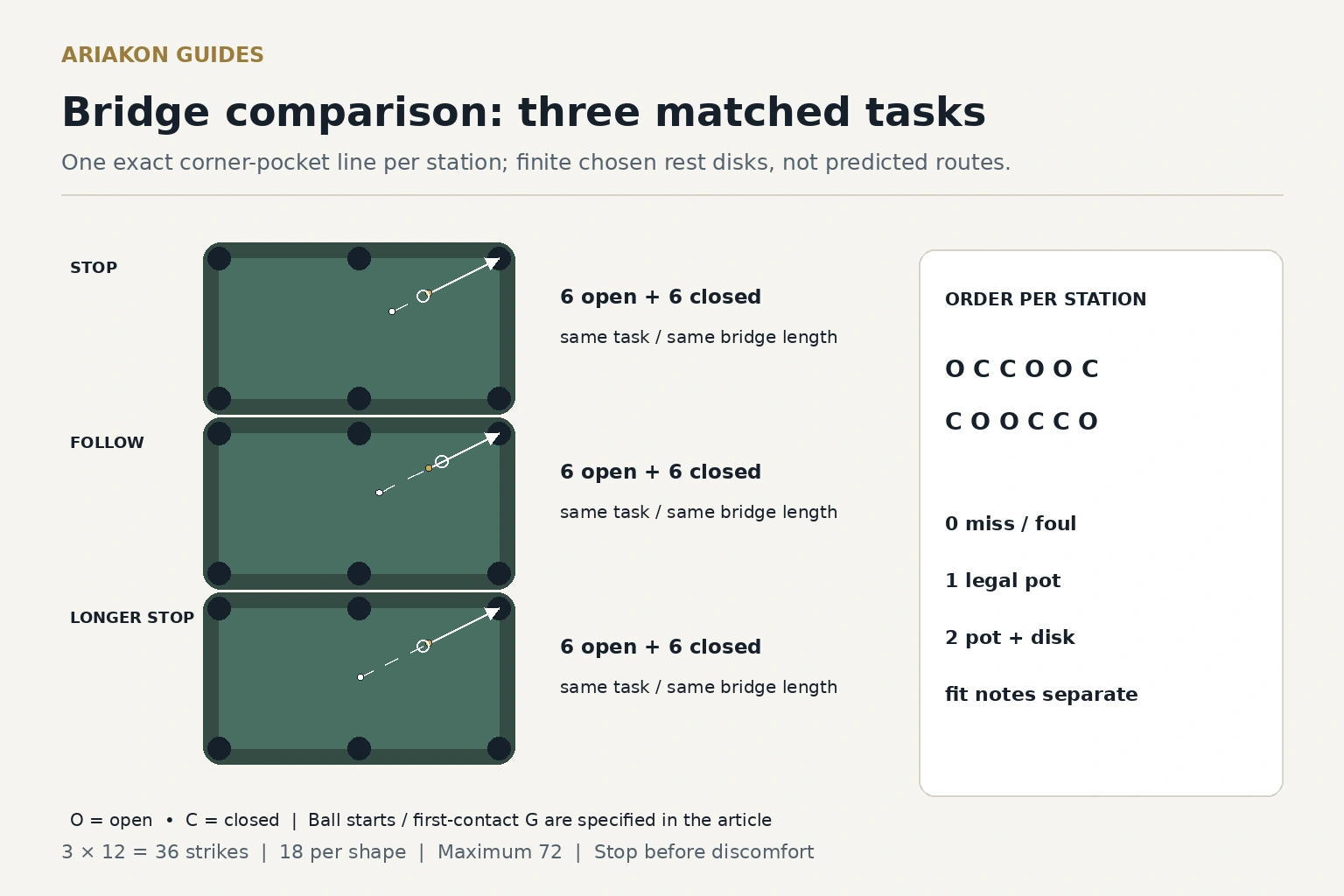
All stations use O(6, 3), real corner P(8, 4), intended first-contact cue center G(5.839003, 2.919502) and direction u=(2,1)/√5. Each called finish is a cue-center rest disk of radius 0.18. A stop task asks for arrival without topspin/backspin; follow asks for forward travel, not a specific proprietary tip recipe. Pace must remain comfortably controllable.
The longer stop uses two units of approach versus one for the near stop. That does not mean an arbitrary hard strike. No cushion contact is required before the finish disks, and no drawn object line ends at a nonexistent mid-rail pocket. Reset centers for every attempt.
| Station | Cue start C | Called disk center | Task |
|---|---|---|---|
| Stop | (4.944576, 2.472288) | (5.839003, 2.919502) | stop at G |
| Follow | (4.586805, 2.293403) | (6.375659, 3.18783) | 0.6 units forward from G |
| Longer stop | (4.050149, 2.025074) | (5.839003, 2.919502) | stop at G |
Counterbalance six attempts of each shape per station
For each station take this twelve-attempt order: O,C,C,O,O,C then C,O,O,C,C,O, where O means open and C closed. It gives six of each shape. Repeat the order at each of the three stations: thirty-six baseline strikes, eighteen per shape. Log task, shape, actual result and support notes row by row; do not add a hidden second set from the opposite side.
A pre-strike comfort problem ends the attempt before striking and is an unused allocation, not a fabricated zero or a requirement to continue. An obscured pot/finish is an unscored unknown; reduce the numerical maximum by two. Never turn pain into a competitive tiebreaker.
| Points | Known outcome |
|---|---|
| 0 | Miss or foul |
| 1 | Legal object pot; cue outside called rest disk |
| 2 | Legal pot plus cue in the disk |
Read a close card without inventing superiority
These scores can arise from open pot/joint pairs (6,5),(6,3),(5,2) and closed pairs (6,4),(6,4),(5,1). The whole card is 53/72 across thirty-six strikes. One point between shapes is not evidence of universal superiority or a product benefit. Inspect support and drag, then repeat another day under comparable conditions.
A shape may be useful for one task and not another. If the closed loop binds only in follow, inspect fit and height before blaming cue power. Keep this task-specific result separate from pressure practice or a bridge-length experiment.
| Shape | Stop | Follow | Longer stop | Total / 36 |
|---|---|---|---|---|
| Open | 11 | 9 | 7 | 27 |
| Closed | 10 | 10 | 6 | 26 |
Transfer the choice without rewriting baseline
For six separate transfer attempts mirror the near straight station across x=4: O(2, 3), P(0, 4), G(2.160997, 2.919502), C(3.055424, 2.472288), stop disk radius 0.18 at G. Use the selected comfortable shape and the same 0..2 result score: maximum twelve transfer points. Forty-two strikes occur only if the baseline and transfer finish.
Retain the complete card, unused slots and unknowns. A later pressured task needs its own evidence; a single good sequence cannot erase a recurring uncomfortable bridge. Use the shape that serves the actual layout, including appropriate mechanical support when reach requires it.
Investigate one recurring delivery issue from video as a separate experiment after the bridge choice is repeatable.
Sources and further reading
References support the specific factual information above. The practical checklists are Ariakon editorial guidance.