
Fundamentals · 3 min read
Change Pool Bridge Length for Short and Long Shots
Bridge length is the distance from the hand's cue pivot to the cue ball, not the total reach of the arm. A shorter bridge can make tip placement and a compact stroke easier to control; a longer bridge can provide room for a longer delivery. Neither is automatically correct. Measure three comfortable options and let matched shots reveal where each one helps.
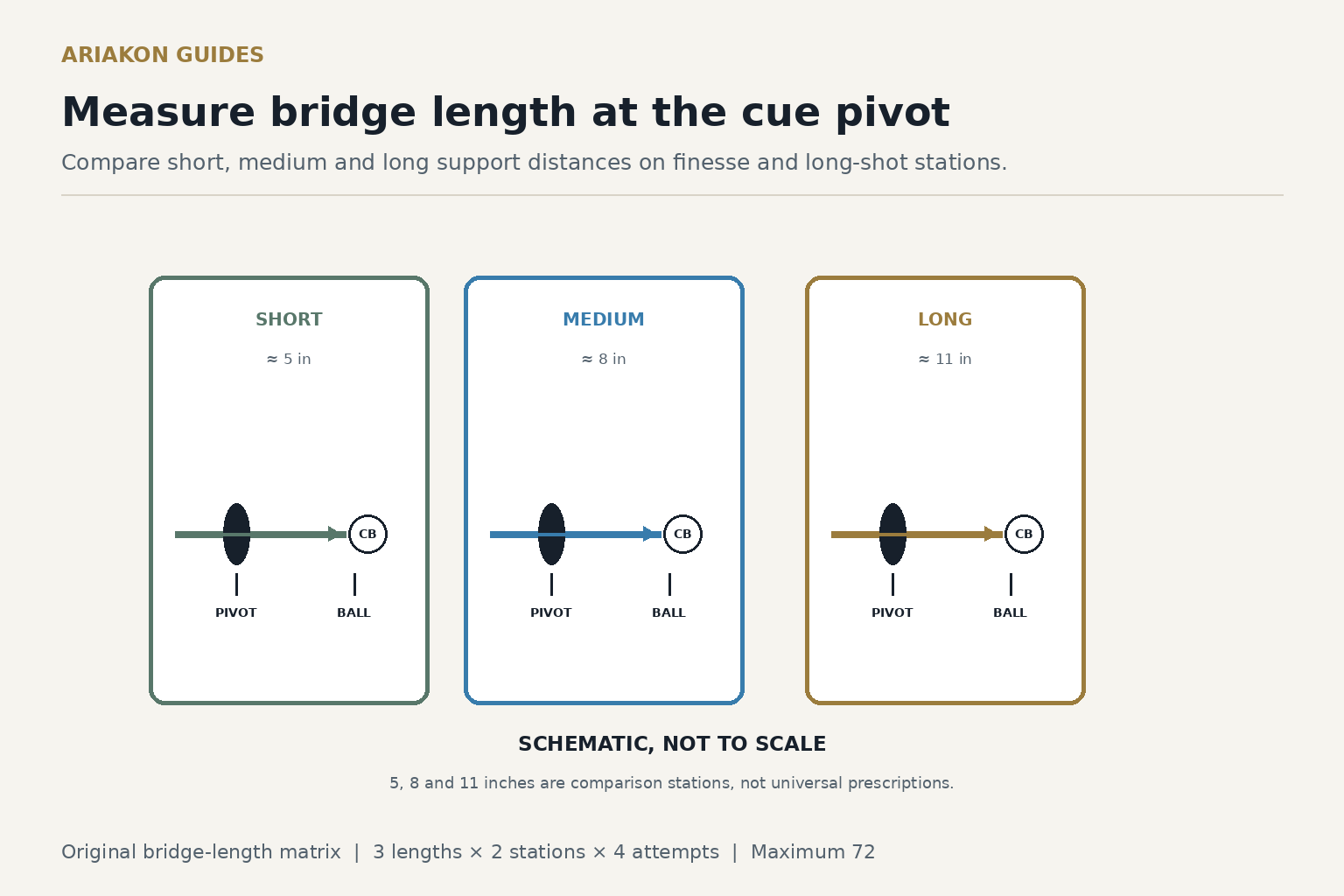
Measure the cue pivot, not a vague hand position
Place the cue on the shot line and measure from the point where the shaft is supported by the bridge to the cue ball. Mark comfortable short, medium and long distances on a paper gauge beside the table; never place a loose ruler in the stroke path. Exact distances vary with hand size, stance and stroke. A useful starting comparison might be about 5, 8 and 11 inches, but those numbers are test stations, not prescriptions.
Keep the same bridge type within a comparison. Changing from open to closed while also changing length creates two variables. Shorten any station that crowds the cue ball or forces the back hand against the body.
For any straight stop-shot score in this guide, center the finish window on the cue-ball center at object-ball contact: one ball diameter behind the object-ball center on the incoming line. The cue-ball starting position is not the stop destination. Keep the window size fixed before the block.
Choose the basic bridge type before isolating its length.
Check bridge stability on video if the hand moves during delivery.
Build two matched shot stations
Station F is a finesse shot: object ball one diamond from a corner, cue ball one diamond behind it, vertical-axis contact and a cue-ball finish inside a one-diamond box. Station L keeps the same pocket line but moves the cue ball about three diamonds behind the object ball; use only enough speed to pocket cleanly and finish within a two-diamond corridor.
Shoot four attempts at each bridge length on each station: short, medium and long. Alternate lengths rather than completing every short-bridge shot first. That controls some warm-up effect. Reset ball centers and the finish zone each time.
| Station | Short | Medium | Long |
|---|---|---|---|
| Finesse F | 4 attempts | 4 attempts | 4 attempts |
| Long L | 4 attempts | 4 attempts | 4 attempts |
| Order | F-S, F-M, F-L | then L-S, L-M, L-L | repeat four cycles |
Score line, tip placement and result separately
Do not promote a bridge length because it produced the single best shot. Compare all twelve points available in each station-length cell. Record bridge-hand movement, cue binding and tip-placement errors even when the object ball falls.
| Point | Observable requirement |
|---|---|
| 1 | Cue travels through the marked line without binding |
| 1 | Chalk mark or video shows intended vertical-axis contact |
| 1 | Ball is pocketed and cue ball reaches the station zone |
| Maximum 72 | 24 attempts; total by station and length |
Read the pattern before making a rule
| Pattern | Next action |
|---|---|
| Long bridge loses tip accuracy at both stations | Shorten until contact becomes repeatable |
| Short bridge restricts the long delivery | Add room gradually; do not lunge the grip hand |
| One length works at both stations | Keep it as the default and change only for clearance |
| Hand moves at every length | Fix the bridge base before comparing distance |
| Rail or obstacle dictates the hand | Choose a legal stable bridge first; accept a shorter stroke |
Worked example and mixed-layout transfer
A player scores F-short 11/12, F-medium 10, F-long 7; L-short 8, L-medium 11 and L-long 9. The next rule is specific: short for compact finesse shots, medium for the longer station, with long reserved for clearance that actually requires it. The result does not prove that these inch measurements suit another player.
For transfer, set eight random open shots. Before approaching, call short, medium or long and state why: finesse, normal delivery or clearance. Measure the actual bridge after the shot and score line, contact and result. If the call repeatedly differs from the measured setup, simplify to one default length until the choice becomes intentional.