
Fundamentals · 3 min read
Choose One Pool Stroke Change From Video Evidence
Video can reveal a repeated movement, but one angle cannot tell you why every miss occurred. Film one registered shot, code only what the camera can show and change one reversible behavior. The advanced-stroke guide supplies drills; this protocol decides which single change has earned a test.
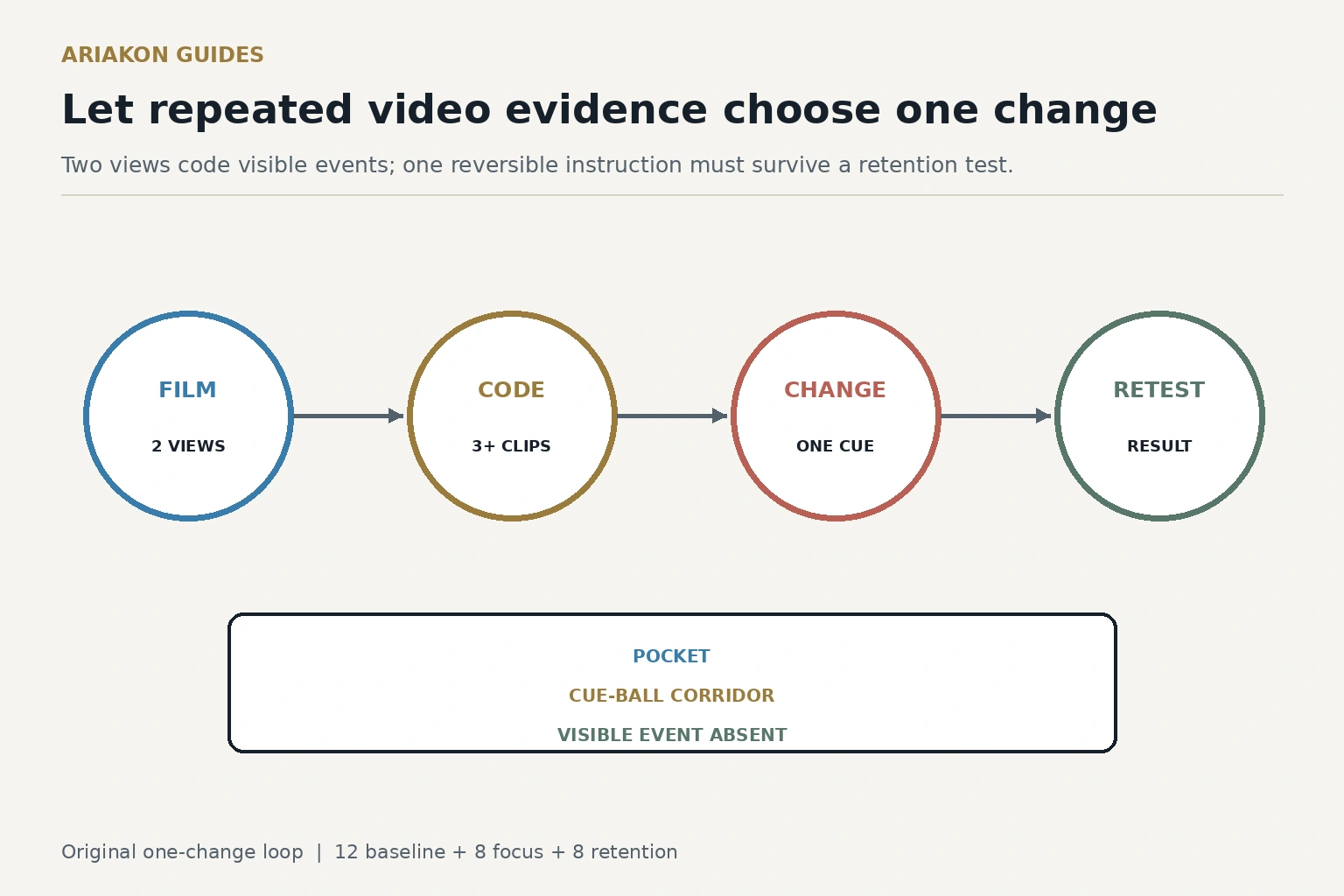
Register a straight shot and safe camera zones
Set the object ball one diamond from a corner pocket and the cue ball three diamonds away on the same line. Mark the bridge-hand area and use center-ball contact at pocket speed. Record twelve baseline attempts without changing technique.
Place a phone behind the shot line for four attempts and perpendicular to the cue for four more, then repeat either view for the last four. Keep equipment outside player and ball traffic. Obtain permission from the room and anyone who may be recorded.
Use advanced stroke drills after the video identifies a testable component.
Check the shot line while lowering when the cue changes line before the bridge settles.
Code observations without inventing causes
Count a code only when the same event is visible on at least three baseline clips. Camera perspective can create apparent offsets, so compare changes within one view rather than treating pixels as a perfect ruler.
| Visible event | Code | What the clip cannot prove |
|---|---|---|
| Cue crosses a two-marker corridor | C | Whether vision or grip caused it |
| Head moves before cue-ball contact | H | Whether the movement caused the miss |
| Grip hand rises or drops late | G | Exact joint mechanics from one view |
| Finish differs across similar shots | F | Which finish is universally correct |
Choose one reversible change
Choose the smallest instruction that can be removed immediately. Do not rebuild stance, grip, elbow and timing in the same block. Pain or restricted movement is not a video-coaching problem; stop and seek appropriate professional guidance.
| Repeated evidence | One candidate instruction | Keep fixed |
|---|---|---|
| Early head movement | Hold the finish for a two-count | Aim, stance, bridge and speed |
| Cue leaves corridor late | Finish through the same visible gate | Grip position and shot setup |
| Grip hand changes height before contact | Use the familiar backswing with a quiet transition | Elbow decision and speed |
| No repeated event | Make no stroke change | Collect another matched view |
Score focus and retention
Keep component totals, not just the maximum of eighty-four. A change that makes the clip look tidier but lowers pocket and cue-ball scores has not earned retention.
| Block | Attempts | Points each |
|---|---|---|
| Baseline | 12 | Pocket + cue-ball corridor + visible event absent |
| One change | 8 | Same three points |
| Retention after two-minute break | 8 | Same three points without a reminder |
Worked example and game transfer
A hypothetical baseline shows head movement before contact in seven of twelve clips and scores 22/36. The player tests a two-count finish hold and scores 20/24, then 19/24 in retention. The visible event decreases without a result tradeoff, so the instruction earns one more session.
Transfer uses six routine position shots. Score the shot result and finish hold separately. If the hold remains but speed control collapses, shorten the instruction to ‘eyes quiet through contact’ and return to a fixed shot. If evidence is mixed, keep filming rather than stacking a second change.